

 Belén Fernández's Ravelry Store
 Pattern

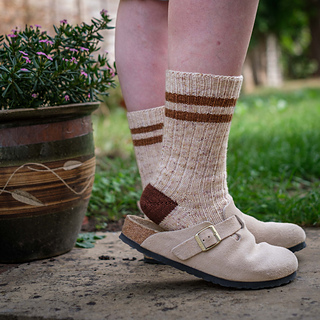
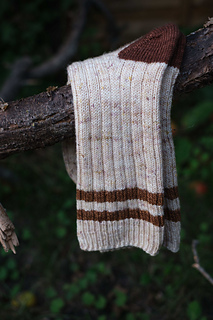
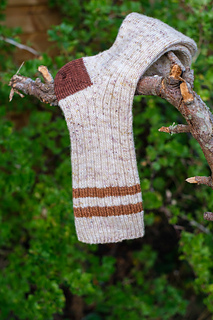
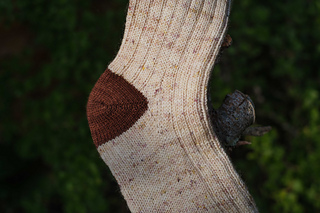
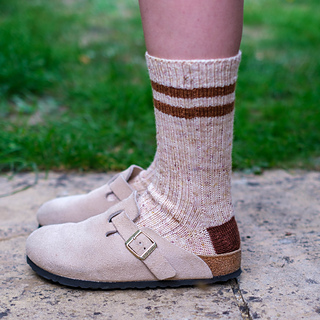
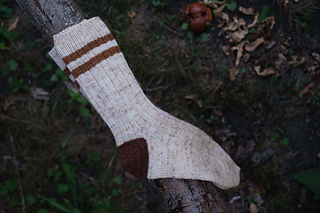


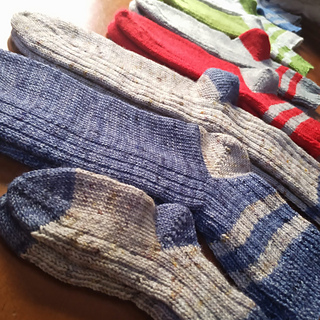


80s Retro


Español más abajo
ENGLISH
This is a sock pattern written especially for those who have never knitted socks before. It’s a simple and easy pattern to follow and it produces a ribbed fabric that will adapt to your foot even if you haven’t quite worked out your sock knitting gauge yet.
The 80s Retro socks are knitted from the toe up and have a German short row heel (one of the simplest ways to knit heels). This latest version of the pattern also includes an optional mini-gusset to add more room if you have a high instep. I have included links to videos that will help you with the techniques you need to make the toe and heel.
The instructions for the mini-gusset and heel will work equally well if you prefer to start your socks from the cuff down.
YARN
Fingering or light fingering weight yarn (400–425 m / 437–465 yards per 100 g). You will need two colours. I used Loom Wool (80% merino and 20% nylon).
- Main colour (MC): 200-350 m (218-385 yards). Colourway: Evermore (natural).
- Contrasting colour (CC): approx. 25-60 m (27-65 yards). Colourway: Scholarly (rust).
The amount of yarn you’ll need will depend on your sock and shoe size (see below) and whether you added a mini-gusset. To give you an idea, I used 200 m of the main colour for a size M (see below), UK5 shoe size without mini-gusset; 264 m for size M and UK6 shoe size with mini-gusset and 330 m for a size L, UK9 shoe size without mini-gusset.
SIZES
In the pattern I give 3 sizes based on your foot circumference around the widest part of the foot (more or less where your foot bends when you tip-toe).
- Size S (small): 20-21 cm / 8”
- Size M (medium): 22-24 cm / 9”
- Size L (large): 25-26 cm / 10”
These sizes are based only on the width of your foot and not the length. To work out the length of the sock, follow the tables given in the pattern.
GAUGE
I’ve designed these socks with a ribbed fabric so they will adapt to your foot even if you haven’t done a gauge sample first or your gauge isn’t perfect. I would recommend that, once you’ve knitted half the foot of the first sock, you measure your gauge (on the bottom/ sole of the sock where you have stockinette stitch) to see if it’s close to the one for this pattern:
8 stitches in 2.5 cm (1”) in stockinette stitch
If you have fewer than 7 stitches, you should knit your next pair with smaller needles (2 mm/US 0).
If you have more than 9 stitches, you should knit your next pair with larger needles (2.5mm/US 1 1⁄2).
If you use Instagram, please use the hasthtag #80sretrosocks or #calcetines80sretro when you upload photos of your project. Or you can tag me: @tejereningles
ESPAÑOL
Este es un patrón de calcetines escrito especialmente para los que nunca hayan tejido calcetines. Es un patrón sencillo y fácil de seguir, con un tejido elástico que se adapta a tu pie aunque no tengas la tensión aún controlada.
Los calcetines 80s Retro se tejen de la puntera hacia arriba y tienen un talón de vueltas cortas alemanas (uno de los talones más sencillos que puedas hacer). También ofrece la opción de un mini-escudete para dar más amplitud a la zona del empeine si la necesitas. El patrón tiene enlaces a vídeos que explican cómo hacer la puntera y el talón.
Si prefieres empezar los calcetines por la caña, las instrucciones para el mini-escudete y talón funcionarán igual.
LANA
Lana de grosor fingering (400 m por 100 g) apropiada para calcetines (es decir, con un 20-25% de nylon que es lo ideal para que sean resistentes). Necesitarás dos colores. Yo usé Loom Wool, calidad Twist Sock (80% merino, 20% nylon).
- Color principal (CP): 200-350 m. Yo usé el color Evermore (natural).
- Color de contraste (CC): 25-60 m. Yo usé el color Scholarly (ocre).
La cantidad de metros que necesitas depende de la talla (ver más abajo), el número de zapato y si añades un mini-escudete. Para darte una idea yo usé 200 m del color principal para una talla M, número 38 sin mini-escudete; 265 m para talla M, número 39 y mini- escudete y 330 m para una talla L, número 43 sin mini-escudete.
TALLAS
En el patrón doy tres tallas basadas en la circunferencia del pie por la parte más ancha de este (más o menos por donde se dobla el pie cuando te pones de puntillas).
Talla P (pequeña): 20-21cm
Talla M (mediana): 22-24 cm
Talla G (grande): 25-26 cm
Estas tallas se basan solo en el ancho del pie y no el largo. Para calcular el largo del calcetín sigue las tablas que se dan en el patrón.
TENSIÓN
Es difícil hacer una muestra de tensión para calcetines sin haber tejido un buen trozo del calcetín, así que he diseñado estos con un tejido elástico para que se adapten bien a tu pie aunque no hayas hecho muestra de tensión primero o tu tensión no sea perfecta. Yo te recomendaría que una vez hayas tejido medio pie, midas la tensión en la parte de la planta (donde el tejido es en punto jersey) para ver si se aproxima a esta:
8 puntos en 2,5 cm en punto jersey
Si tienes menos de 7 pt, teje el próximo par con agujas más pequeñas (2 mm). Si tienes más de 9 pt, teje el próximo par con agujas más grandes (2,5 mm).
Si usas Instagram, por favor utiliza la etiqueta #calcetines80sretro o #80sretrosocks cuando subas fotos de tu proyecto, o etiquétame: @tejereningles


 Ravelry download


 Cancel
114 projects
stashed 114 times
 stashed