

 Esti Juango's Ravelry Store
 Pattern



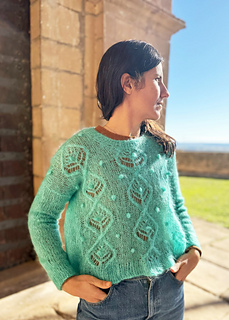
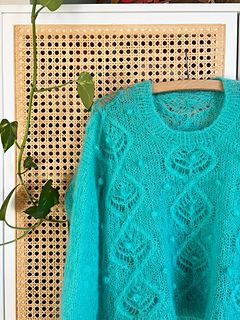
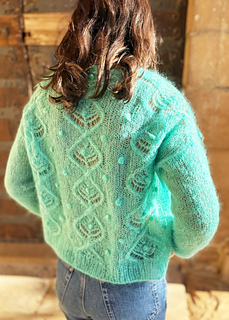
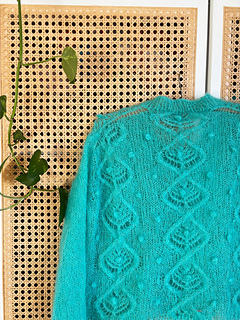
Amari

INSPIRATION
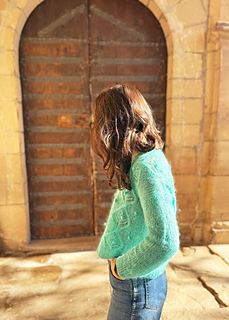
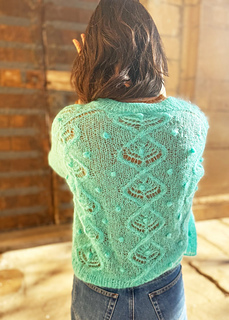
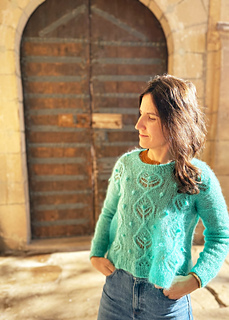
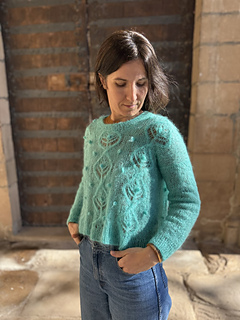
Amari is a design created for my mother’s special birthday. She chose the yarn colors and entrusted the design to me. It plays with lace, cables, and bobbles, suggesting botanical shapes and motifs to create a truly unique garment.
DIFFICULTY LEVEL. WHAT DO YOU NEED TO KNOW?
Intermediate. To knit, purl, make increases & decreases and to work in the round
Pattern has been tech edited and tested
SIZES
1 (2, 3, 4, 5) (6, 7, 8, 9) with final measurement of the sweater after blocking of bust width of 91.5 (101.5, 111.5, 121.5, 131.5) (141.5, 155.5, 165.5, 175.5) cm/ 36 (40, 44, 47.75, 51.75) (55.75, 59.75, 63.5, 67.5) “. Positive ease of around 10-15 cm/ 4-6”.
MATERIALS
- Yarn: Bilobila “Beta” – 25 gr; 120 m (132 yds). 77% superkid mohair, 23% silk. Aran weight
- Amount: 4 (4, 5, 5, 5) (6, 6, 7, 7) skeins of 25 gr
- Total in m: 480 (480, 600, 600, 600) (720, 720, 840, 840) m
- Total in yds: 528 (528, 660, 660, 660) (792, 792, 924, 924) yds
- Circular 5,0 mm (US 8) needles to work in the round the body and sleeves
- Circular 4,5 (US 7) mm needle for the collar
- Markers. A different BOR marker. 4 locking markers
- Stitch holders
- Tapestry needle
GAUGE
In a 10x10 cm (4x4 in) gauge you should have 16 sts and 25 rounds worked with larger needles in lace back stitch, in the round.
In a 10x10 cm (4x4 in) gauge you should have 16 sts and 22 rounds worked with larger needles in the round in Stockinette Stitch.
CONSTRUCTION NOTES
The pullover is started at the back neck and then increased to the full width of the back. After, those stitches are picked up along the sloped shoulders for the fronts. The pieces are joined at the underarm and the body is knitted in one piece in the round. The sleeve stitches are then picked up from the body and worked in the round. Stitches for the collar are picked up and worked with an elastic rib.
-----Español/Spanish-----
INSPIRACIÓN
Amari es un diseño tejido para un cumpleaños especial de mi madre. Ella eligió el color de las lanas y dejó en mis manos el diseño. Un juego entre los calados, las trenzas y bodoques que sugieren formas y motivos botánicos para lucir una prenda única.
REQUISITOS PREVIOS – NIVEL INTERMEDIO
Saber tejer derecho, revés, hacer aumentos y disminuciones. Tejer en circular.
El patrón ha sido testeado y editado técnicamente.
TALLAS
1 (2, 3, 4, 5) (6, 7, 8, 9) con contorno de pecho en prenda bloqueada de 91.5 (101.5, 111.5, 121.5, 131.5) (141.5, 155.5, 165.5, 175.5) cm. Holgura positiva de unos 10-15 cm.
MATERIALES
- Hilo: Bilobila “Beta” – 25 gr; 120 m (132 yds). 77% superkid mohair, 23% seda. Grosor Aran
- Cantidad: 4 (4, 5 , 5, 5) (6, 6, 7, 7) ovillos de 25 gr
- Total en m: 480 (480, 600, 600, 600) (720, 720, 840, 840) m
- Agujas circulares de 5,0 mm para el cuerpo y mangas
- Agujas circulares de 4,5 mm para el cuello (cortas o largar para magic loop)
- Marcadores. Un marcador distinto para el inicio. 4 Marcadores de imperdible
- Imperdible o hilo adicional para dejar los puntos en espera
- Aguja lanera para rematar los hilos
TEJIDO DE MUESTRA
En una muestra tejida en circular de 10 x 10 cm en punto calado 16p por 25 vueltas.
Tejido en P jersey la muestra en circular es de 16p por 22 vueltas.
NOTAS DE CONSTRUCCIÓN
La prenda se empieza en la parte trasera del cuello y luego se aumentan los puntos hasta alcanzar el ancho completo de la espalda. Después, esos puntos se recogen a lo largo de los hombros inclinados para los frentes, se montan puntos para el cuello uniendo los delanteros. Las piezas se unen en la sisa y el cuerpo se teje en una sola pieza en circular. Luego, los puntos de las mangas se recogen del cuerpo y se trabajan en redondo.


 Ravelry download


 Cancel

 stashed


