

 MosterMoster Ravelry store
 Pattern



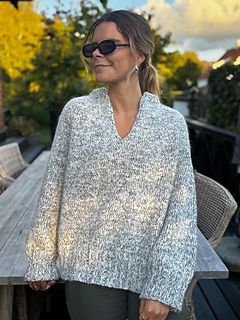
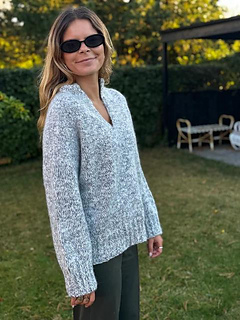
Dalia Sweater No2


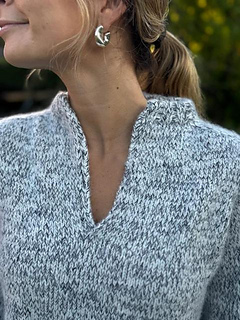
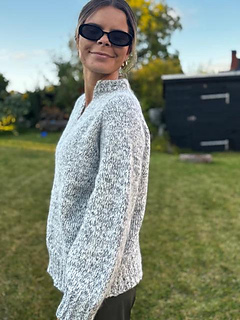
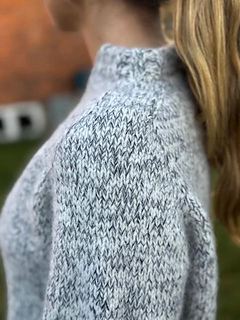
The DALIA SWEATER NO2 is worked from the top down. The design features an attractive neckline and a saddle shoulder construction that transitions into raglan increases, creating a beautiful shoulder line and a comfortable, relaxed fit.
The top-down construction makes it easy to adjust the length of both the body and sleeves as you knit.
Skill Level
★★★☆☆ – Intermediate
This pattern is suitable for knitters who have mastered the basics and have some experience knitting garments. The saddle shoulder construction, raglan increases, and separation of the body and sleeves require particular attention.
Sizes
XS/S (M) L (1XL) 2XL (3XL) 4XL (5XL)
Body bust circumference:
76–82 (82–88) 88–94 (94–100) 100–106 (106–114) 114–122 (122–130) cm
Finished Measurements
Bust circumference:
110 (114) 120 (125) 130 (136) 143 (147) cm
The sweater has a relaxed, comfortable fit with approximately 21–31 cm of positive ease, depending on the size selected.
Total length:
58 (59) 60 (61) 62 (63) 64 (65) cm
Total length is measured vertically from the shoulder point to the bottom edge of the hem ribbing.
Yarn
The entire sweater is worked holding two strands together.
Baby Alpaca Merinould by MosterMoster
130 m per 50 g
7 (8) 8 (9) 10 (10) 11 (11) balls
Held together with:
Tynd Baby Alpaca Følgetråd
400 m per 50 g
3 (3) 3 (3) 4 (4) 4 (4) balls
Yarn Substitution
You may substitute other yarns as long as you achieve the required gauge and the resulting fabric has a similar soft, airy feel and drape.
For example, you could choose:
A soft wool and/or alpaca main yarn held together with a fine companion yarn.
Two other yarns that achieve the required gauge when held together.
A single yarn that achieves both the required gauge and a similar drape without a companion strand.
When substituting yarn, gauge is not the only consideration. The yarn’s weight, loft, fiber content, and drape also affect the finished result.
Always make and wash a gauge swatch before choosing your final needle size.
Gauge
17–18 stitches × 21–22 rows = 10 × 10 cm in stockinette stitch using 5 mm needles.
Achieving the correct gauge is essential for the sweater’s finished measurements.
Needles and Notions
5 mm circular needles with a 60, 80, and/or 100 cm cable
4 mm circular needles for the neckband
Stitch markers
Stitch holder or waste yarn
Tapestry needle
Construction
The DALIA SWEATER NO2 is worked from the top down.
The neckline is shaped first while working back and forth. The saddle shoulders are then developed with increases.
The construction subsequently transitions into raglan increases. Once the fronts are joined at the bottom of the neck opening, work continues in the round.
After completing the yoke, the stitches are separated for the body and sleeves. The body is worked downward in the round and finished with k2, p2 ribbing.
The sleeves are then worked separately in the round and also finished with ribbing.
Finally, stitches are picked up along the upper neckline edge for the neckband. The neckband is worked back and forth, folded to the inside, and secured in place.
Required Skills
For this pattern, it is helpful to be familiar with:
Knitting flat and in the round
Knit and purl stitches
Stockinette stitch
K2, p2 ribbing
Casting on additional stitches while knitting
Right- and left-leaning increases
Right- and left-leaning decreases
Yarn overs
Knitting two stitches together
Working with stitch markers
Placing stitches on a stitch holder or waste yarn
Picking up stitches
Separating the body and sleeves
Picking up and knitting a neckband, then folding it to the inside and securing it


 Ravelry download


 Cancel


