

 MosterMoster Ravelry store
 Pattern



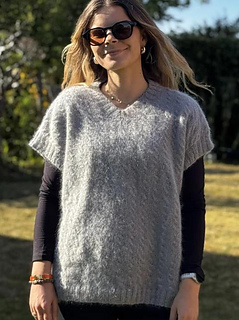
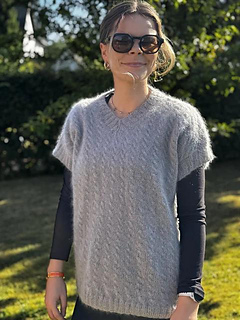
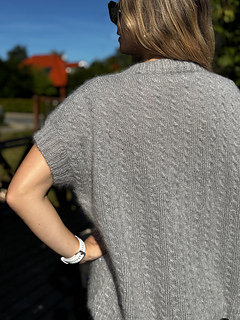
Dalia Vest


Dalia Vest — MosterMoster
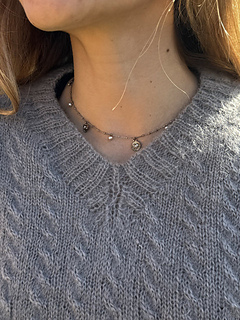
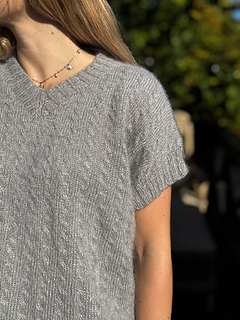
A soft, airy vest featuring delicate cables, a V-neck, and a relaxed fit. Layer Dalia Vest over a blouse, shirt, or dress for extra warmth.
The vest is worked from the bottom up with two strands of Silk Mohair held together. The body is worked in the round to the armholes, then the front and back are worked separately, back and forth. The shoulders are joined using a three-needle bind-off. Stitches are then picked up for the neckband and armhole edgings.
Skill level: ★★★☆☆ — Intermediate
Suitable for knitters who are comfortable knitting and purling and would like to develop their cable-knitting and V-neck shaping skills. The techniques used are explained in the pattern.
Sizes and fit
XS (S) M (L) XL (2XL) 3XL (4XL) 5XL (6XL)
Finished bust circumference:
111 (118) 125 (132) 139 (146) 153 (160) 167 (174) cm.
Approx. 43¾ (46½) 49¼ (52) 54¾ (57½) 60¼ (63) 65¾ (68½) in.
Total length:
58 (60) 62 (64) 66 (68) 70 (72) 74 (76) cm.
Approx. 22¾ (23½) 24½ (25¼) 26 (26¾) 27½ (28¼) 29¼ (30) in.
The vest is designed with approximately 19–25 cm / 7½–9¾ in of positive ease. Choose your size according to your actual bust measurement and preferred amount of ease.
Yarn
Silk Mohair by MosterMoster
238 m / approx. 257 yd per 25 g / 0.88 oz ball.
Work with two strands held together throughout.
Number of balls required:
9 (10) 10 (11) 12 (13) 14 (14) 15 (16).
These quantities are the total number of balls needed for both strands combined. Yarn requirements are approximate and may vary depending on your gauge.
Gauge
23 stitches × 34 rows = 10 × 10 cm / approx. 4 × 4 in in cable pattern on US 6 (4 mm) needles.
Check both stitch and row gauge, and adjust your needle size if necessary.
Needles and notions
- US 4 (3.5 mm) and US 6 (4 mm) circular needles in suitable lengths of 60, 80, or 100 cm / approx. 24, 32, or 40 in
- Cable needle
- Stitch markers
- Stitch holder or waste yarn
- Tapestry needle
Required techniques
- Casting on and binding off
- Knitting and purling
- Working in the round and flat
- Working k2, p2 ribbing
- Working right-crossing cables over 4 stitches
- Maintaining the cable pattern after dividing the work
- Working right-leaning decreases with k2tog
- Working left-leaning decreases with SSK
- Shaping a V-neck with decreases
- Placing stitches on hold
- Joining shoulders using a three-needle bind-off
- Picking up and knitting stitches around the neckline and armholes
- Working decreases in a ribbed V-neckband
- Working a stretchy bind-off and weaving in ends
Yarn substitution
You may substitute another yarn if it produces 23 stitches × 34 rows per 10 × 10 cm / approx. 4 × 4 in in cable pattern, with a similarly airy fabric and soft drape.
For the closest result, choose a similar lace-weight mohair-silk yarn and work with two strands held together. A different fiber blend or yarn construction may change the drape, volume, and appearance of the cables.
Compare yardage and always knit a gauge swatch before beginning. Recalculate the number of balls required according to the yardage of your substitute yarn.
Digital pattern
You will receive a digital knitting pattern in PDF format. No printed pattern or finished garment is included.


 Ravelry download


 Cancel


