

 Pope knits
  Pattern


Decisions

SIZES
1 (2, 3, 4, 5) (6, 7, 8, 9)
Recommended ease: 0.75–2” / 2–5 cm of positive ease. The sample is shown in size 1, on a model with a 32.75” / 82 cm bust.
FINISHED MEASUREMENTS
A. Bust circumference: 33 (37.75, 41, 44.5, 48.75) (52.25, 56.75, 60.25, 63.75)“ / 84 (96, 104, 113, 124) (133, 144, 153, 162) cm.
B. Yoke depth:8.25 (8.25, 8.75, 9, 9.5) (9.5, 9.75, 9.75, 10.25)” / 21 (21, 22, 23, 24) (24, 25, 25, 26) cm.
C. Body length (from underarm to hem): 11.5 (12.25, 13, 13.75, 13.75) (14.5, 14.5, 15.25, 15.25)“ / 29 (31, 33, 35, 35) (37, 37, 39, 39) cm.
D. Total length: 19.75 (20.5, 21.75, 22.75, 23.25) (24, 24.25, 25.25, 25.75)” / 50 (52, 55, 58, 59) (61, 62, 64, 65) cm.
E. Upper Arm: 13 (13.25, 14.75, 15.5, 16.5) (17.25, 18.25, 19, 20.5)“ / 32 (33, 37, 39, 41) (43, 46, 48, 51) cm.
F. Sleeve length: 17 (17.75, 18.25, 19, 19.75) (20, 21, 21, 21.75)” / 43 (45, 46, 48, 50) (51, 53, 53, 55) cm.
Construction
The sweater is worked seamlessly from the top down. Short rows are used to shape the neckline (optional), and the yoke is shaped with increases.
You can try it on as you go to check the desired length. The body and sleeves are then separated, with the sleeves placed on hold. The body is worked in the round, followed by the sleeves, which are resumed and also worked in the round.
YARNS: DK-weight
VERSION 1:
Main Color (MC): Held together with one strand of Yarn A and one strand of Yarn B.
Yarn A: approx. 175 (200, 225, 250, 275) (300, 325, 350, 375) g / 763 (872, 981, 1090, 1199) (1308, 1417, 1526, 1635) yds / 700 (800, 900, 1000, 1100) (1200, 1300, 1400, 1500) m. Suggested yarn: Isager Tweed – 70% wool, 30% mohair (218 yds / 200 m – 50 g). 4 (4, 5, 5, 6) (6, 7, 7, 8) skeins, color: Sand.
Yarn B: approx. 83 (94, 106, 118, 130) (142, 153, 165, 177) g / 763 (872, 981, 1090, 1199) (1308, 1417, 1526, 1635) yds / 700 (800, 900, 1000, 1100) (1200, 1300, 1400, 1500) m. Suggested yarn: Rowan Kidsilk Haze – 70% kid mohair, 30% silk (232 yds / 212 m – 25 g). 4 (4, 5, 5, 6) (6, 7, 7, 8) skeins, color: 00686.
VERSION 2:
Main Color (MC): Held together with one strand of Yarn A and one strand of Yarn B.
Yarn A: approx. 175 (200, 225, 250, 275) (300, 325, 350, 375) g / 763 (872, 981, 1090, 1199) (1308, 1417, 1526, 1635) yds / 700 (800, 900, 1000, 1100) (1200, 1300, 1400, 1500) m. Suggested yarn: Manos del Uruguay Alegría – 75% merino, 25% polyamide (445 yds / 405 m – 100 g). 2 (2, 3, 3, 3) (3, 4, 4, 4) skeins, color: Silver.
Yarn B: approx. 83 (94, 106, 118, 130) (142, 153, 165, 177) g / 763 (872, 981, 1090, 1199) (1308, 1417, 1526, 1635) yds / 700 (800, 900, 1000, 1100) (1200, 1300, 1400, 1500) m. Suggested yarn: Isager Silk Mohair – 75% kid mohair, 25% silk (232 yds / 212 m – 25 g). 4 (4, 5, 5, 6) (6, 7, 7, 8) skeins, color: 00.
BEADS (OPTIONAL)
Recommended beads: (These beads are the recommended size for this yarn). Delica 8/0, round 6/0, and square 3 mm or 4 mm.
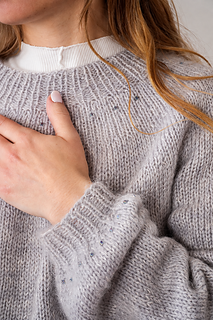
Bead used in Version 2: Miyuki, square 4 mm, 123 (133, 146, 157, 169) (180, 192, 203, 216) units, color: 283.
GAUGE
18 sts x 24 rnds = 4” / 10 cm. Measured in stockinette stitch, worked in the round with N1 and MC, after blocking.
Needles and Cables
N1: US 7 / 4.5 mm circular needles, 16” / 40 cm and 32” / 80 cm long.
N2: US 5 / 3.75 mm circular needles, 16” / 40 cm and 32” / 80 cm long.
Notions
Crochet hook for beading US 14/10 – 0.75 mm, row counter (recommended), 1 stitch marker, tapestry needle, waste yarn, or 2 stitch holders.
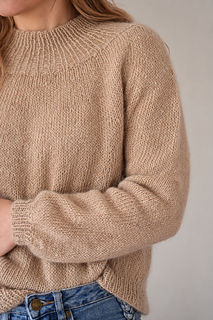
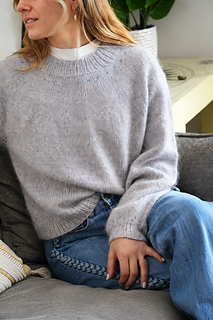
Este es un patrón básico en el que puedes dar un paso más en tu tejido tomando tus propias decisiones, y por eso se llama suéter Decisiones.
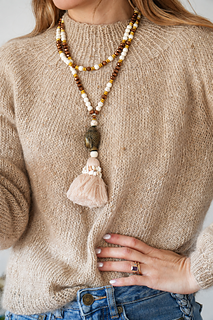
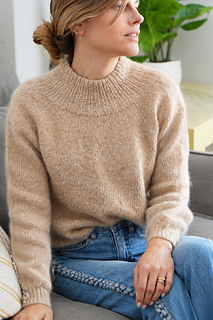
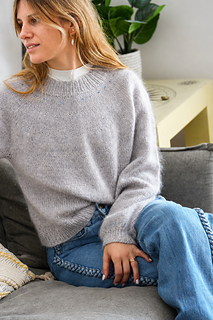
La primera decisión es el cuello. Puedes elegir tejer un cuello más alto, como en la Versión 1, pensado para doblarse, o un cuello más bajo, como en la Versión 2.
La segunda decisión es si quieres incluir vueltas cortas para mejorar el calce del escote. Yo utilicé vueltas cortas en ambas versiones, pero si eres principiante, puedes omitirlas.
La tercera decisión es si quieres agregar mostacillas, como en la Versión 2. Esta versión utiliza solo unas pocas mostacillas y está pensada como una introducción a esta técnica, para que puedas ver lo sencillo que es insertarlas utilizando un ganchillo.
Todos estos pasos cuentan con tutoriales en video para las técnicas más complejas, así que puedes elegir seguirlos o no. Tú decides. También puedes combinar ambas versiones y crear tus propias variaciones. Tu suéter, tus decisiones.
TALLAS
1 (2, 3, 4, 5) (6, 7, 8, 9)
Holgura recomendada: 2–5 cm de holgura positiva. La muestra corresponde a la talla 1 con 82 cm de contorno de busto.
MEDIDAS FINALES
A) Contorno de busto: 84 (96, 104, 113, 124) (133, 144, 153, 162) cm.
B) Largo de sisa: 21 (21, 22, 23, 24) (24, 25, 25, 26) cm.
C) Largo de cuerpo (desde la sisa hasta la pretina): 29 (31, 33, 35, 35) (37, 37, 39, 39) cm.
D) Largo total: 50 (52, 55, 58, 59) (61, 62, 64, 65) cm.
E) Contorno de brazo: 32 (33, 37, 39, 41) (43, 46, 48, 51) cm.
F) Largo de manga: 43 (45, 46, 48, 50) (51, 53, 53, 55) cm.
CONSTRUCCIÓN
El suéter se teje sin costuras, de arriba hacia abajo. Las vueltas cortas se utilizan para dar forma al escote de manera opcional y el canesú se forma mediante aumentos. Puedes probártelo mientras avanzas para comprobar el largo deseado.
Luego se separan el cuerpo y las mangas, dejando los puntos de las mangas en espera. El cuerpo se trabaja en circular y, posteriormente, se retoman las mangas, que también se trabajan en circular.
HILADOS: Grosor DK
Versión 1:
Color principal (CP): Teje usando una hebra de hilo A junto con una hebra de hilo B.
Hilo A: 175 (200, 225, 250, 275) (300, 325, 350, 375) g / 700 (800, 900, 1000, 1100) (1200, 1300, 1400, 1500) m. Hilado sugerido: Isager Tweed – 70% lana, 30% mohair (200 m – 50 g). 4 (4, 5, 5, 6) (6, 7, 7, 8) ovillos, color: Sand.
Hilo B: aprox. 83 (94, 106, 118, 130) (142, 153, 165, 177) g / 700 (800, 900, 1000, 1100) (1200, 1300, 1400, 1500) m. Hilado sugerido: Rowan Kidsilk Haze – 70% kid mohair, 30% seda (212 m – 25 g). 4 (4, 5, 5, 6) (6, 7, 7, 8) ovillos, color: 00686.
Versión 2:
Color principal (CP): Teje usando una hebra de hilo A junto con una hebra de hilo B.
Hilo A: aprox. 175 (200, 225, 250, 275) (300, 325, 350, 375) g / 700 (800, 900, 1000, 1100) (1200, 1300, 1400, 1500) m. Hilado sugerido: Manos del Uruguay Alegría – 75% merino, 25% poliamida (405 m – 100 g). 2 (2, 3, 3, 3) (3, 4, 4, 4) ovillos, color: Silver.
Hilo B: aprox. 83 (94, 106, 118, 130) (142, 153, 165, 177) g / 700 (800, 900, 1000, 1100) (1200, 1300, 1400, 1500) m. Hilado sugerido: Isager Silk Mohair – 75% kid mohair, 25% seda (212 m – 25 g). 4 (4, 5, 5, 6) (6, 7, 7, 8) ovillos, color: 00.
MOSTACILLAS (Opcional)
Mostacillas recomendadas: Tamaños de mostacillas recomendados para este hilado: Delica 8/0, redondas 6/0 y cuadradas de 3 o 4 mm.
Mostacilla utilizada en la Versión 2: Miyuki, cuadrada de 4 mm, 123 (133, 146, 157, 169) (180, 192, 203, 216) unidades, color: 283.
MUESTRA DE TENSIÓN
18 ptos x 24 vtas = 10 cm. Medido en punto jersey, tejido en circular con las A1 y el CP, después del bloqueo.
AGUJAS Y CABLES
Agujas principales (A1): agujas circulares de 4.5 mm, con cables de 40 cm y 80 cm de largo.
Agujas para punto elástico (A2): agujas circulares de 3.75 mm, con cables de 40 cm y 80 cm de largo.
MATERIALES ADICIONALES
Ganchillo para mostacillas 0.75 mm, contador de vueltas (recomendado), 1 marcador de puntos, aguja lanera, hebra de descarte o 2 sujetapuntos.


 Ravelry download


 Cancel
53194 projects
stashed 50103 times
 stashed
4796 projects
stashed 3638 times