

 Léa Loiseau's Ravelry Store
 Pattern

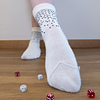
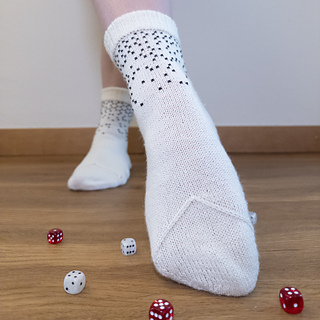
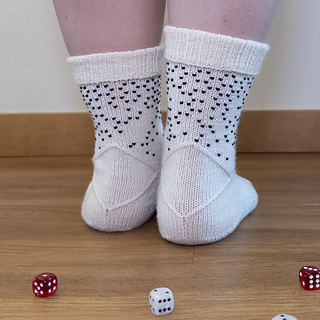
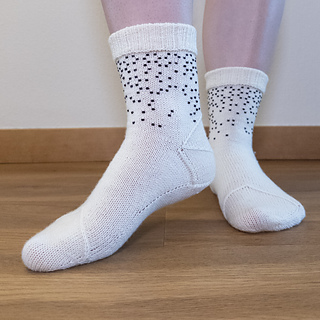
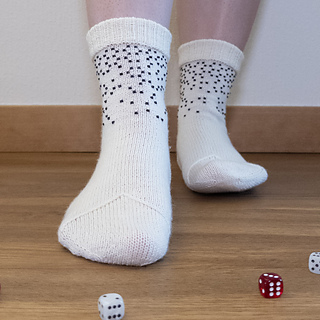
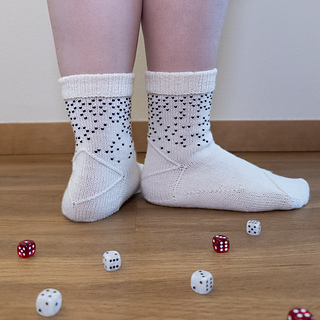
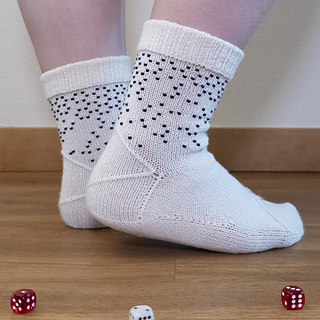
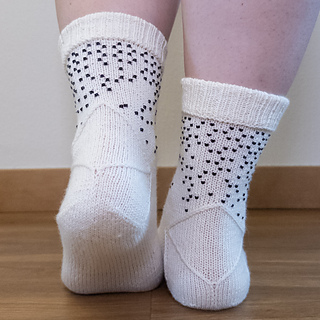
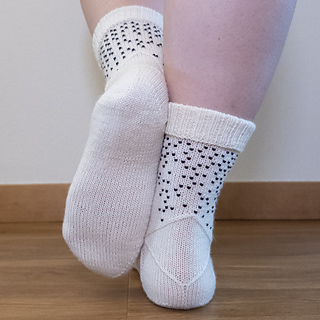
Dice Dice Baby Socks
This pattern is released as a bonus pattern for SWC 26. It will be available to general public later this year.
The Dice Dice Baby socks are worked toe-up. The toe and heel are adorned with twisted-stitches details. Beads are placed in hexagonal motif on the leg based on a dice roll with increasing probability.
Gauge
36 stitches and 44 rows = 10 cm / 4 inches in stockinette stitch.
Techniques
- Judy’s Magic Cast On
- m1 knit increases
- lifted purl increases
- ssk, k2tog, p2tog and sk2p decreases
- left and right twisted stitches worked on RS and WS
- German Short Rows
- beading
- (optional) Kitchener sts
Difficulty Level
This pattern is designed for intermediate knitters. Special techniques include twisted stitches worked both on the RS and WS and beading.
Although neither technique is inherently complex, the combination of both may not be well-suited for beginners.
Knitters should be comfortable following charts (or corresponding written instructions)
Sizing
Choose the size closest to your widest feature, aiming for 10% of negative ease in width. The foot and leg lengths are adjustable. For foot length, ease should range from 10% negative ease to no ease, depending on your fit preference.
Foot: [62, 66, 74, 78] sts / [17.2, 18.3, 20.6, 21.7] cm / [6 7/8, 7 3/8, 8 1/4, 8 5/8] inches
Leg: [60, 66, 72, 78] sts/ [16.7, 18.3, 20, 21.7] cm / [6 5/8, 7 3/8, 8, 8 5/8] inches
To accommodate the 6-stitch repeat of the beaded motif while maintaining an odd number of stitches for the heel flap, sizes 1 and 3 include 2 extra stitches on the foot compared to the leg
Materials
100g/400m of fingering weight sock yarn should be sufficient for all sizes.
Consider splitting your yarn into two, or ensure that the first sock uses no more than half.
[451, 491, 530, 569] beads in size 6/0 or 8/0 (see comment below)
Beads
This pattern uses dice rolls to determine bead placement, which introduces variation in the total number of beads required.
The expected number of beads is [415, 454, 491, 528].
To ensure sufficient supply, [451, 491, 530, 569] beads should be set aside.
These correspond to the upper bound of a 99.8% confidence interval, meaning that fewer than 1 in 1000 knitters would exceed them.
The theoretical maximum, in which every single die roll results in a bead, would require [768, 832, 892, 952] beads. The probability of this occurring is extraordinarily small, less likely than winning the lottery several
times in a row.
Needles
2.25 mm / US 1 needles for the sock body or the needle size needed to achieve gauge. Use needles 1 to 2 sizes smaller for the cuff (optional).
The pattern is written to be needle-agnostic. Use your preferred method to knit small circumferences, but note that if you are using small circulars, you will need another method to start the toe.
Notions
-
0.6 - 1 mm crochet hook for beading or your preferred beading method
-
1 D6 die (or use a digital die roller)
-
Tapestry needle
-
Stitch markers
-
If knitting the folded cuff, an additional set of needles (any size up to the gauge needle size)


1893 projects
stashed 1928 times
 stashed