

 YRJA Knit
 Pattern

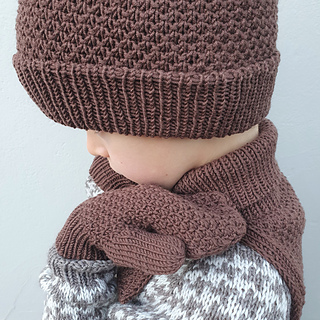
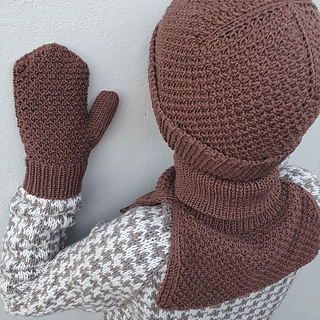
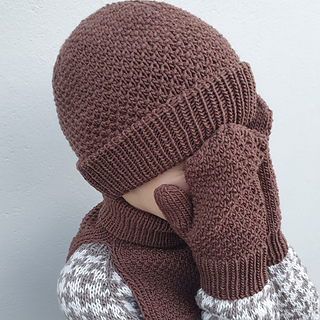
Duggari Junior Winter Set


A hat, a cowl and mittens for children, worked in a textured stitch (same as the Duggari sweater). The stitch is simple and quickly learned, and it gives the fabric a surface that keeps the knitting interesting.
Each piece has a choice built into it, so the set can be made to suit the child wearing it.
Sizes; 2–3 · 4–6 · 7–9 · 10–12 years
Gauge; 22 sts and 28 rows in stocking stitch = 10 × 10 cm
Yarn; DK weight, 200–300 g for the full set
Difficulty; 2 of 5
Written instructions for all three pieces, a pattern graph, explanations and links to video tutorials at the back.
The three pieces
The beanie has a folded brim, so the ribbing sits double over the ears and stays warm.
The cowl can be worked in plain ribbing, or long enough to fold down as a roll neck.
The mittens come two ways: with a plain ribbed cuff, or with an extended edge above the ribbing that tucks up under a coat sleeve and keeps the snow out.
All three are seamless, the beanie is worked from the crown, the mittens and cowl from the ribbing.
Sizes
Size 2–3 yrs · 4–6 yrs · 7–9 yrs · 10–12 yrs
Yarn for the full set (g) 200 · 200 · 250 · 300
The quantities are for the beanie, cowl and mittens together, rib extension on the mittens and a roll neck on the cowl. Skip these and you´ll need one ball less in the smallest and largest size (if worked in the sample yarn).
Since we all knit a little differently, no yarn quantity can be exact.
Yarn and needles
Gauge: 22 sts and 28 rows in stocking stitch = 10 × 10 cm
Needles: Short circular needles and DPNs, 3 mm and 4 mm mm US size 2 ½ and 6, — or whatever size you need to reach gauge. If you prefer magic loop, use a long circular in each size.
Yarn: DK weight, or any yarn that knits to 21–24 sts over 10 cm. Pure wool, or a blend of natural fibers such as alpaca and wool, is what we would recommend.
Techniques used
Italian cast-on and bind-off if you want them, and right- and left-leaning increases and decreases. Increases worked in pattern according to schematics. All of it is explained at the back of the pattern, with links to video tutorials.
Difficulty 2 of 5


 Ravelry download


 Cancel