

 Easy as Knit website
 Pattern

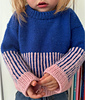
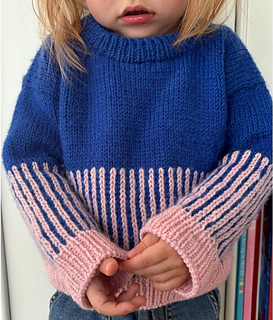
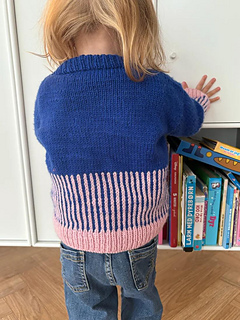
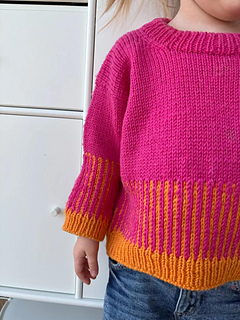
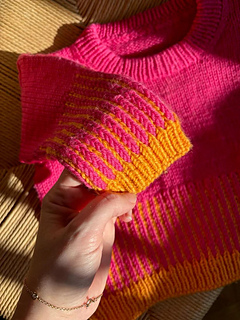
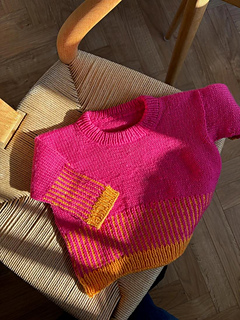
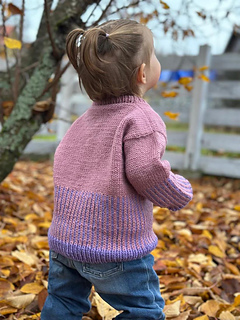
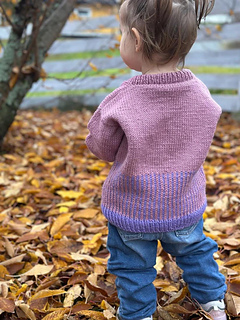
Easy Colour Mix Sweater Junior


✅ This pattern includes detailed step-by-step video guides – knit every step in the pattern together with us!
Easy Colour Mix Sweater Junior is made in a stockinette stitch. The sweater is worked from the top down. Sleeves and ribbed edges are added at the end. The simple bicoloured pattern is worked only in the round. This project is the perfect opportunity to learn how to work with two colours at the same time.
You can read about what you can expect in our patterns here
You can read about our videoguides here
Sizes: 2 (4) 6 (8) 10 (12) years
Measurements:
Circumference: 68 (72) 76 (80) 84 (88) cm
Length: 33 (36) 40 (44) 48 (50) cm
Gauge: 20 stitches x 30 rows in a stockinette stitch on 4 mm needles = 10 x 10 cm
Needles: 4 mm circular needle (60 cm) for the monocoloured part + 5 mm circular needle (60 cm) for the bicoloured part + 3 mm circular needle (40 + 60 cm) for the ribbed edges.
The sweater is worked in two colours: A base colour that the monocoloured upper part of the sweater will be worked in, and a contrast colour that will be worked with the base colour to create the bicoloured bottom part of the sweater.
Yarn alternative 1: 1 strand of Hobbii Friends Wool (50g=100m). You will need: 3 (4) 4 (5) 5 (6) balls of the base colour and 2 (2) 2 (2) 3 (3) balls of the contrast colour.
Yarn alternative 2: 1 strand of Drops Lima (50g=100m). You will need: 3 (4) 4 (5) 5 (6) balls of the base colour and 2 (2) 2 (2) 3 (3) balls of the contrast colour.
Yarn alternative 3: 1 strand of Sandnes Peer Gynt (50g=91m). You will need: 4 (4) 4 (5) 6 (6) balls of the base colour and 2 (2) 3 (3) 4 (4) balls of the contrast colour.
Difficulty: ★★★ 3 – which corresponds to almost easy. You can read about our classification of difficulties here


 Ravelry download


 Cancel
28641 projects
stashed 17378 times
 stashed
47996 projects
stashed 27733 times
2221 projects
stashed 2746 times