

 asawki_knits Ravelry Store
 Pattern




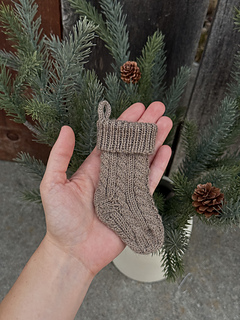
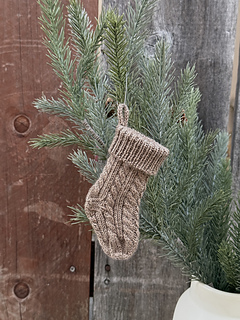

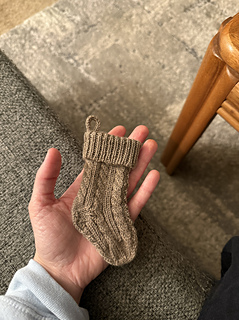
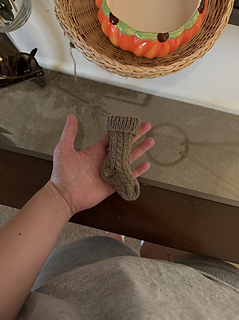
Itty Bitty Mini Stocking

The Itty Bitty Mini Stocking is a fingering-weight miniature stocking, perfect as a tree ornament, gift topper, or little advent decoration. It’s worked from the cuff down in the round, and the pattern includes two separate PDFs: one for the magic loop method and one for double-pointed needles (DPNs). A long tail tubular cast-on creates a neat, stretchy edge for the folded 1x1 ribbed cuff, which leads into cables that run the full length of the stocking. Waste yarn is placed at the end of the leg to mark a forethought heel. Once the foot and toe are complete, the waste yarn is removed to reveal the heel opening, and the heel is finished the same way as the toe. Finally, a tiny i-cord loop is worked and sewn to the top for hanging.
Sizes
One size.
Finished measurements
Approx. 3½“ (9 cm) circumference × 4½” (11.5 cm) length.
Gauge
50 sts × 48 rows = 4 × 4” (10 × 10 cm) in cable pattern, after blocking. Gauge is not critical for this project; a different gauge will make a slightly larger or smaller ornament.
Needles
Magic loop version: 2.25 mm (US 1) circular needle, 80 or 100 cm (32 or 40”) long.
DPN version: set of 2.25 mm (US 1) DPNs.
Either a 2.25 mm (US 1) circular needle or DPNs can be used for the i-cord loop.
Yarn needed
10 g / approx. 44 yd (40 m) of fingering weight yarn.
Notions
Stitch marker, cable needle, tapestry needle, waste yarn for the forethought heel.
Yarn used
Cascade Heritage in Brindle.
Techniques used
Long tail tubular cast-on, 1x1 ribbing, cables (worked from a chart), working in the round with magic loop or DPNs, decreases, forethought heel (waste-yarn placement), Kitchener stitch at the toe and heel, and i-cord.
Difficulty
Intermediate. The teeny size and long tail tubular cast-on make this a bit fiddly, but the cable pattern itself is simple. Confident beginners can absolutely give it a try!


 Ravelry download


 Cancel
93969 projects
stashed 79651 times
 stashed