

 canyouknitwithpineneedles
 Pattern


Köynnösruusu

Four Season Shawls - Spring
Köynnösruusu (Climbing Rose)
Here in the north, climbing roses often bloom best in the springtime dreams. If summer gets chilly, wrap yourself into this floral splendor.
Four Season shawls are the result of a long “quest for crescent”, where I wanted to eliminate the often appearing “bump” in the upper edge. Also the tips of the shawls don’t curl at all or very little.
There are four sizes, which all have their own charts. The pattern is very detailed and user friendly. For example the beginning is explained with pictures and video. I’ve also tried to explain each step in detail for less experienced knitters.
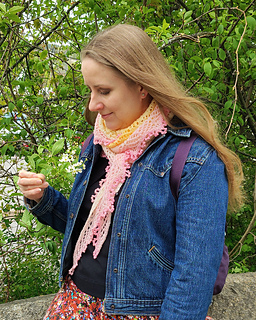
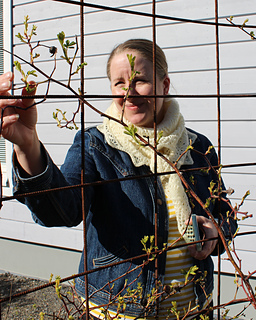
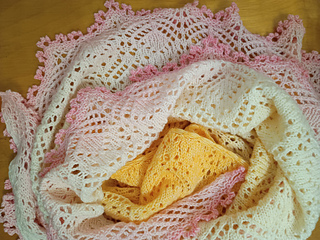
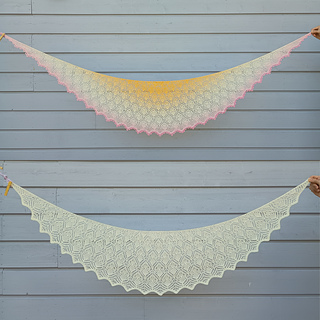
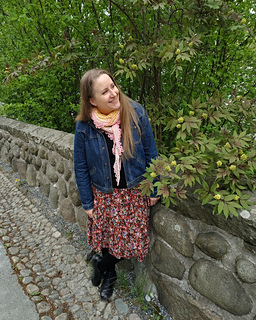
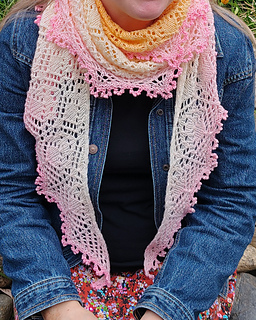
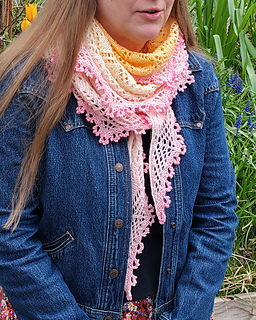
Sample shawls in pictures:
Wollelfe Merino Pure: Gloria Dei (discontinued), 100 g / 400 m
Size: large, Needles: 4 mm, 5 mm for crown edging, Weight: 176 g, Meterage: 704 m, Wingspan: 228 cm
Isager Highland Wool: White, 50 g / 275 m
Size: small, Needles: 4,5 mm, 5,5 mm for basic bind off, Weight: 71 g, Meterage: 391 m, Wingspan: 160 cm (prototype shawl with a bit less increases and therefore smaller meterage)
Note: Final version of a small sized shawl made out of Isager Highland Wool made with 5 mm needles took 92 g of yarn with meterage of 506 m. Medium sized shawl out of Isager Highland Wool took 111 g of yarn with meterage of 611 m.
Unfortunately I don’t have a mini sized sample shawl. My other shawl Rantahiekka, which has roughly the same row count in mini size took 352 m, but the edging in Köynnösruusu takes more yarn.
You can use any fingering weight yarn (or some other yarn weight by adjusting the needle sizes). For stretchy merino yarns, I recommend 4 mm needles. For Isager Highland Wool, 4,5mm or 5mm. (I´ve used both, but now prefer 5mm). Prepare with extra meterage - there are no instructions to switching to a smaller size in the middle of a project.
The lace is created with quite basic lace knitting skills: k, p, k2tog, ssk, yo, centered 2-stitch decrease and twist to right/left. The last row has kfb:s. The shaping is made with: kyok, make 1 right/left, make 1 purled st right/left. Wrong side rows are purled, with shaping in the ends.
The repeat is 14 sts. The pattern forms elements that can all be remembered without looking to the pattern as you knit. Though, in this pattern, 3 out of 10 rows may be a bit more difficult to memorize.
Note that I knit in continental (Norwegian) style, if it makes difference.
Materials:
- yarn (fingering weight)
- needles: 4 mm, 4,5 mm or 5 mm (US 6, 7 or 8)
- needles for bind off: 4,5 mm, 5 mm, 5,5 mm or 6 mm (US 7, 8, 9 or 10)
- short scrap yarn/thin ribbon (for start, not obligatory)
- crochet hook (for start, not obligatory)
- (stitch markers are not instructed, but can be added)
- darning needle (for weaving in yarn ends)
- blocking mats and lots of sewing pins


 Ravelry download


 Cancel
6070 projects
stashed 4670 times
 stashed
184 projects
stashed 172 times