

 Biscotte Yarns
 Pattern



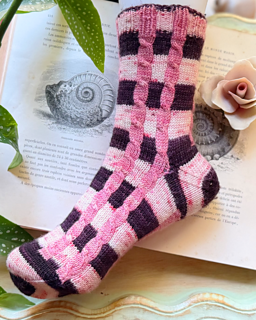
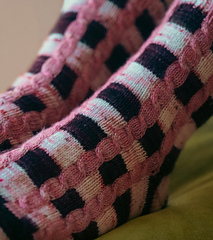
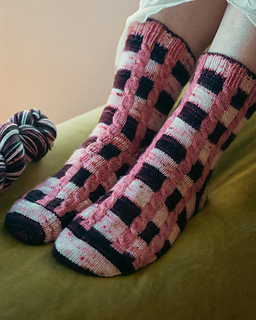
Lava Socks


Here’s a sock pattern featuring columns of cables that flow like a lava trail down an erupting volcano. Be careful not to burn your fingers Happy knitting!
MATERIALS
Biscotte Yarns BIS-SOCK 85% sw merino wool, 15% nylon; 400m /100g in the following color and quantity :
- A – LESTAT (self-striping color): 100 grams;
- B – PAPAYA (solid color): 50 grams.
Circular or double-pointed needles (DPNs) of 2.5 mm (or the size required to obtain the gauge)
Cable needle and a tapestry needle
GAUGE
32 stitches = 10 cm; 4” in stockinette stitch.
SIZES
Adult circumference: S/M (L/XL). Foot length is adjustable. Make sure to read the note regarding the sizes.
NOTES
REGARDING THE CONSTRUCTION - This pattern is worked from the top down with an afterthought heel, which means that the sock is worked as a tube, and the heel is opened and knitted at the very end.
To work this pattern, you may use a set of double-pointed needles or circular needles using the magic loop technique.
The stitch pattern is available as written instructions, and the charts are provided on page 6.
Since the pattern involves several consecutive stitches in the same color and requires the contrasting yarn to be carried behind the work, I designed it using the ladderback jacquard technique.
With this method, instead of tucking the floats behind the work, you create a temporary “ladder stitch” on the wrong side and purl it as long as needed. Using this technique helps increase the elasticity of the knitted fabric.
To make your work easier, I’ve added a red line in the charts indicating where to create (or purl) your “ladder stitches”.
For both techniques involved (ladder-back jacquard and afterthought heel), you will find a tutorial at the end of the pattern.
REGARDING THE SIZES – Despite the technique used to compensate for its limited elasticity, the nature of this pattern (stranded colorwork and cables) makes it much less stretchy than traditional knitting. Therefore, be sure to check your gauge carefully, and if in doubt, knit the larger size.
La version francophone de ce patron se trouve également sur LesLainesBiscotte.com


 Ravelry download


 Cancel

12499 projects
stashed 12979 times
 stashed
563 projects
stashed 591 times


