

 Apolonnie
 Pattern




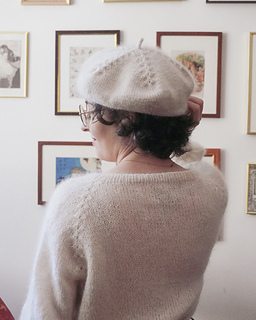
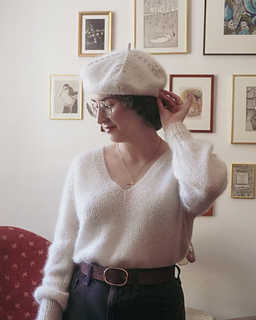
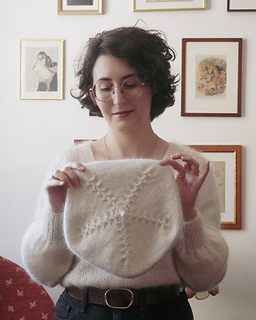
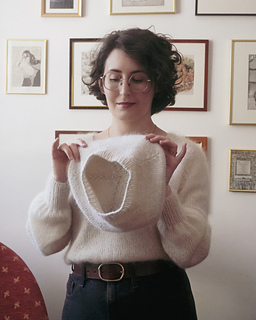

Leda Beret


☞ This pattern is available at a lower price if you purchase from my website.
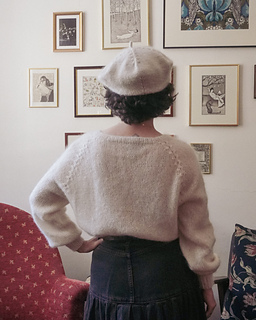
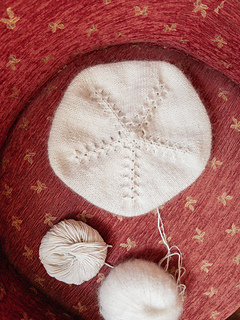
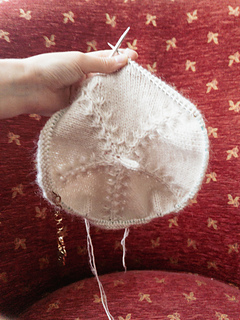
Leda Beret is a classical style beret knitted seamlessly from the top down. Its
crown is shaped with five branches of decorative increases, the same ones as its
sister pattern the Leda Blouse.
The beret is finished with a ribbed cuff that can be worn folded in the inside for
a traditional beret look, or unfolded for a slouchier style.
Yarn
1 (1, 1, 1), 2 balls of De Rerum Natura Albertine (200 m / 50 g), held together with 1 (1, 1, 1), 1 ball of De Rerum Natura Bérénice (210 m / 25 g)
Or 149 (154, 184, 191), 224 m / 163 (168, 201, 209), 245 yd of fingering or sport weight yarn, held together with 156 (162, 194, 201), 235 m / 171 (177, 212, 220), 257 yd of fluffy lace weight yarn (mohair silk or suri alpaca silk)
Sample shown in De Rerum Natura Albertine and Bérénice in colorway Orgeat.
About yarn choice: Albertine gives a densier fabric than most yarns with similar yardage. If you choose a more typical fingering weight yarn, keep in mind the result will be looser than the sample.
Gauge
22 stitches and 34 rounds per 10 cm / 4 in in stockinette after blocking
Wash your swatch in the same way as your future beret and allow it to dry completely before measuring.
Needles & Notions
- 3.5 mm / US 4 knitting needles (circular, small circular or double-pointed needles)
- Tapestry needle
- Stitch markers Always use the needle size that gives you the right gauge.
Sizes
1, (2, 3, 4), 5 to fit a head circumference of 51, (53, 55, 57), 59 cm / 20, (20.75, 21.75, 22.5), 23.25 in
~
☞ Ce modèle est disponible à un tarif plus bas si vous l’achetez directement depuis mon site.
Leda est un béret classique, tricoté sans couture, du haut vers le bas. Sa calotte est structurée par cinq branches d’augmentations décoratives, identiques à celles que l’on retrouve sur le modèle associé, la blouse Leda.
Le béret se termine par une bordure en côtes qui peut être portée repliée vers l’intérieur ou laissée dépliée, pour un tombé plus souple.
Fil
1 (1, 1, 1), 2 pelotes De Rerum Natura Albertine (200 m / 50 g), tenue avec 1 (1, 1, 1), 1 pelote de De Rerum Natura Bérénice (210 m / 25 g)
Ou 149 (154, 184, 191), 224 m / 163 (168, 201, 209), 245 yd de fil de calibre fingering ou sport, tenu avec 156 (162, 194, 201), 235 m / 171 (177, 212, 220), 257 yd de fil duveteux de calibre lace (mohair et soie ou suri alpaga et soie)
Le prototype est tricoté en De Rerum Natura Albertine et Bérénice dans le coloris Orgeat
Note sur le choix du fil : Albertine donne un tricot plus dense que la plupart des fils de même métrage. En cas de substitution pour un fil fingering classique, gardez à l’esprit que le rendu obtenu sera plus souple.
Échantillon
22 mailles et 34 rangs pourr 10 cm / 4 po en jersey après blocage
Lavez votre échantillon de la même manière que votre future béret, et laissez-le sécher complètement avant de le mesurer.
Aiguilles & matériel
- Aiguilles à tricoter 3.5 mm / US 4 (circulaires, petites circulaires ou aiguilles double-pointe)
- Aiguille à tapisserie
- Marqueurs de mailles
Utilisez toujours la taille d’aiguilles qui vous permet d’obtenir le bon échantillon.
Tailles
1, (2, 3, 4), 5 pour un tour de tête d’environ 51, (53, 55, 57), 59 cm / 20, (20.75, 21.75, 22.5), 23.25 po


 Ravelry download


 Cancel

2039 projects
stashed 1404 times
 stashed
2588 projects
stashed 1576 times


