

 Vicky Aquilino's Ravelry Store
 Pattern


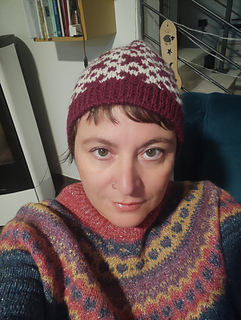


Leontopodium Hat

Leontopodium Hat è un cappello lavorato dal basso verso l’alto. Si inizia con un avvio provvisorio utilizzando un filato di scarto; una breve sezione tubolare introduce il bordo a coste 1/1 con maglie passate. Il corpo prosegue con una lavorazione Fair Isle a due colori, seguendo la chart, fino alle diminuzioni della corona.
Il motivo grafico, ispirato alla stella alpina, rende il cappello riconoscibile e piacevole da lavorare. Scegli due colori con un buon contrasto per valorizzare il disegno. Il modello è pensato per essere indossato con un’agio negativo compreso tra 0 e 3 cm.
Taglie: 1 (2, 3). Circonferenza finita: 48 (52,5, 57) cm. Lunghezza: 24 cm.
Filato: Remì di Lollo Crea, 70% baby alpaca e 30% poliammide; 100 g / 330 m. Colore principale (MC), blu: 79 (86, 95) m. Colore a contrasto (CC), panna: 45 (50, 55) m.
Ferri: 4 mm, con cavo corto oppure con cavo lungo per la tecnica magic loop.
Campione: 21 maglie e 26 ferri = 10 × 10 cm nel motivo della chart, dopo il lavaggio e un bloccaggio delicato.
Occorrente: Filato di scarto per l’avvio provvisorio, marcapunti, ago da lana e materiale per il bloccaggio.
Tecniche: Avvio provvisorio, sezione tubolare, coste 1/1 con maglie passate, lavorazione Fair Isle, lettura della chart e diminuzioni centrate doppie (CDD).
Leontopodium Hat is worked from the bottom up. It begins with a provisional cast-on using waste yarn; a short tubular section leads into a slipped-stitch 1/1 rib. The body is then worked in two-colour Fair Isle, following the chart, up to the crown decreases.
Inspired by the edelweiss flower, the graphic motif gives the hat its distinctive look and makes for an engaging knit. Choose two colours with good contrast to highlight the design. The hat is intended to be worn with 0–1.25 in / 0–3 cm of negative ease.
Sizes: 1 (2, 3). Finished circumference: 18.9 (20.7, 22.4) in / 48 (52.5, 57) cm. Length: 9.4 in / 24 cm.
Yarn: Remì by Lollo Crea, 70% baby alpaca and 30% polyamide; 3.5 oz / 361 yd (100 g / 330 m). Main colour (MC), blue: 86 (94, 104) yd / 79 (86, 95) m. Contrast colour (CC), cream: 49 (55, 60) yd / 45 (50, 55) m.
Needles: US 6 / 4 mm, with a short cable or a long cable for magic loop.
Gauge: 21 sts and 26 rows = 4 × 4 in / 10 × 10 cm in chart pattern, after washing and gentle blocking.
Notions: Waste yarn for the provisional cast-on, stitch markers, tapestry needle and blocking supplies.
Techniques: Provisional cast-on, tubular section, slipped-stitch 1/1 rib, Fair Isle colourwork, chart reading and central double decreases (CDD).
Leontopodium Hat wird von unten nach oben gestrickt. Die Arbeit beginnt mit einem provisorischen Anschlag mit Restgarn; auf einen kurzen Schlauchabschnitt folgt ein 1/1-Rippenmuster mit Hebemaschen. Anschließend wird der Mützenteil zweifarbig in Fair-Isle-Technik nach der Strickschrift bis zu den Abnahmen für die Mützenspitze gearbeitet.
Das von der Edelweißblüte inspirierte grafische Motiv verleiht der Mütze ihren unverwechselbaren Charakter. Wähle zwei Farben mit deutlichem Kontrast, damit das Muster gut zur Geltung kommt. Die Mütze ist mit 0–3 cm negativer Mehrweite konzipiert.
Größen: 1 (2, 3). Fertiger Umfang: 48 (52,5, 57) cm. Länge: 24 cm.
Garn: Remì von Lollo Crea, 70% Babyalpaka und 30% Polyamid; 100 g / 330 m. Hauptfarbe (HF), Blau: 79 (86, 95) m. Kontrastfarbe (KF), Creme: 45 (50, 55) m.
Nadeln: 4 mm, mit kurzem Seil oder mit langem Seil für die Magic-Loop-Methode.
Maschenprobe: 21 M und 26 R = 10 × 10 cm im Muster der Strickschrift, nach dem Waschen und vorsichtigen Spannen.
Weiteres Material: Restgarn für den provisorischen Anschlag, Maschenmarkierer, Wollnadel und Material zum Spannen.
Techniken: Provisorischer Anschlag, Schlauchabschnitt, 1/1-Rippenmuster mit Hebemaschen, Fair Isle, Arbeiten nach Strickschrift und zentrierte doppelte Abnahmen (CDD).


 Ravelry download


 Cancel
8 projects
stashed 1 time
 stashed