

 L'atelier Lacazavent
 Pattern



Litote

Enjoy -20% off the pattern price with the coupon code Litote26 until Tuesday, october 27.
Bénéficiez de -20% de réduction sur le patron jusqu’au mardi 27 octobre 2026 avec le code Litote26.
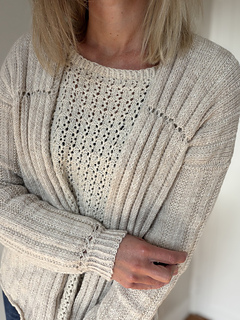
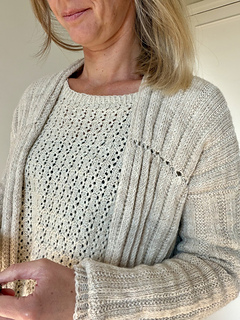
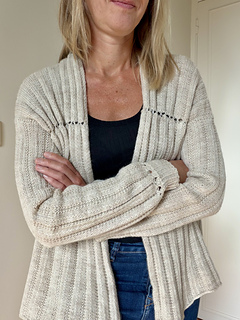
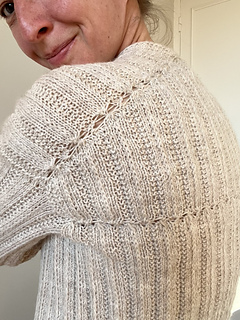
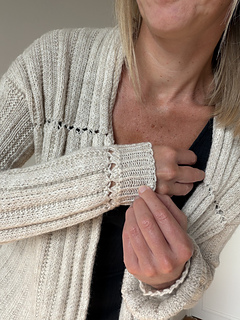
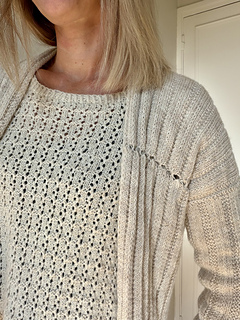
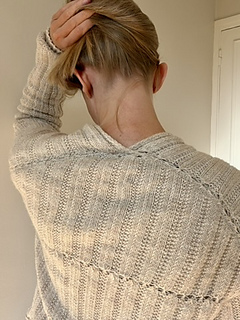
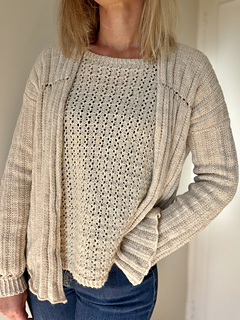
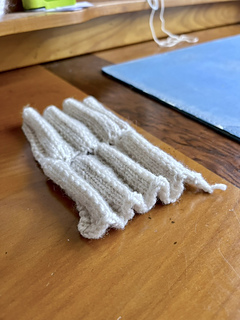
Litote is a loose-fitting cardigan worked with an allover easy-to-knit texture. Easy to remember and fun, it’s gives to Litote its unique character, creating—as you knit—that subtle pleated 3D effect that will make it a must-have in your wardrobe! It’s a surprising project, rich in detail : crossed at the back, the fronts can be joined however you like, the little twist that breaks up the rhythm and highlights the lines running along the body.
The body’s finishing is worked as you go and the cuffs are finished in half-twist ribbing.
Litote is worked from top down seamlessly with an allover simple and sophisticated cable pattern. You start by working the back neck edge, then the back section is worked down beginning with a large number of increases. Stitches are then picked up along each shoulder line to form the front section. The back and front are joined, the lower body is knitted flat to the hem continuing the pattern.
Finally, stitches for the sleeves are picked up and then worked in the round to the cuffs. It’s an enjoyable project, with the textured stitch adding a nice rhythm and keep things interesting.
Sizes
• Recommended ease between
20 to 40 cm/ 7.75 to 15.75 inches of positive ease.
• Finished bust measurements including the intended ease.
(101, 114, 126) 139, 152, 165 (178, 190, 203) cm/ (39.75, 45, 49.5) 54.75, 60, 65 (70, 74.75, 80) inches including the intended ease. (adjustable)
• Armhole height
(18.5, 19.5, 20) 21, 22.5, 25.5 (27, 28.5, 29.5) cm / (7.25, 7.75, 7.75) 8.25, 8.75, 10 (10.75, 11.25, 11.75) inches. (adjustable)
• Length hem to underarm
30 cm/11.75 inches. (adjustable)
• Upper arm circumference
(32 ; 32; 35) 35; 38; 42 (42; 45, 48) cm/ (12.5, 12.5, 13.75) 13.75, 15, 16.5 (16.5, 17.75, 19) inches. (adjustable)
Shown in size 2 with 32 cm/ 12.5 inches of positive ease.
Changing the dimensions of the garment (length, width, and ease) will also change the amount of yarn needed to complete your project.
Yarn
fingering to sport weight yarn.
Sample
Pernilla 100% Peruvian Highland wool (175 m/50g) by Filcolana, color n° 977
Approx
(1290, 1435, 1595) 1720, 1915, 2155 (2310, 2525, 2730) m/ (1410, 1570, 1745) 1880, 2090, 2355 (2520, 2760, 2985) yards of similar weight yarn.
All the finishing touches on this project are done as you go, it’s the perfect way to make the most of the amount of yarn you have.
Gauge
• 25 sts x 35 rows in pattern (according to chart B, p7), worked flat, on larger needles, after blocking.
• 25 sts x 35 rounds in pattern (according to chart D, p7) in the round on larger needles, after blocking.
In this pattern, all key measurements are given in cm and inches. As long as the difference remains reasonable, you can opt for the needles that gets you the correct stitch gauge (width).
Needles
• 4 mm US 6 circular needles for the body and sleeves.
• 3,25 mm US 3 circular needles for ribbing.
Always use the needle size that gives you the right gauge, adjust if necessary.
◀︎––––––––––––––––––––––––––––––––––––––––––––––––––––––►
Litote est un gilet ample tricoté entièrement dans un point texturé très facile à retenir et amusant à réaliser. Il amène à Litote toute sa particularité en créant, au fil de votre avancé, ce petit effet plissé qui le rendra indispensable à votre garde-robe !
C’est un projet surprenant riche de détails, croisé dans le dos, les devants se rejoignent à l’envie sans oublier le petit twist qui casse le rythme et souligne les lignes qui courent le long du corps.
Les finitions sont en côtes semi-torses et celles du corps se font au fur et mesure de votre avancé.
Litote est tricoté de haut en bas sans couture. On commence par tricoter le dos en réalisant dans un premier temps un grand nombre d’augmentations. Les mailles sont ensuite relevées le long de chaque ligne d’épaules pour former les devants de l’ouvrage. Les lignes d’épaules se placent légèrement en retrait dans le dos. Dos et devant sont assemblés puis tricotés tout en poursuivant le point en relief. Les mailles des manches sont relevées puis tricotées ensuite en circulaire.
Tailles
• Aisance recommandée entre 20 et 40 cm.
• Taille du vêtement terminé, mesure prise à la poitrine –aisance comprise-
(101, 114, 126) 139, 152, 165 (178, 190, 203) cm.
• Hauteur emmanchure
(18.5, 19.5, 20) 21, 22.5, 25.5 (27, 28.5, 29.5) cm (ajustable)
• Longueur du corps : 30 cm. (ajustable)
• Circonférence des manches
(32 ; 32; 35) 35; 38; 42 (42; 45, 48) cm.
Tricoté en T2, il est porté avec une aisance positive de 32 cm.
Changer les dimensions du vêtement (longueur, largeur et aisance) modifiera également la quantité de fil nécessaire pour terminer votre projet.
Fil
Nécessite un fil de type fingering à sport.
Le modèle de présentation a été tricoté en Pernilla 100% Peruvian Highland wool (175 m/50g) de Filcolana, couleur n° 977
Métrages
environ (1290, 1435, 1595) 1720, 1915, 2155 (2310, 2525, 2730) m d’un fil ou d’un mélange de fil équivalent.
L’ensemble des finitions de ce projet se font au fur et à mesure, il est donc idéal pour pouvoir utiliser au mieux la quantité de fil dont vous disposez.
Échantillons
• 25 mailles x 35 rangs en point texturé (cf. Annexe) pour un carré tricoté à plat de 10 cm par 10 cm après blocage.
• 25 mailles x 35 rangs en point texturé (cf. Annexe) pour un carré tricoté en circulaire de 10 cm par 10 cm après blocage.
Matériels
• Aiguille circulaire en 4 mm ou de la taille nécessaire pour obtenir le bon échantillon.
• Aiguille circulaire en 3,25 mm pour les finitions des manches.
Utilisez toujours une taille d’aiguille qui vous permet d’obtenir le bon échantillon, au besoin, ajustez-la.


 Ravelry download


 Cancel

8724 projects
stashed 4714 times
 stashed


