

 Knit Stars 11: Your Season of Genius
 Pattern



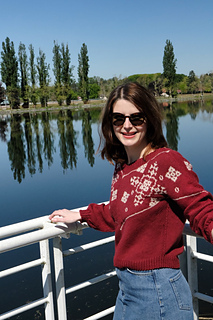
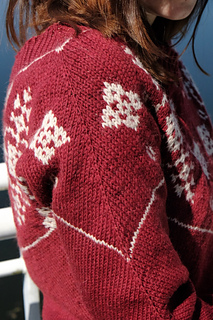
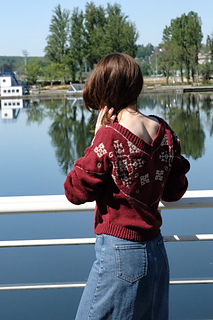
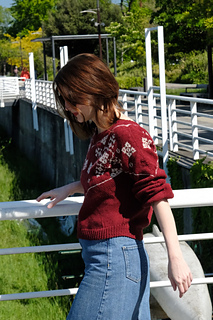
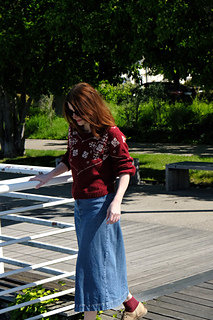
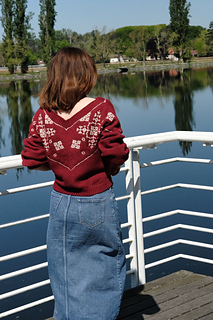
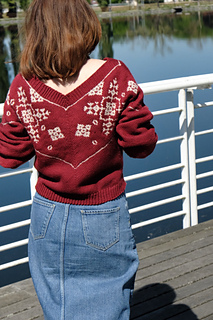
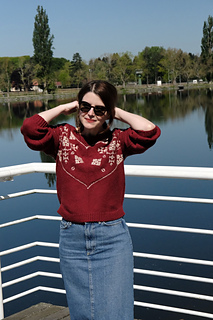
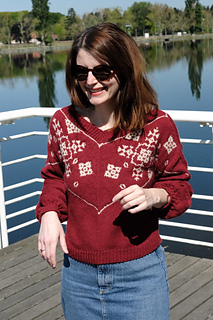
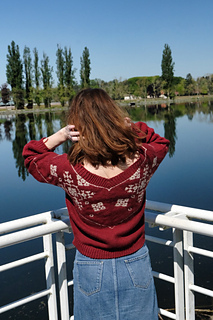
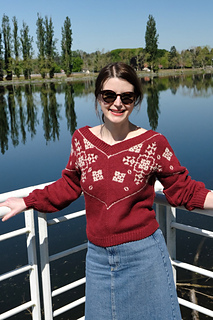
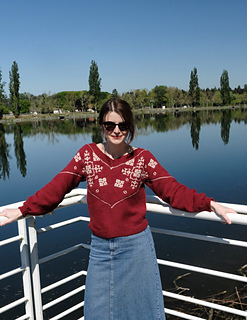
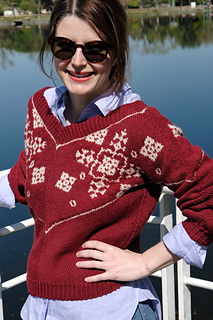
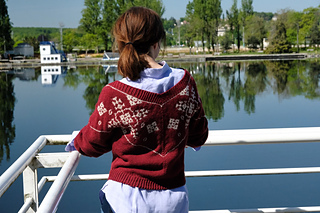
Manège
Ma dernière publication de patron est le pull Manège créé pour mes élèves du cours de jacquard ladderback Knit Stars.
Le ladderback est une méthode de gestion des fils flottant derrière un tricot en jacquard qui permet de tricoter de grandes plages de couleurs tout en conservant l’élasticité du projet et en évitant les désagréments du jacquard à fils croisés tels que le fil contrastant qui apparait aux croisements ou un tricot qui froufroute.
On pourrait le traduire par « échelles à l’arrière » et effectivement, on crée une seconde couche de tricot avec le fil contrastant qui forme des échelles de mailles qui ne rencontrent jamais la couche principale de l’ouvrage.
L’idée du ladderback c’est de garder souplesse et élasticité et je voulais que mon pull dégage une idée de mouvement. J’ai choisi une construction en biais, une forme ample et un décolleté dans le dos comme dans les tenues de danse.
Le patron est offert à toutes les inscrit(e)s à cette saison de Knit Stars et ne sera pas disponible à l’unité.
Matériel
• Aiguilles circulaires de 3,5 mm
• Aiguilles circulaires de 4,5 mm
• Anneaux marqueurs
• Compte-rangs
Échantillon
20,5 mailles et 24 tours font 10 cm avec les
aiguilles de 4,5 mm, après blocage.
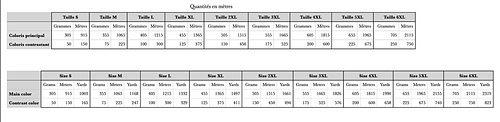
Laine
Nimbus de chez Fonty, 150 m dans 50 g,
voir le tableau des quantités dans les photos.
You might have noticed that I haven’t been publishing patterns every single day lately. My latest release is the Manège sweater, created for my students in the Knit Stars ladderback jacquard class.
Ladderback is a method for managing floating yarns on the wrong side of colorwork knitting. It allows you to knit large sections of color while preserving the project’s elasticity and avoiding the typical downsides of traditional stranded colorwork, such as the contrasting yarn peeking through at the crosses or a puckered fabric. It could be translated as “ladders in the back,” and indeed, you create a second layer of knitting with the contrasting yarn that forms vertical mesh ladders that never intersect with the main layer of the piece.
The point of ladderback is to maintain suppleness and elasticity, and I wanted my sweater to convey a sense of movement. I chose a bias construction, a relaxed fit, and a low back neckline reminiscent of dance wear.
I really love this type of construction; you might have already seen my Ethel top, which is also knit on the bias.
The pattern is free for everyone enrolled in this season of Knit Stars and will not be available individually.
Notions
• US 4 (3.5 mm) circular needles
• US 7 (4.5 mm) circular needles
• Stitch markers
• Row counter
Gauge
20.5 stitches and 24 rounds for 4” (10 cm)
with US 7 (4.5 mm) needles after blocking.
Yarn
Please find the yardage needed in the photo section.
20.5 stitches and 24 rounds for 4” (10 cm)
with US 7 (4.5 mm) needles after blocking.


432 projects
stashed 286 times
 stashed


