

 Sass Jackson's Ravelry Store
 Pattern

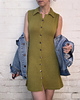
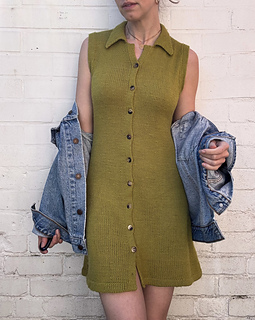
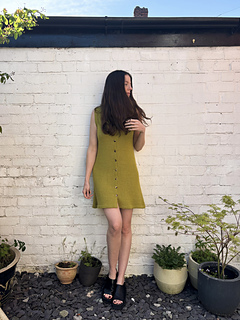
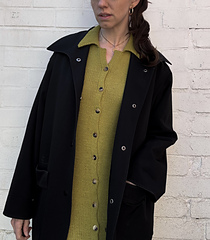
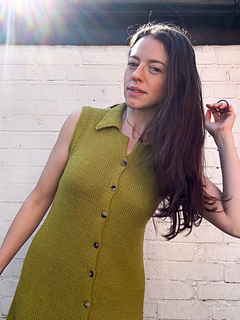
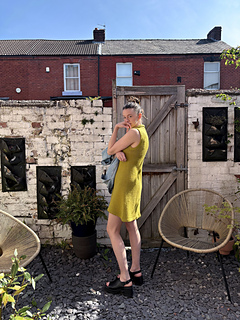
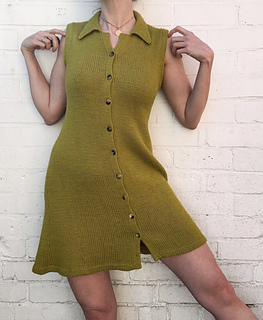
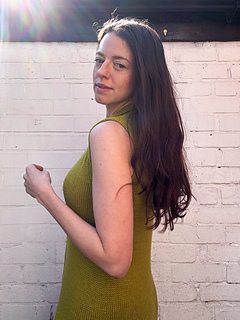
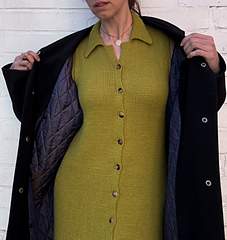
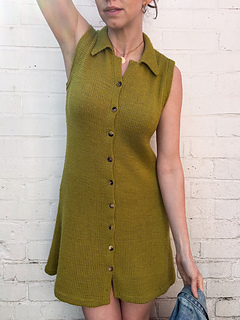
Omi Dress

About the Omi dress
The Omi dress is a relaxed, mid-thigh button-up dress with a collar. The design was inspired by a vintage, well-loved dress that I found in my maternal grandmother’s (my “Omi”’s) wardrobe that always reminds me of how effortlessly stylish she was, even on the most average of days. Pop on the Omi dress with some loafers for a clean, sophisticated day look; dress it up with a jean jacket, chunky sandles, and a few bits of jewelry to meet a friend for a cocktail; or toss it over a swimsuit for a beach picnic. Versatile, comfy, and classy, the Omi dress fits in (and stands out) just about anywhere summer might take you.
The Omi dress is worked top-down, mostly in stockinette stitch with clean double-stockinette finishes. It’s knit flat and is virtually seamless—except one small bit of seaming to complete the armhole finishes.
Sizing
This pattern includes 7 sizes: XS (S) M (L) XL (2XL) 3XL.
XS = UK size 4-6 | US size 0-2 | bust closest to 75cm
S = UK size 8-10 | US size 4-6 | bust closest to 85cm
M = UK size 12-14 | US size 8-10 | bust closest to 95cm
L = UK size 16-18 | US size 12-14 | bust closest to 105cm
XL = size 20-22 | US size 16-18 | bust closest to 115cm
2XL = UK size 24-26 | US size 20-22 | bust closest to 125cm
3XL = UK size 28-30 | US size 24-26 | bust closest to 135cm
Required skill level and techniques:
This pattern is an intermediate skill level, but may also be suitable for adventurous beginners. The techniques required for the pattern are listed below:
- Standard long-tail cast-on
- Knitted cast-on
- Italian cast-on
- Standard stockinette stitch
- Double stockinette
- German short rows
- Increase using M1L, M1R, M1pL, and M1pR stitches
- Pick up and knit
- Italian cast-off
- Shoulder seam
Note that the pattern contains a curated list of links to video tutorials of each of the techniques listed above.
Gauge information:
19 stitches / 23 rows in stockinette stitch, worked flat = 10cm x 10cm after blocking
Please note that making and blocking a gauge swatch is extra important and strongly recommended for this pattern, as the target gauge is a little atypical for a DK weight yarn. Friends, skip swatching at your own risk.
Materials
Needles:
• 5.0 mm circular needles (with long cable, 75-125cm long) and
• 4.0 mm circular needles (with long cable, 75-125cm long)
Other notions:
• 10 stitch markers
• Tapestry needle (for Italian cast-off and weaving in ends)
• 10 buttons, 15mm diameter
Recommended yarns:
-
Recommendation 1: Lovely Merino Treat by Rosy Green Wool Weight: 400 (400) 500 (500) 600 (600) 600 g Meterage: 840 (840) 1050 (1050) 1260 (1260) 1260 m) OR
-
Recommendation 2: Drops Daisy Weight: 400 (400) 450 (500) 550 (600) 600 g Meterage: 880 (880) 990 (1100) 1210 (1320) 1320 m)
Yarn selection tips
Choosing a yarn weight: This pattern is designed to have a relaxed, moderate drape. To achieve this in the designer’s sample, I used a larger needle size than is typically recommended for DK weight yarn, paired with a pure wool yarn to ensure a “bouncy” fabric—one that’s lightweight and fluid without becoming limp or losing its shape.
If you choose to deviate from pure wool (for example, by using a cotton, linen, or bamboo blend), be aware that these fibers lack wool’s natural elasticity and “bounce”. In those cases, you may find it easier to achieve the target gauge and desired fabric density by choosing a yarn that falls closer to a worsted weight. Regardless of your fiber choice, I strongly recommend swatching and blocking to ensure you love the look and drape of the resulting fabric.
Choosing a yarn fibre: The right yarn fibre for the Omi depends largely on your local climate:
• For moderate climates (under 25°C / 75°F), I highly recommend superwash merino wool. It keeps you at a comfortable temperature even when there’s a slight coolness in the air, and offers a beautiful drape, crisp stitch definition, and a smooth finish that feels lovely.
• For hot and/or humid climates (over 25°C / 75°F), merino can get a bit toasty! To stay cool, try a yarn that blends wool with a plant-based fiber like cotton or linen. Just note that you may get a drapier fabric that grows a bit more than wool on blocking.
• I’d generally suggest avoiding heavy insulators like cashmere, alpaca, or mohair, as they might be too warm for this style. But hey, you do you if you have a vision!*


 Ravelry download


 Cancel
502 projects
stashed 457 times
 stashed
9983 projects
stashed 5456 times