

 maschenmond
 Pattern


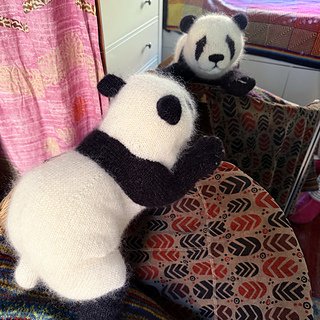
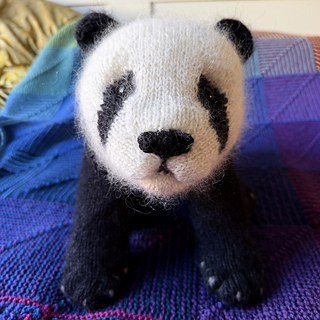
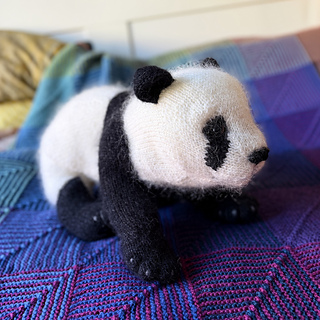
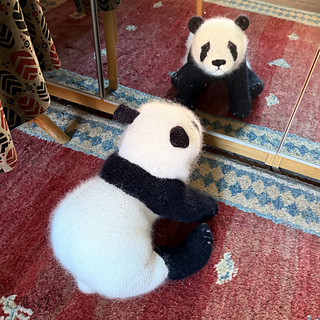
Panda Cub – Pandabär

Little Panda Bear – Kleiner Pandabär
Pattern in English (US terms) and German – deutsche Beschreibung weiter unten.
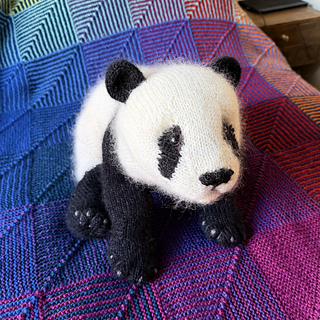
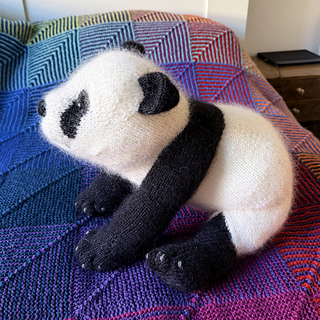
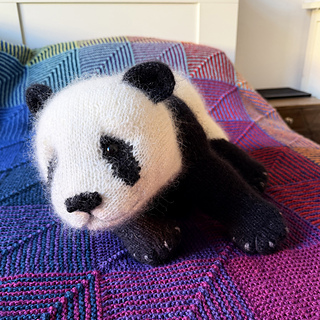
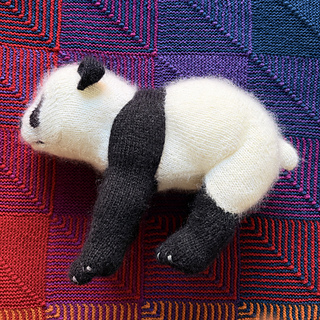
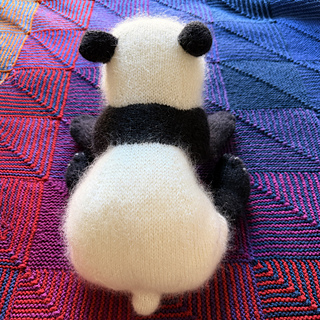
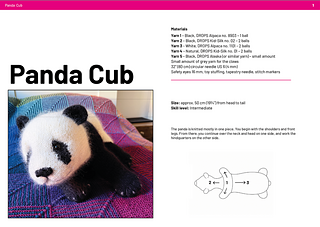
A realistic panda cub knitted mostly in one piece, with a soft mohair halo in black and white, knitted-in eye patches, a knitted nose with nostrils, round ears and sturdy paws with heels. The panda uses the same construction as my Little Polar Bear and Little Brown Bear.
Construction
The panda starts at the shoulders in black with a provisional cast-on. Both front legs and paws are worked as part of the shoulder pieces. Stitches are then picked up in white in two directions: forward over the neck and head to the muzzle, and backward over the back and thighs. The hind legs and belly are divided from the back stitches, and the belly continues all the way up to the chin, with the black chest band worked in. Shaping is done mainly with short rows (wrap and turn), and the black eye patches are worked in intarsia. The nose is picked up and knitted on, with the nostrils formed by short rows and two small seams. Ears, hind paws and tail are worked separately or picked up.
The pattern includes
– PDF with 13 pages
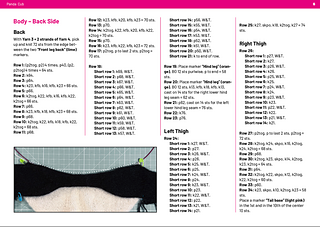
– Row-by-row instructions with stitch counts
– Many process photos for construction and finishing
– A color-coded marker system: markers of the same color show which edges are sewn together
– Finishing instructions for jaw edging, chin dart, nose, ears, toes and claws
Techniques
Provisional cast-on, short rows (wrap and turn), intarsia, picking up stitches, mattress stitch, backstitch
With safety eyes, the finished panda is not suitable for children under 3.
Kleiner Pandabär
Ein realistisches Pandajunges, weitgehend in einem Stück gestrickt, mit Mohair-Flausch in Schwarz und Weiß, eingestrickten Augenflecken, einer gestrickten Nase mit Nasenlöchern, runden Ohren und kräftigen Tatzen mit Fersen. Der Panda hat dieselbe Konstruktion wie mein Kleiner Eisbär und mein Kleiner Braunbär.
Konstruktion
Der Panda beginnt an den Schultern in Schwarz mit einem offenen Anschlag. Die Vorderbeine mit Tatzen entstehen gleich mit den Schulterteilen. Von dort werden in Weiß Maschen in zwei Richtungen aufgenommen: nach vorn über Hals und Kopf bis zur Schnauze und nach hinten über Rücken und Oberschenkel. Hinterbeine und Bauch werden aus den Rückenmaschen geteilt, der Bauch läuft mit eingestricktem schwarzem Brustband bis zum Kinn weiter. Geformt wird vor allem mit verkürzten Reihen (Wickeln und Wenden), die schwarzen Augenflecken entstehen in Intarsientechnik. Die Nase wird angestrickt, die Nasenlöcher entstehen durch verkürzte Reihen und zwei kleine Nähte. Ohren, Hintertatzen und Schwanz werden separat gestrickt oder angestrickt.
Die Anleitung enthält
– PDF mit 13 Seiten
– Reihe-für-Reihe-Anleitung mit Maschenzahlen
– Viele Prozessfotos zu Konstruktion und Ausarbeitung
– Ein Farbmarker-System: gleichfarbige Marker zeigen, welche Kanten zusammengenäht werden
– Anleitung zum Ausarbeiten von Kiefereinfassung, Kinnabnäher, Nase, Ohren, Zehen und Krallen
Techniken
Offener Anschlag, verkürzte Reihen (Wickeln und Wenden), Intarsie, Maschen aufnehmen, Matratzenstich, Rückstich
Mit Sicherheitsaugen ist der fertige Panda nicht für Kinder unter 3 Jahren geeignet.


 Ravelry download


 Cancel

84718 projects
stashed 59738 times
 stashed
91422 projects
stashed 47792 times


