

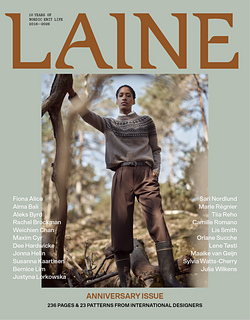
 Laine Magazine, Anniversary Issue
 Pattern

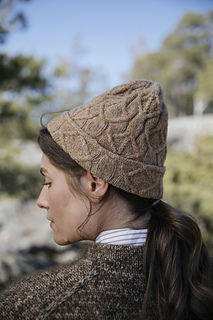
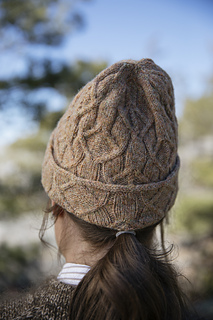
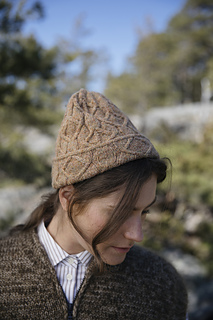
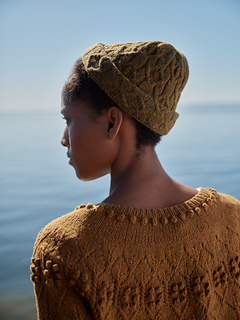
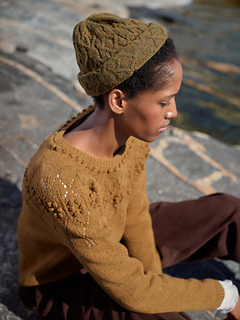
Pinaceae Hat
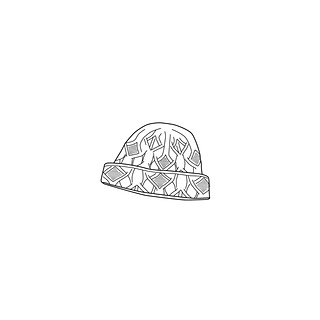
Rachel Brockman was delighted to revisit her Pinaceae design, originally published in Issue 9 of Laine Magazine. Here, the motif is reimagined as a delicate cabled hat without traditional ribbing, featuring an all-over cable pattern and options for a single- or double-folded brim.
SIZES
1 (2, 3, 4)
To fit head circumference of approx. 19–20 (21–22, 23–24, 24–25)“ / 48.5–51 (53.5–56, 58.5–61, 61–63.5) cm.
Recommended ease: 1–2” / 2.5–5 cm of negative ease.
FINISHED MEASUREMENTS
Brim Circumference: 18 (20.5, 21.75, 24.75)“ / 45.5 (52, 55.5, 63) cm.
Height (single-folded brim): 7.75 (8, 7.75, 8)“ / 19.5 (20.5, 19.5, 20.5) cm, adjustable.
Height (double-folded brim): Approx. 6.25” / 15.5 cm (all sizes), adjustable.
MATERIALS
Yarn: 2 (3, 3, 4) skeins of 2-Ply Jumper Weight by Jamieson & Smith (100% Shetland wool, 115 yds / 105 m – 25 g), in the colourway 1281 Mix.
Or approx. 223 (269, 284, 319) yds / 204 (246, 260, 292) m of fingering-weight wool yarn.
Alternative yarn suggestions are for example Shetland by Harrisville Designs or Spindrift by Jamieson’s of Shetland.
Needles: US 3 / 3.25 mm 16” / 40 cm or 32–40” / 80–100 cm circular needles and set of DPNs (or preferred needles for working small circumferences)
US 2 / 2.75 mm 16” / 40 cm or 32–40” / 80–100 cm circular needles for I-Cord BO.
Notions: Stitch marker, cable needle.
GAUGE
31 sts x 41 rnds to 4” / 10 cm on US 3 / 3.25 mm needles in Main Patt, after blocking.
28 sts x 38 rnds to 4” / 10 cm on US 3 / 3.25 mm needles in St St, after blocking.
NOTES
The Pinaceae Hat begins with the main body of the hat, which is worked traditionally bottom-up with thoughtful crown shaping. Then, stitches are picked up around the cast-on edge, a purl ridge is knit, then a short row is worked to turn the work inside out so that the right side shows when the brim is folded. The same motif is worked throughout the brim, and it is finished with a tidy I-cord bind-off. The hat is designed to be folded either once, like a traditional beanie, or twice, like a watch cap.


30072 projects
stashed 50237 times
 stashed