

 Simstrikk´s Ravelry Store
 Pattern


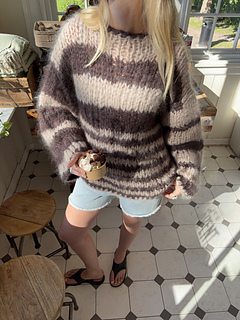

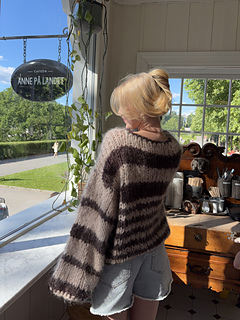
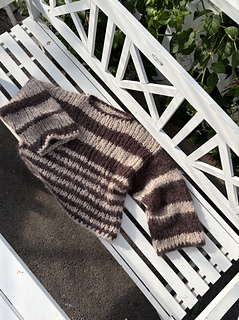
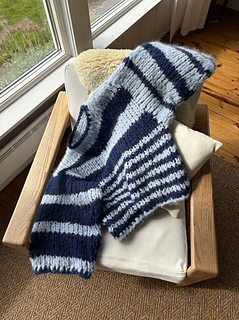
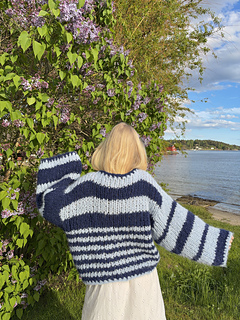
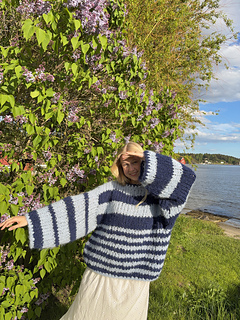
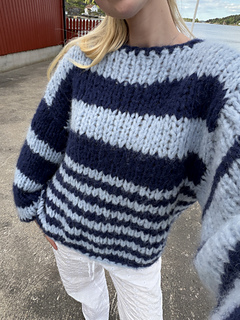
Sim stripe sweater

A LITTLE ABOUT SIM STRIPE SWEATER
Sim Stripe Sweater is the perfect quick-knit striped chunky sweater. It has an oversized and boxy fit and is an easy garment to simply throw on, with no defined front or back, making it perfect for both everyday wear and special occasions. The sweater is worked flat from the top down in stockinette stitch using alternating stripes. The back piece is worked first, after which sts are picked up for the front piece. The pieces are then joined and worked in the round for the body. The stripe pattern changes on the body, dividing the garment into sections with stripes of varying widths. Stitches are picked up for the sleeves, which are worked with different stripe patterns to create asymmetry and a playful look. Finally, crochet edging is worked along the lower edge of the body, the sleeves and around the neckline.
Size: 1 (2) 3 (4)
Finished bust circumference: Approx. 120 (130) 140 (150) cm
Total length: Approx. 58 (58) 62 (62) cm
Recommended needles: Circular needles 15 mm 80/100 cm
Gauge: 5 sts × 10 rnds = 10 × 10 cm in stockinette stitch on 15 mm needles
The stated gauge is measured after blocking (if you knit tighter, use larger needles. If you knit looser, use smaller needles).
Suggested yarn: Triple strand Påfugl in Paris (50 g = 90 m) or Double strand Fnugg in Florence (50 g = 80 m) from House of Yarn.
Yarn requirements:
Påfugl in Paris Colour 1: approx. 300 (350) 350 (400) g
Påfugl in Paris Colour 2: approx. 300 (350) 350 (400) g
Fnugg in Florence Colour 1: approx. 200 (250) 250 (300) g
Fnugg in Florence Colour 2: approx. 200 (250) 250 (300) g
Alternatively, use another yarn that matches the gauge. Please note that yarn requirements will vary depending on yardage and the number of strands held together


 Ravelry download


 Cancel
27 projects
stashed 15 times
 stashed
15 projects
stashed 16 times