

 Rebecaknits Ravelry Store
 Pattern

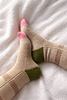
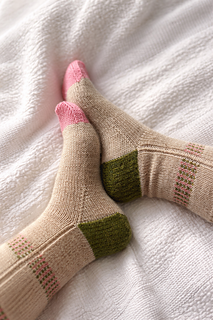
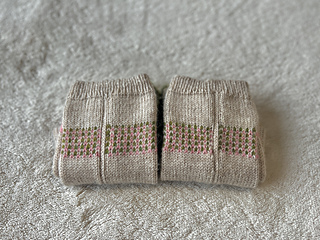
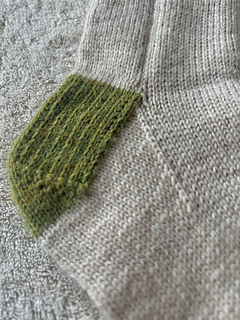
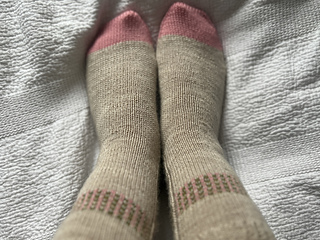
Soft Play Socks

EN
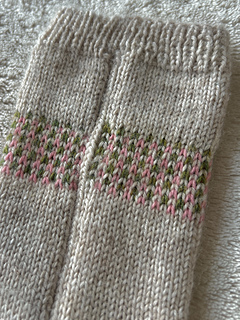
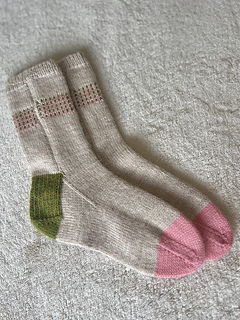
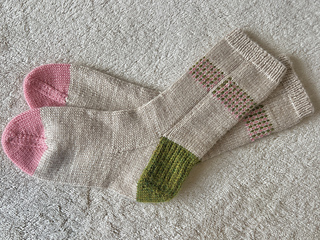
The Soft Play Socks are worked from the top down, beginning with the ribbed cuff. After completing the ribbing, a few centimetres of stockinette stitch are worked before introducing a ten-round section of colourwork using two contrasting colours.
Once the colourwork section is complete, the socks continue in stockinette stitch until the heel. The heel features a classic heel flap and gusset construction, making it straightforward to knit and comfortable for a variety of foot shapes.
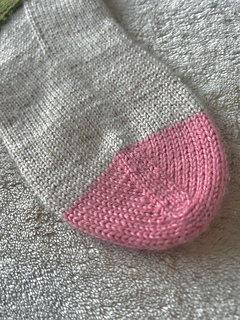
To finish, the foot is worked to the desired length, followed by simple toe decreases. The stitches are then grafted using the Kitchener stitch for a clean, seamless finish.
The pattern includes 3 sizes:
- Size S (Small): 19-20 cm / 7.5-8 inches
- Size M (Medium): 21-22 cm /8.25-8.75 inches
- Size L (Large): 23-24 cm / 9-9.5 inches
Yarn
Fingering weight yarn (350-425 m / 383-465 yds in 100 g).
For this pattern, you will need three colours:
- Main Colour (MC)
- Contrast Colour 1 (CC1)
- Contrast Colour 2 (CC2)
The original sample is knitted with Filcolana Arwetta (80% superwash merino wool, 20% nylon | 210 m / 230 yds in 50 g).
Colours used:
- MC: Marzipan (977)
- CC1: Avocado (809)
- CC2: Flamingo (370)
The exact amount will depend on the size:
Sample (size S, EU 35):
MC: 44 g / 185 m / 202 yds
CC1 and CC2: approx. 7 g / 30 m / 33 yds each
Test knitters:
MC: between 50–70 g
CC1 and CC2: approx. 10 g each
It is recommended to use yarn with nylon for added durability.
Needles
- 2.25 mm (circular or double-pointed needles)
- 2.75 mm (circular or double-pointed needles)
Other materials
- 2 stitch markers
- Tapestry needle
Gauge
36 stitches x 48 rounds = 10 cm in stockinette stitch, worked in the round and blocked.
ESP
Los Soft Play Socks se tejen de arriba hacia abajo, comenzando por el elástico de la caña. Tras completar el elástico, se trabajan unos centímetros en punto jersey antes de incorporar una sección de diez vueltas de colourwork (jacquard) con dos colores de contraste.
Una vez finalizado el motivo del colourwork, se continúa nuevamente en punto jersey hasta el talón. El talón, de construcción clásica con solapa y escudete, es sencillo de tejer y se adapta cómodamente a distintos tipos de pie.
Para terminar, se teje el pie hasta alcanzar el largo deseado y se forma la puntera mediante disminuciones simples. El cierre se realiza con punto Kitchener para un acabado limpio y prácticamente invisible.
El patrón tiene 3 tallas: S, (M, L):
- Talla S (Pequeña): 19-20 cm
- Talla M (Mediana): 21-22 cm
- Talla L (Grande): 23-24 cm
Hilado
Hilado de grosor fingering (350–425 m en 100 g).
Para este patrón necesitarás tres colores:
- Color Principal (CP)
- Color de Contraste 1 (CC1)
- Color de Contraste 2 (CC2)
El modelo original está tejido con Filcolana Arwetta (80% lana merino superwash, 20% nailon | 210 m en 50 g).
Colores utilizados:
- CP: Marzipan (977)
- CC1: Avocado (809)
- CC2: Flamingo (370)
La cantidad exacta dependerá de la talla:
Muestra (talla S, pie 35):
CP: 44 g / 185 m
CC1 y CC2: aprox. 7 g / 30 m cada uno
Testers:
CP: entre 50–70 g
CC1 y CC2: aprox. 10 g cada uno
Se recomienda usar hilado con nylon para mayor durabilidad.
Agujas
- 2.25 mm (circulares o agujas de doble punta)
- 2.75 mm (circulares o agujas de doble punta)
Otros materiales
- 2 marcadores de puntos
- Aguja lanera
Muestra de tensión
36 puntos x 48 vueltas = 10 cm en punto jersey, tejido en circular y bloqueado.


 Ravelry download


 Cancel
62469 projects
stashed 33793 times
 stashed