
 Kate Harvie's Ravelry Store
 Pattern


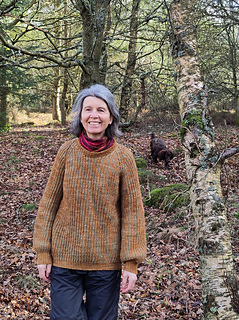
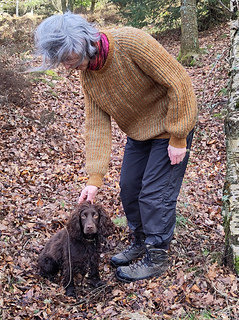
Squishy Jumper

About the pattern
It is well known that if you do something twice, it becomes a tradition that must be repeated.
My brother had a birthday with a zero on it, and I knitted him a jumper. (Too bad he never received it, because it got lost in the post. I will try again for the next zero birthday).
Then my sister had a birthday with a zero on it, and I knitted her a cardigan.
So now it is my other sister’s zero birthday and I asked her if she had any thoughts. She sent me what was essentially a mood board of oversized squishy knitwear, so I had to do two colour Fisherman’s Rib didn’t I?
Nothing like jumping in at the deep end, I also had to design it. Well why not? Er – I hadn’t done Fisherman’s Rib before, except perhaps in a different life before I had children. So this started a long rabbit hole of research, practice and fun.
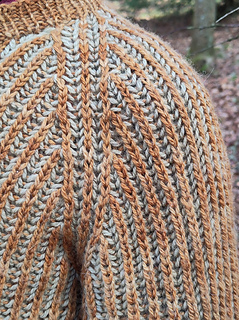
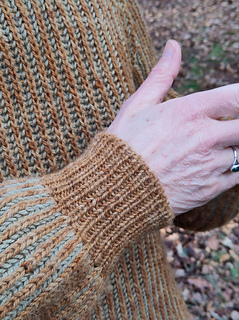
Some people will tell you that Fisherman’s Rib or Brioche Rib are a completely different kind of knitting and very difficult indeed, so much that you have to go on a course to learn it and all the different terminology associated with it. I disagree. Like all knitting, it’s just variations on knit and purl. The terms Brioche and Fisherman’s Rib tend to be used by different people to describe different techniques for exactly the same knitting architecture. It is a version of what is known as a “tuck stitch”, where each stitch when completed has two loops of yarn around it not just one. There are lots of different versions of tuck stitches but this garment is made in what might also be described as “Full Fisherman’s Rib” or “Two Colour Brioche”, which makes a thick but light fabric with lots of pockets of air in it.
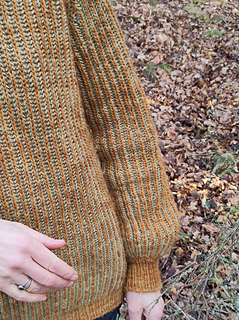
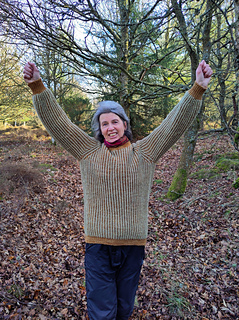
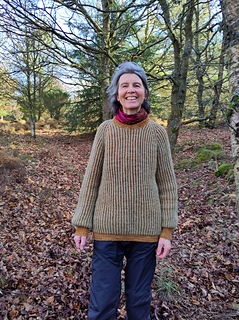
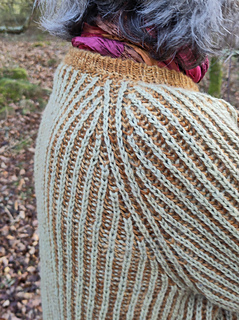
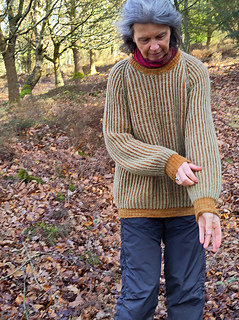
This is an oversized pullover worked from the bottom up. Starting with a tubular cast-on, which is easy but looks impossible (to impress your family and friends), a fitted one-colour rib at the hem gives way to a roomy unshaped sweater in two colours. The sleeves begin with a fitted cuff (to avoid draughts) but are also roomy, so you can pull your hands up inside your sleeves if you want. The raglan yoke is worked with wide details at the raglan shapings, and the garment is finished with a folded ribbed neckband.
If you finish it neatly it is reversible.
Skill Level
If you are comfortable working Fisherman’s Rib or Brioche this will be an easy project. If you have never done it before, and want to go straight for a garment rather than starting with a hat or cowl, this will be a good place to start.
Correcting mistakes can be a bit more challenging in this garment as the architecture of the fabric is more complex than ordinary rib. Lifelines might be useful.
Techniques include provisional cast-on, stretchy bind-off, knit, purl, yarnovers, increases and decreases in rib.
The pattern includes a written tutorial for three different techniques for working the stitches in the pattern. I have also included a photo tutorial as a separate file.
Finished measurements (after blocking)
Finished bust/chest circumference 84.5[96.5, 106, 115.5, 127] {136.5, 146, 157.5, 167} cm 33.25[38, 41.75, 45.5, 50] {53.75, 57.5, 62, 65.75} inches.
This jumper is designed to be worn with 10-15cm 4-6 inches of ease at the bust.
Yarn
The sample was worked in hand-dyed yarn. The base yarn is World of Wool York Stone DK, 40% Shetland, 40% Blueface Leicester, 20% alpaca, 230 metres/252 yards per 100g.
Colour A was dyed with lichen foraged sustainably from the forest floor in Aberdeenshire and Yorkshire. Colour B was dyed with bramble shoots harvested from the local woods in Yorkshire.
Very similar yarn can be purchased from Bluebell Yarns, an indie dyer based in Dorset. Have a look at www.bluebellyarns.co.uk
Any other DK yarn can be used if preferred. A yarn with three or more plies in a solid or lightly heathered colour would work best.
Yarn A: 680[759, 827, 892, 976] {1054, 1133, 1237, 1314} metres 743[830, 905, 975, 1067] {1152, 1239, 1353, 1437} yards.
Yarn B: 600[673, 734, 794, 870] {943, 1017, 1113, 1185} metres 656[736, 803, 868, 951] {1031, 1112, 1217, 1296} yards.
These amounts include an extra 10% for swatching and minor variations in gauge which are likely with this fabric.


 Ravelry download


 Cancel
0 projects
stashed 3 times
 stashed