

 Matt Hutson's Ravelry Store
 Pattern

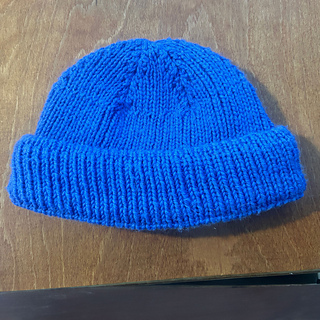
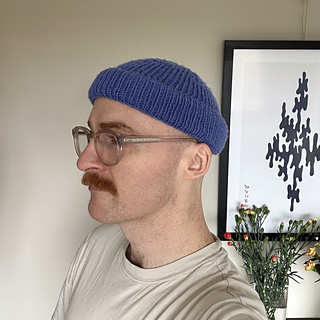
The Hackney Bald Man's Beanie

It is a truth universally acknowledged, that a bald man in East London, must be in want of a little beanie hat.
A fitted fisherman's beanie knit in the round in 1×1 rib with a structured double-fold tubular brim and clean centred crown decreases. Think docker hat meets watch cap — snug, structured, and the perfect look to rock at the graphic design studio/rare grooves day rave/autonomous weapons symposium.
Quick to knit in worsted weight wool, this men's ribbed beanie sits close to the head with good negative ease. The double tubular fold gives the brim real body without bulk, and six CDD decrease lines create a neat, symmetrical crown. Great for confident beginners looking to level up their hat game — you'll practise German twist cast on, tubular fold technique, and paired decreases.
Size
One size, fitting head circumference approximately 56–58cm. Easily sized up or down by adjusting the cast-on count in multiples of 6 stitches — each 6 stitches added or removed changes the circumference by roughly 2cm (e.g. 126 sts for a smaller head, 138 sts for a larger one). Always finish on 24 stitches before cinching the crown.
Gauge
14 stitches and 18 rows over 10cm in 1×1 rib on 3.75mm needles, with firm, consistent tension. This is knit below the ball band recommended needle size for a dense, structured fabric with good negative ease.
Materials
- 3.75mm circular needles, 40cm cord
- 6 stitch markers
- Tapestry needle
Yarn
Approximately 80–90m of worsted weight wool. One 100g skein is plenty with yarn to spare.
Sample knit in Rowan Pure Wool Superwash Worsted (100% wool, 100g/200m). Any worsted or heavy worsted weight wool with good stitch definition will work well — look for a yarn that holds its shape in rib.
Techniques
- Knitting in the round
- German twist cast on
- 1×1 rib
- Tubular fold (slip stitch technique)
- Centred double decrease (K2tog, P1, SSK)


 Ravelry download


 Cancel
16116 projects
stashed 12824 times
 stashed