

 Trizas y Trazos / Cecilia García Rodrigo
 Pattern


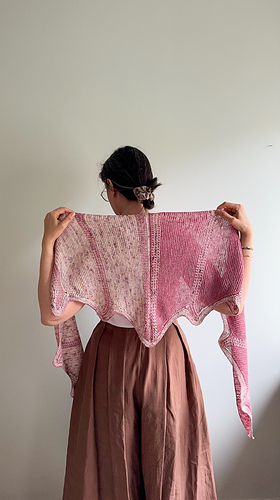
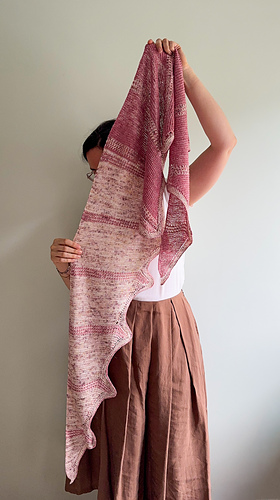
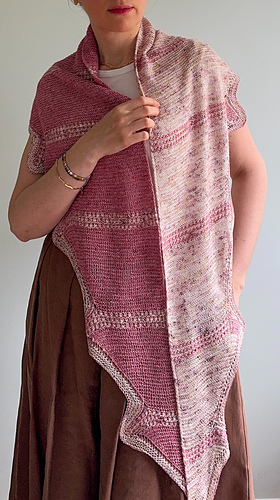
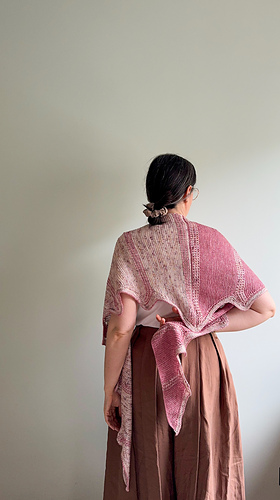
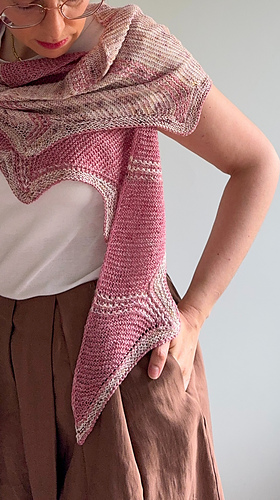
Versura Shawl

---- TEXTO EN ESPAÑOL, ABAJO ----
CONSTRUCTION
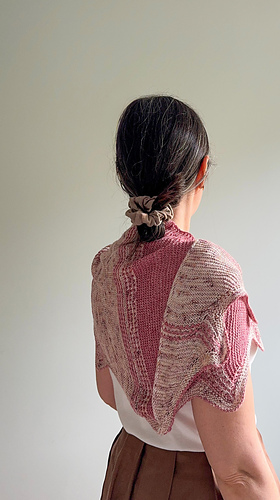
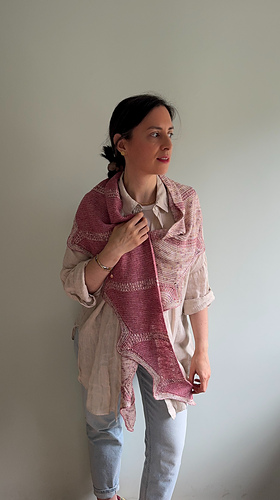
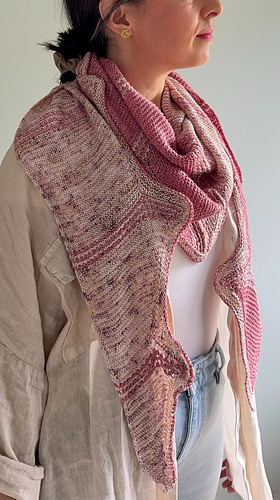
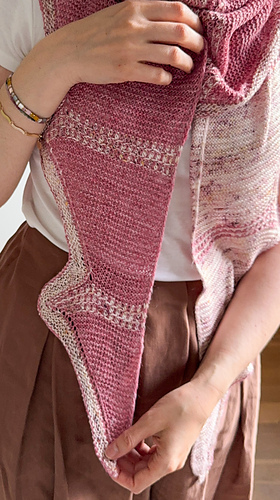
The Versura Shawl is composed of two symmetrical sections, worked separately. Each section is shaped through a sequence of increases and texture changes that create a series of defined peaks along one edge.
The two sections are then joined at the center to create one continuous shawl.
Once joined, stitches are picked up along the lower edge, and a final border is worked to soften the original peaks, transforming them into fluid waves and changing the silhouette of the piece.
MEASUREMENTS:
Length: 220 cm 86 ½”
Width: 45 cm 17 ¾”
MATERIALS
Yarn - COLOR 1
El Robledal de la Santa - Mulberry:
100% hand-dyed Grade A mulberry silk | 100 grams, 400 meters 437 yards.
1 skein, approximately 84 grams, 336 meters 367 yards used.
Shown in the color Fig Dust.
Yarn - COLOR 2
My knitted closet - The melange linen:
58% Linen | 42% Viscose from sustainable forests | 50 grams, 160 meters 175 yards.
2 balls, approximately 95 grams, 304 meters 332 yards used.
Shown in the color Red.
Needles:
For the first half of the shawl: 3.00 mm US 2 ½.
For the second half of the shawl: 2.75 mm US 2.
80 cm 32” cable. For the final border, you may find it helpful to use a longer cable if available.
Notions:
Tapestry needle for weaving in ends, scissors, measuring tape and/or ruler.
GAUGE
26 stitches and 38 rows = 10 x 10 cm 4 x 4”
Work the gauge swatch flat in garter stitch (cast on at least 30 stitches and work at least 44 rows).
Needles: 3.00 mm US 2 ½.
Yarn used for the swatch: COLOR 1 - El Robledal de la Santa - Mulberry.
Measure after washing and blocking the swatch, shaping it and stretching it to its fullest extent.
VERY IMPORTANT:
Keep in mind that gauge affects not only the final size of the shawl but also the amount of yarn used.
If you knit with a looser gauge than the one indicated in the pattern, meaning that you obtain fewer stitches or rows per 10 cm 4”, you may require more yarn than stated. In this case, it is recommended to use a smaller needle size in order to match the gauge given in the pattern.
---- TEXTO EN ESPAÑOL ----
CONSTRUCCIÓN
El chal Versura se compone de dos secciones simétricas, tejidas por separado. Cada una se construye mediante una secuencia de aumentos y cambios de textura que generan una serie de picos definidos en un lateral.
Posteriormente, se unen las dos piezas en el centro para formar un chal continuo.
Una vez unidas, se retoman puntos a lo largo del borde inferior y se trabaja un borde final que suaviza los picos iniciales, transformándolos en ondas fluidas y cambiando la silueta de la pieza.
MEDIDAS
Largo: 220 cm 86 ½ pulgadas
Ancho: 45 cm 17 ¾ pulgadas
MATERIALES
Hilo - COLOR 1
El Robledal de la Santa - Mulberry:
100% seda mulberry de grado A teñida a mano | 100 gramos, 400 metros 437 yardas.
1 madeja, de la cual se han gastado 84 gramos, 336 metros 367 yardas aproximadamente.
En las fotos se muestra en el color Fig Dust.
Hilo - COLOR 2
My knitted closet - The melange linen:
58% Lino | 42% Viscosa de bosques sostenibles | 50 gramos, 160 metros 175 yardas.
2 ovillos, de los cuales se han gastado 95 gramos, 304 metros 332 yardas aproximadamente.
En las fotos se muestra en el color Red.
Agujas:
Para la primera mitad del chal: 3.00 mm US 2 ½.
Para la segunda mitad del chal: 2.75 mm US 2.
Cable de 80 cm 32”. Para el borde final, puede serte útil si dispones de un cable más largo.
Extras:
Aguja lanera para rematar cabos, tijeras, cinta métrica y/o regla.
MUESTRA
26 puntos y 38 vueltas = 10 x 10 cm 4 x 4″
Tejer la muestra en punto bobo y en plano (montar mínimo 30 puntos y tejer mínimo 44 vueltas).
Agujas de 3.00 mm US 2 ½.
Hilo usado para la muestra: COLOR 1 - El Robledal de la Santa - Mulberry.
Medir después de lavar y bloquear la muestra, dándole forma y estirándola al máximo.
MUY IMPORTANTE:
Ten en cuenta que la muestra no solo afecta al tamaño final de la prenda, sino también a la cantidad de hilo utilizada.
Si tejes con una tensión más floja que la indicada en el patrón, es decir, si obtienes menos puntos o vueltas por 10 cm 4”, es posible que necesites más cantidad de hilo de la indicada. En ese caso, se recomienda utilizar un número de aguja menor para ajustarte a la muestra indicada en el patrón.


 Ravelry download


 Cancel
24 projects
stashed 18 times
 stashed
40 projects
stashed 42 times