

 The Knit Purl Girl Website
 Pattern

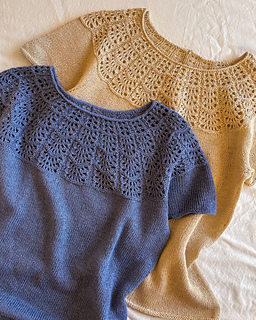
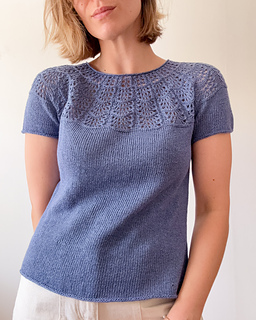
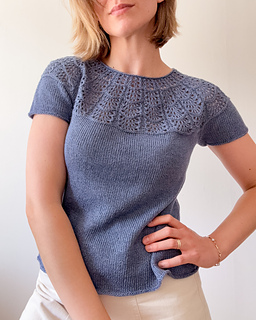
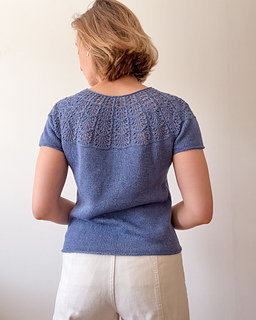
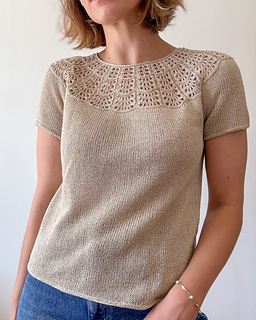
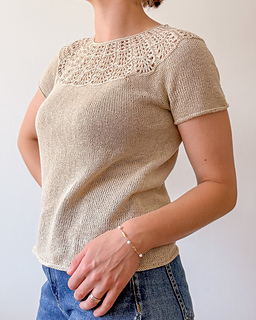
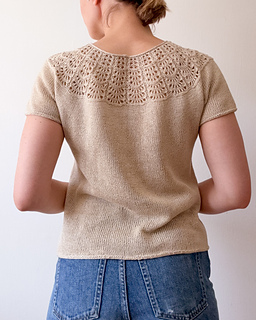
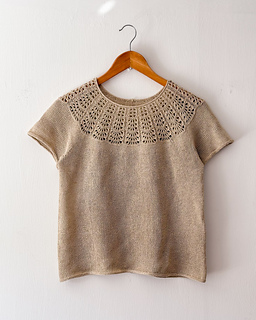
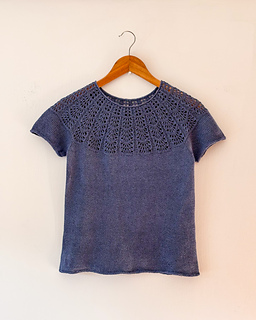
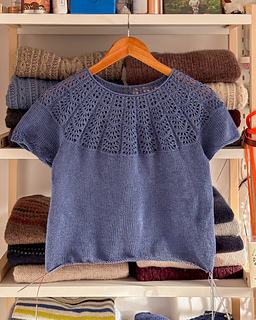
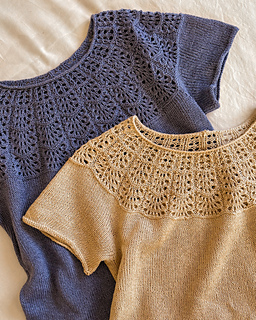
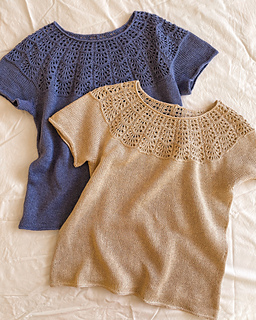
Waffle Tee


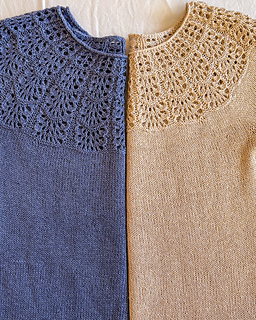
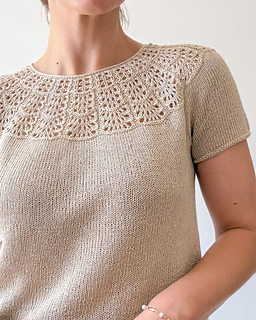
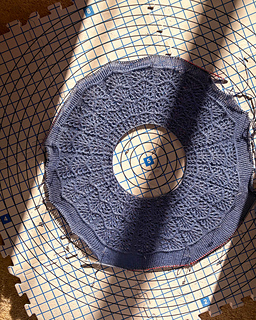
The Waffle Tee is worked top-down and in the round. You will begin by working the lace motif through the yoke, which has 2 depth options for the lace. The lace motif consists of yarnovers and decreases, and is fairly easy to memorise. You will then move onto some German short rows and raglan increases to improve the fit across the back and shoulders. Once the yoke is complete, you will work the lengths of the body and then the sleeves in turn. The body, sleeves, and collar are finished with i-cords.
This pattern has been fully tech edited and test knitted. For pattern support, please contact me by email (the.knit.purl.girl2020@gmail.com) where possible. Thanks!
Materials and fit
Notions: 3 mm / US 2.5 circular needles with 40-, 60-, and 80-cm / 16-, 24-, and 32-in cords. If you’re making one of the larger sizes, you may also find it helpful to have needles with a 100-cm / 40-in cord.
You will also need some ring stitch markers, your preferred stitch holder (i.e., scrap yarn, a set of spare needles, or a cord), a darning needle, and you may find some clip-on markers helpful to track your work.
Tension: 25 stitches x 40 rounds = 10 x 10 cm / 4 x 4 in in Stockinette stitch on 3 mm / US 2.5 needles; 27 stitches x 38 rounds in lace pattern (see chart on Page 6 below for the swatch chart; if made in full, the swatch should measure approximately 13 cm / 5 in x 8 cm 3 in.
Sizing and ease: The Waffle Tee has a recommended positive ease of 6.5-11.5 cm / 2.5–4.5 in for Sizes A-H, and 1-11.5 cm / 0.5-4.5 in for Sizes I-L. However, if you wanted less ease, you would be welcome to choose a smaller size relative to your chestmeasurement and vice versa.
Size: A (B) C (D), E (F) G (H), I (J) K (L)
Chest measurement (cm): 75-80 (80-85) 85-90 (90-95), 95-100 (100-105) 105-110 (110-115), 115-125 (125-135) 135-145 (145-155)
Chest measurement (in): 29.5-31.5 (31.5-33.5) 33.5-35.5 (35.5-37.5), 37.5-39.25 (39.25-41.25) 41.25-43.25 (43.25-45.25), 45.25-49.25 (49.25-53.25) 53.25-57 (57-61)
Actual circumference of garment at chest (cm): 86.5 (91) 96 (101), 105.5 (110.5) 117 (121.5), 126.5 (136) 145.5 (157)
Actual circumference of garment at chest (in): 34 (36) 37.75 (39.75), 41.5 (43.5) 46 (47.75), 49.75 (53.5) 57.25 (61.75)
Yoke depth (cm): 18 (18.5) 18.5 (19), 19.5 (20) 20.5 (20.5), 21 (22) 23 (23.5)
Yoke depth (in): 7 (7.25) 7.25 (7.5), 7.75 (7.75) 8 (8), 8.25 (8.5) 9 (9.25)
Body length from cast-on edge to hem at centre back (cm): 51.5 (52) 52 (52.5), 53 (53.5) 54 (54), 54.5 (55.5) 56.5 (57)
Body length from cast-on edge to start of hem at centre back (in): 20.25 (20.5) 20.5 (20.75), 20.75 (21) 21.25 (21.25), 21.5 (21.75) 22.25 (22.5)
Sleeve circumference at bicep (cm): 29 (30.5) 32 (33.5), 35 (35) 37 (38.5), 40 (43) 46.5 (51)
Sleeve circumference at bicep (in): 11.25 (12) 12.5 (13.25), 13.75 (13.75) 14.5 (15), 15.75 (17) 18.25 (20.25)
Sleeve length (cm): 5
Sleeve length (in): 2
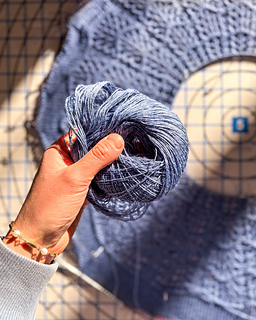
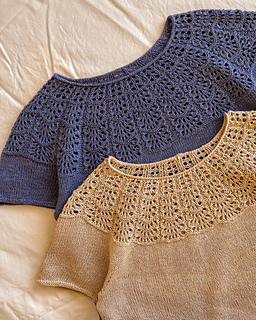
Yarn: For my sample, I used 2 strands of Isager Trio 1 (50% Linen, 30% cotton, 20% Lyocell; 50 g = 350 m / 383 yds). This yarn is lovely held double, but it is quite fiddly to use as it has very little memory, so proceed with some caution. If you want a similar fabric from a yarn that is easier to work with, consider Isager Trio 2 (50% Linen, 30% cotton, 20% Lyocell; 50 g = 175 m / 191 yds) or another linen-based yarn for closest results. For my first sample (Chart Option 1, blue yarn), I used the shade Sky. For my second sample (Chart Option 2, beige yarn), I used the shade Linen.
If you want to use the same yarn as my samples, you will need approximately 4 (4) 4-5 (5), 5 (5) 5 (5-6), 6 (6) 6-7 (7) balls of Isager Trio 1.
If you want to use a different laceweight yarn held double, I estimate that you will need 1290 (1330) 1400 (1530), 1590 (1630) 1670 (1750), 1900 (2010) 2100 (2200) m / 1420 (1460) 1540 (1680), 1740 (1790) 1830 (1900), 2130 (2200) 2300 (2410) yds.
If you want to use a different sport-weight yarn held single, I estimate that you will need 650 (670) 700 (770), 800 (820) 840 (880), 970 (1010) 1050 (1070) m / 720 (740) 770 (850), 880 (900) 920 (970), 1070 (1100) 1150 (1170) yds.
Techniques include reading a chart, working German short rows, working yarnovers, working leaning increases and decreases, and working an i-cord cast-off.
This isn’t an especially difficult pattern, but some of the decreases in the lace (e.g., K4tog and SSSSK) are quite fiddly so may not be the best choice for newer knitters. The lace itself is quite simple, however, so this is a good option for knitters wanting to gain confidence working lace motifs. I am always happy to help via email :)


 Ravelry download


 Cancel
3831 projects
stashed 2350 times
 stashed