

 Lee's Ravelry Store
 Pattern


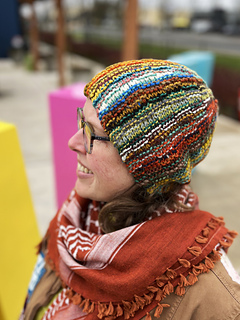
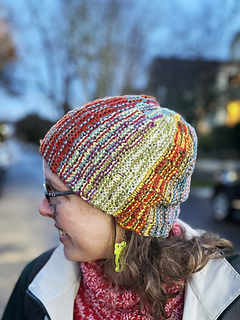
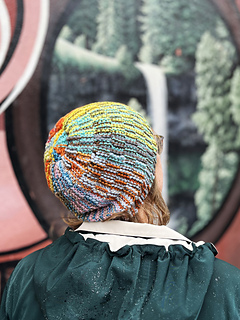
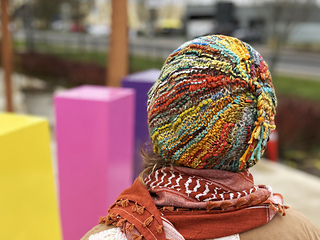
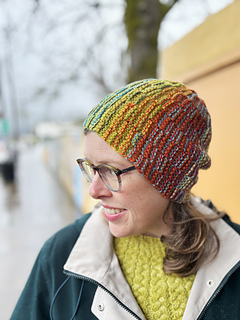
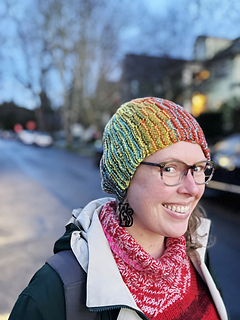

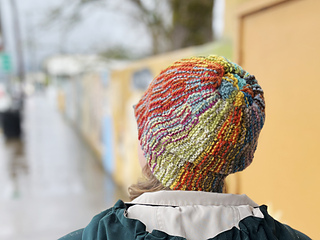
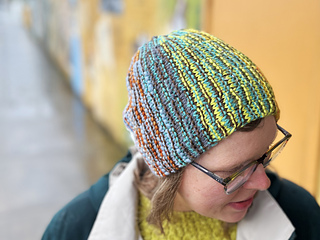
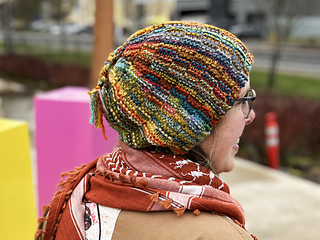
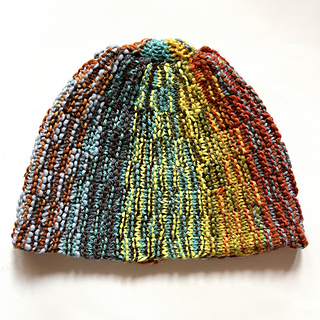
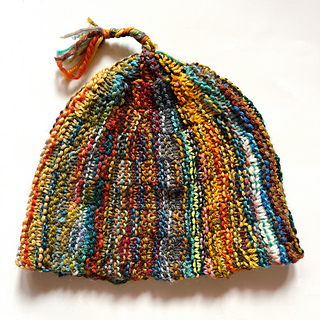
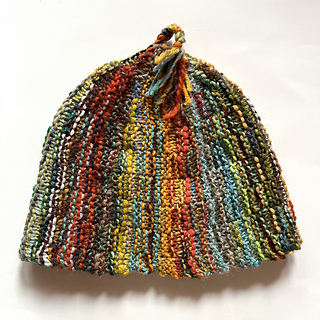
Wowee Zowee


This hat concept was based my Slanted & Enchanted scarf design, which is meant for using up varying lengths of leftover scraps of yarn. The scarf is, well, slanted, because there are short rows created by some of the strands not making it to the end of the row. I realized that this concept could be turned into a hat by the narrow side becoming the crown. It couldn’t be as scrappy and freeform as the scarf though, since it needed to function as a hat, and randomly placed short rows would result in pointed crowns and wonky shapes!
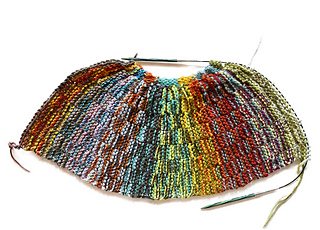
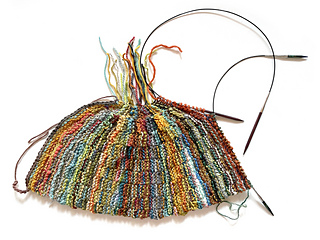
So I designed it two different ways: one that’s more similar to the scarf, using two circular needles which slide in the stitches, same as the scarf, meant for lots of quite short scraps of yarn leftovers. Then I made a variation, less similar to the scarf, meant for leftover mini-balls of yarn, which just uses one pair of needles, worked more normally. This version creates blended stripes, as you work with three colors at a time throughout.
You need
Worsted weight yarns in lots of small leftover balls or scraps, or a range of sport to bulky weights that average around worsted, approx 115–165 yards / 105–150 meters total
Size US 8–9 / 5–5.5mm needles, to achieve your desired gauge/height
- for longer leftovers version: any needles to work flat, plus one extra for 3-needle bind-off
- for shorter scraps version: two circular needles, ideally one longer for main needle (24–32” length) and one shorter for extra needle (16–24” length)
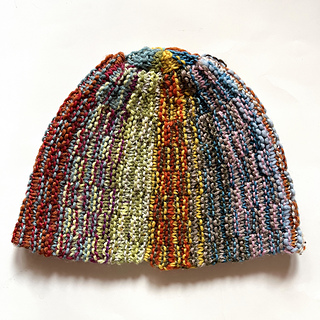
- samples are both the standard height in a variety of weights on size 9 needles; the one with the braided top is the shorter scraps version and the one with no braid is the longer leftovers version
A crochet hook and scrap yarn for provisional cast-on
Gauge
15–16 sts per 4” / 10cm, in garter rib pattern.
Instead of making a gauge swatch, it’s recommended that you just start your hat and use the first section or two to test your gauge, by measuring the piece—the width across your stitches will be the approx height of your hat.
Row gauge doesn’t matter—you’ll stop the hat when it reaches your desired circumference.
Sizing
The two cast-on counts are for standard{taller} heights, approx 9–9.5{11–11.5}“/23–24{28–29}cm tall. Adjust your gauge to get different heights.
The taller height could have a fold-up brim but only on the longer leftovers version, as the shorter version has too many ends woven in along the bottom which wouldn’t be attractive folded up.
The pattern lists circumference sizes of approx 16{18, 20, 22, 24}“/41{46, 51, 56, 61}cm unstretched, which are for child or adult xs{adult sm, med, lg, xl}, but you can just pull it around you head and stop when it fits nicely.
The Two Versions
While the end results look similar, the process is quite different for if you’re using lots of short leftover scraps versus longer leftover mini-balls.
Longer leftovers version: The longer version will use 3 continuous strands throughout the entire hat, switching between yarn 1, yarn 2, yarn 3 on every row, but you’ll switch each to a new color when it runs out, or by purposefully breaking the yarn, trying to switch them at different points so that the stripes blend between colors.
Shorter scraps version: The shorter version will have a different color for every other row throughout the entire hat, and the same color for 3 rows in each 6-row segment so you’ll use very short strands (around 30”) and longer strands (around 115”).
Techniques
The short rows in this pattern don’t use any kind of wrap & turn, you’ll simply stop rows short. Just do as the pattern says.
Both versions start with a provisional cast-on (tutorial included) and end with a 3-needle bind-off (instructions included).
Dealing with ends: The pattern has tutorials for weaving in your ends as you knit, which is key to this project. The only way you won’t really need to do this is if you’re making the longer leftovers version and you choose to splice the yarns together when you switch colors.


 Ravelry download


 Cancel