How I’m Fading Colors in My Brioche Sweater
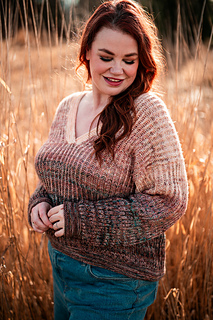
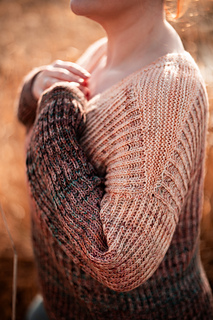
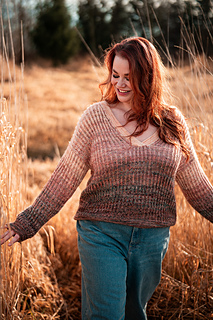
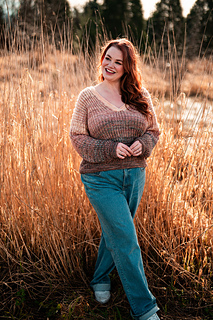
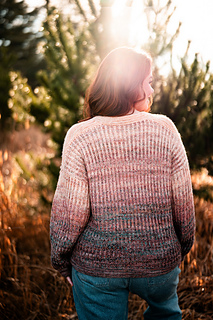
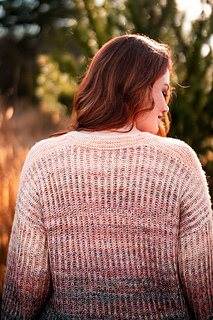
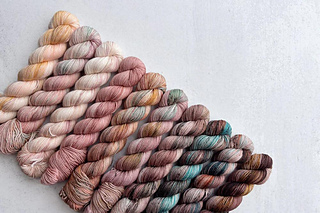
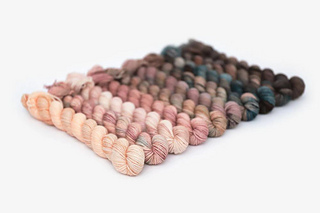
For this sweater, I’m using 10 different colors, numbered from 1 (lightest) to 10 (darkest). Each row of brioche is knit holding two different colors together—two strands for the foreground (fg), and two strands for the background (bg). The color numbers in brackets show which shades I’m using for each strand.
For example:
1–2 fg 2–3 bg — 5 rows
means I’m knitting the foreground with colors 1 and 2 held together, and the background with colors 2 and 3, for 5 rows.
Throughout the fade, I change the colors at different intervals to create a natural, blended transition from light to dark. I never use the exact same pair for both fg and bg at the same time, and I avoid repeating the same combination back-to-back. You’ll notice some colors stick around a bit longer, while others come in for just a few rows, this keeps things looking organic, without harsh lines or sudden jumps.
Complete Fade Sequence I gave myself a little wiggle room to add or skip a row here and there as I knit, just letting the fade evolve organically on the needles and making small adjustments to fit the schematic. My size 54” sweater yoke measures about 9.5” deep and the body is 14” long.
( 1–2 ) fg ( 2–3 ) bg — 5 rows
( 1–1 ) fg ( 2–3 ) bg — 2 rows
( 1–2 ) fg ( 2–2 ) bg — 3 rows
( 2–2 ) fg ( 2–3 ) bg — 4 rows
( 1–2 ) fg ( 3–3 ) bg — 3 rows
( 2–3 ) fg ( 3–3 ) bg — 5 rows
( 2–3 ) fg ( 3–4 ) bg — 3 rows
( 2–4 ) fg ( 3–3 ) bg — 2 rows
( 3–4 ) fg ( 2–3 ) bg — 4 rows
( 2–3 ) fg ( 2–4 ) bg — 3 rows
( 3–4 ) fg ( 3–3 ) bg — 4 rows
( 2–4 ) fg ( 3–4 ) bg — 3 rows
( 2–3 ) fg ( 3–4 ) bg — 4 rows
( 2–4 ) fg ( 4–5 ) bg — 2 rows
( 2–5 ) fg ( 4–6 ) bg — 3 rows
( 2–4 ) fg ( 5–6 ) bg — 4 rows
( 4–5 ) fg ( 5–6 ) bg — 3 rows
( 4–6 ) fg ( 5–7 ) bg — 2 rows
( 5–7 ) fg ( 6–7 ) bg — 4 rows
( 5–8 ) fg ( 6–8 ) bg — 3 rows
( 6–8 ) fg ( 7–8 ) bg — 2 rows
( 6–9 ) fg ( 7–9 ) bg — 4 rows
( 7–9 ) fg ( 8–9 ) bg — 3 rows
( 7–10 ) fg ( 8–10 ) bg — 2 rows
( 8–10 ) fg ( 9–10 ) bg — 4 rows
( 9–10 ) fg ( 8–9 ) bg — 3 rows
( 8–9 ) fg ( 9–10 ) bg — 2 rows
( 8–10 ) fg ( 9–10 ) bg — 5 rows
( 9–10 ) fg ( 8–10 ) bg — 3 rows
( 8–9 ) fg ( 9–10 ) bg — 2 rows
( 9–10 ) fg ( 8–9 ) bg — 4 rows
( 8–10 ) fg ( 9–10 ) bg — 3 rows
( 9–10 ) fg ( 8–10 ) bg — 5 rows
This approach lets the fade feel soft and seamless as the colors move from light to dark across the sweater. If you’re following along or adapting your own fade palette, you can use these brackets as a guide, swapping in your own color numbers to match your stash.
Yarn + Color Inspiration
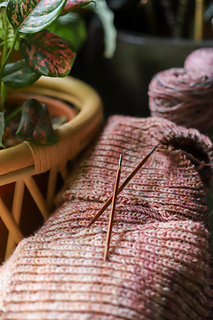
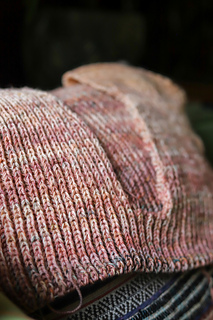
I’m knitting this sweater with Hue Loco Merino Sock, combining the Taproot and Pagosa sets to create a marled mauve fade that moves from a soft blush into a beautiful, richly speckled wine. The Taproot and Pagosa set is warm and earthy with pops of blush, mauve, muted purple violet tones, ochre, and teal!


 DankFiber notebook


 projects
 handspun
 stash
stash queue
queue favorites
 friends
 groups & events
 needles & hooks
 library
 blog posts
 Project



 stashed