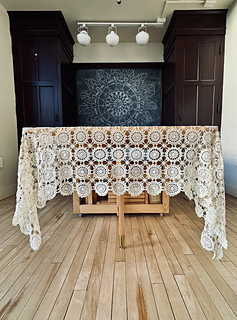
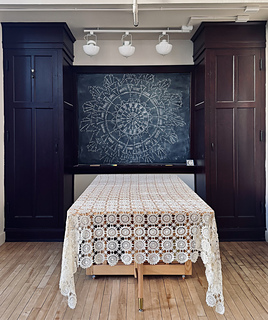
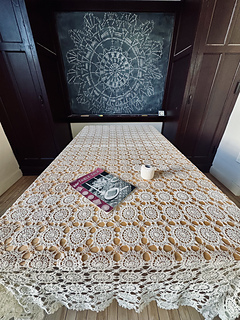
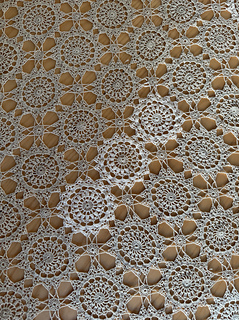
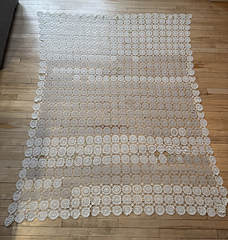
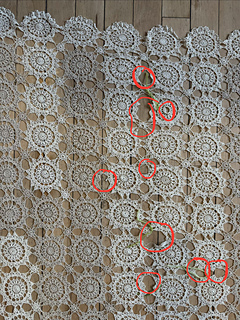
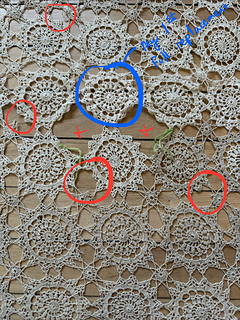
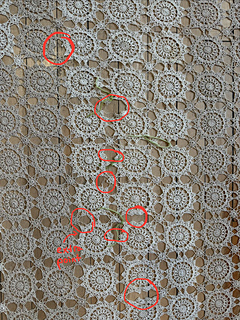
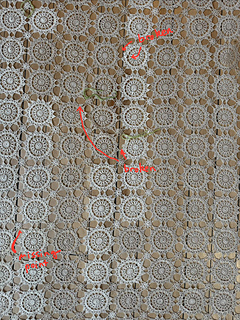
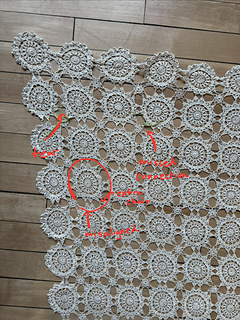
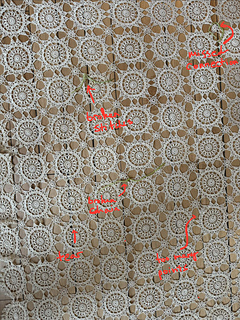
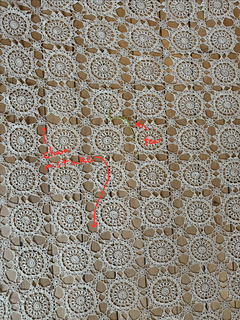
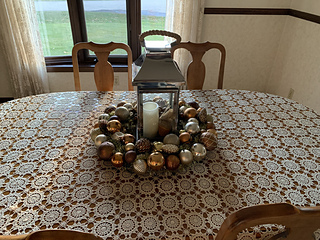
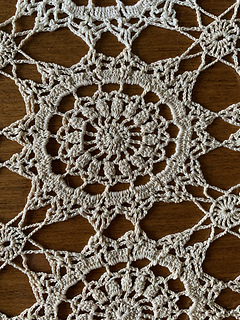
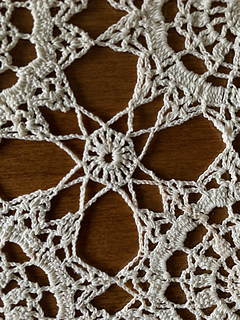
This tablecloth was crochet by my great-grandmother Augusta sometime in the early 1940’s, and has been in regular use in my family ever since. Over the decades, the cloth has broken down in a few places. I’ve taken on the task to restore it.
A brief history of Augusta, her tablecloth, and how my project developed:
As family lore tells it: Once upon a time, a little girl, Augusta Cohen, was born in New York. Not long after, her mother died, and her father, unable to care for an infant himself, placed her in an orphanage.
At this time, many east coast urban orphanages were overcrowded. Some institutions thought that it would be better for the children to move them out of the eastern cities and into western rural communities. This idea evolved into the orphan train system, and operated in the USA from the mid nineteenth century into the early twentieth century.
When she was a toddler, Augusta was placed on an orphan train and transported westward.
In Nebraska, Anna, a nurse, had married a widower, Joseph. He was father to 2 sons by his late wife and the proprietor of the local liquor store and pharmacy. When the orphan train came to Broken Bow, Anna’s sister wanted to foster a child. Anna’s sister was unmarried however, and needed a man to cosign the papers, so Joseph and Anna accompanied her to assist in the adoption.
As the story goes, when the family met the group of orphans, Anna noticed little Augusta right away. This was because, as a toddler, Augusta wore leg braces (we speculate that she had rickets). Anna, as a nurse, felt called to raise this child. Augusta was adopted by Joseph and Anna.
Many children on the trains had unfortunate outcomes. Some were treated as little more than indentured farm labor by the foster families. Augusta was very lucky. She was loved. This adoption occurred at a time when the sons were away at boarding school. When the boys arrived home for the summer, they discovered that they now had a baby sister, and apparently treated her like a little princess. Augusta grew up to be a nurse, like her mother.
As an adult, Augusta moved to Chicago along with one of her brothers. She worked as a private nurse for the Merchandise Mart and other companies, and married an Italian-American man named Anthony (but who went by Charles professionally). Charles had studied to be a liscensed surveyor at the Illinois Institute of Technology (the same school that, most of a century later, I studied civil engineering). They had their first child, a daughter. Then the great depression hit, and my great-grandpa Charles was without work.
Augusta and Charles decided to hold off on having a second child until he was working again. Happily, Charles was able to get hired by Civilian Conservation Corps, and that supported the family until he was able to restart his surveying business . My grandmother, Mary-Magdalene, was born in 1936, as Charles was working for the CCC.
While my grandma was still a child, Augusta made this tablecloth. My grandma noted that, possibly due to war-time supply shortages, Augusta could not always get matching colors of thread. This is why the original has a few different stripes of white.
My grandma kept and used Augusta’s tablecloth, then passed it to her eldest daughter, Mary, my mother, who currently keeps it. Mom likes to set a formal table when the occasion calls for it, and this tablecloth regularly gets use.
The Inspiration:
A couple years back, I took special notice of the cloth when I was home for the holidays and the table was set. I know myself to be a skilled crocheter, and realized I could probably repair the damaged areas of the cloth. Restitch the few worn-out motifs.
On this thought, I decided to post a picture of the cloth to r/crochet, on the offhand chance someone could help me find the original pattern. At that time, I didn’t know where to start looking for it. The post got a few replies, but they weren’t particularly helpful. Oh well, I figured that when I was ready to really start this project, I’d borrow the cloth and reverse engineer the pattern.
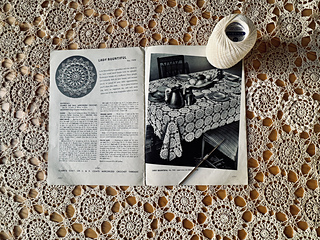
Months later, after a different post of mine got some notice on r/knitting, someone went back through my post history and saw my tablecloth query. That user, U/kfinchwrites, then FOUND the tablecloth pattern and replied to my post with the link. I am incredibly grateful to them.
This new piece of information sparked a new burst of enthusiasm in me for the project. I managed to source the type of cotton thread listed on the pattern, though it is no longer in production. (I have no idea if my GG used this brand of thread, or just what was available). But, as it happens, I got distracted with a different project while waiting on the delivery.
As the tablecloth lives at my mom’s house and I do not, the project once more hibernated in the back of my head while I worked on other projects and lived life.
Then, I was contacted by the Loose Ends project. This was my first time hearing from them since signing up to be a finisher shortly after it was founded. I was connected with a woman trying to finish her grandmother’s blanket. I really had fun finishing it, and after was again inspired to take on my own loose end of the tablecloth.
The Process:
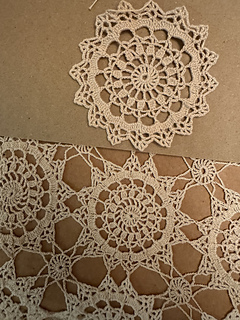
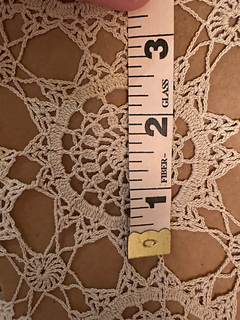
The challenge for this tablecloth project was exactly matching the gauge of Augusta’s work. I couldn’t have the roundels be too large and sag, or too small and pull the surrounding pieces. Hook size, thread size, and tension was critical.
My first attempt was made with a 1.25 mm hook (the smallest I had on hand) and #20 thread. It was clearly too large, and too embarrassing to photograph since I made mistake and ended up with a 15 pointed star rather than 16.
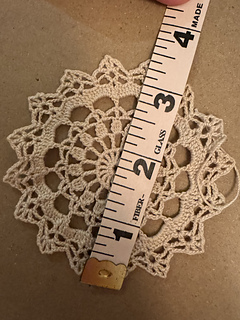
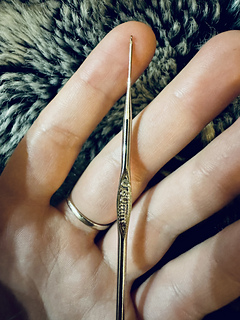
I ordered an even smaller set of hooks and tried again using the smallest one, a 0.60 mm hook. This one was close, but still about 3/8” larger in diameter than the original. Also, as I was stitching it, I could feel that my hook was almost too small for the thread.
In comparing my 2nd attempt to the original cloth, it appeared that the stitches in the tablecloth were more relaxed, and yet still finer than mine. I had intentionally stitched attempt 2 with a relatively high tension in order to get the smallest stitches I could manage. And since it still wasn’t small enough, I decided it must be the thread that was too thick.
This made me start actually researching cotton thread. I’d initially obtained the thread brand and size the pattern listed, and didn’t think about it further. But, I learned that even thinner options were available, and how the numbering convention works. I found a quite helpful guide here.
Based on their hook vs thread chart, I indeed probably was using a poor hook vs thread combo in my second attempt.
So I ordered #30 cotton thread for a 3rd attempt to match gauge. My plan was now to keep trying finer thread until I hit gauge. I hoped this one would work- I’d hate to keep buying finer thread I wouldn’t use but couldn’t return because I’d sampled it. I already feel guilt over no longer having a use for the #20 that didn’t work out.
I did wonder, in many years of washing and using the cloth, how it affected the blocking. Had it stretched over time with use? Had washing it in the past shrunk the cotton?
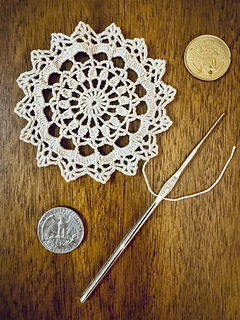
I made a roundel with the .60 hook and #40 cotton thread. Freshly finished, it was still a bit larger than the tablecloth. Just in case, I rinsed and blocked it. And it shrank perfectly! Once the piece dried out, it exactly matched the tablecloth.
Finally, I’d found my gauge.
The repairs actually went pretty smoothly. Of course, ripping out that first damaged roundel was unnerving, but I stitched in the replacement directly and was relieved that it actually blended in. From there it was simple.
My greatest surprise in working on the repairs was that I kept finding not just damaged spots to be fixed, but a lot of mistakes in the original work! Some I’ve kept, like where there was a roundel with 17 points instead of 16, but most I couldn’t help but fix along the way. Like places where she missed a connection between a pair of roundel points.
I’ll be gifting this restored cloth to my mother for Mother’s Day 2026.
To Mary and Mary-Magdalyn,
Happy Mother’s Day!
From Augusta and Caroline


 ModularReality notebook


 projects
 handspun
 stash
stash queue
queue favorites
 friends
 groups & events
 needles & hooks
 library
 blog posts
 Project