

 Aggie in Stitches
 Pattern


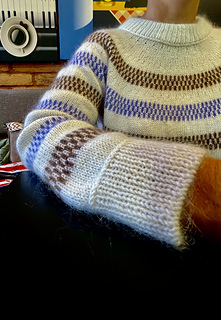
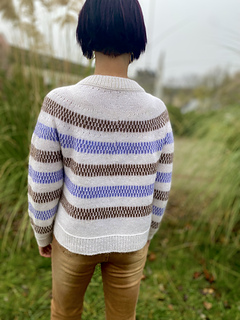
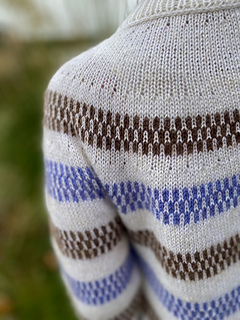
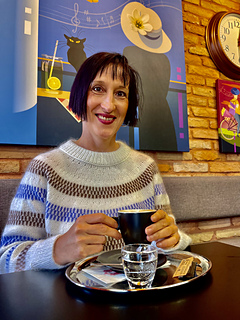
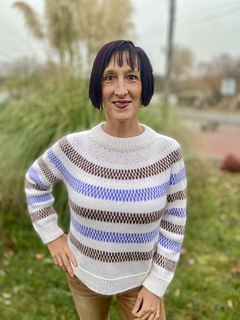
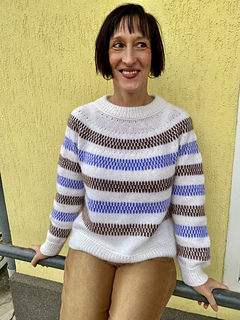
Caldera Sweater

This pattern is part of the Caldera Collection.
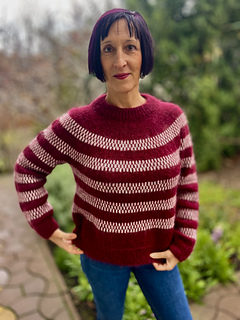
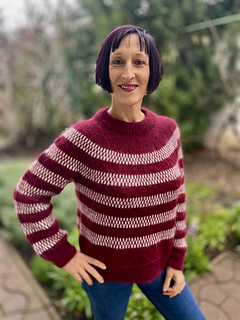
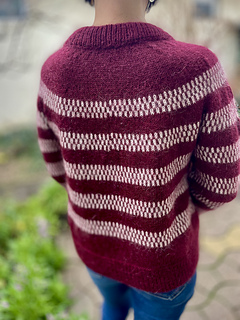
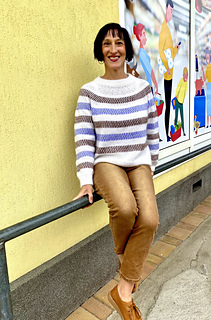
Caldera is a modern, top-down yoke sweater inspired by the quiet strength of nature — calm on the surface, powerful underneath. Clean lines and softly shifting colours create a peaceful, rhythmic fabric that makes every stitch feel intentional and grounding.
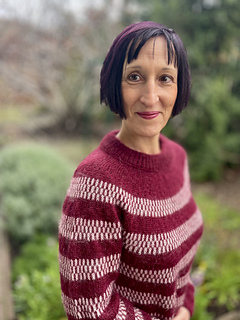
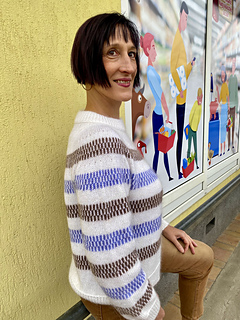
The design features simple yet striking single- and two-colour stripes, creating gentle movement across the yoke, body and sleeves. Subtle lateral braid details add texture and structure, framing the colourwork and giving the sweater its distinctive character.
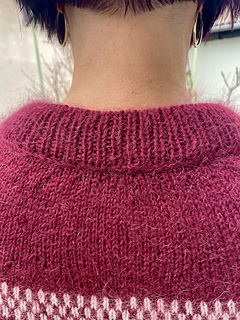
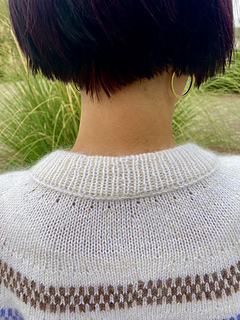
Caldera is designed for a comfortably relaxed fit and an elegant, everyday silhouette. Worked seamlessly in the round from the top down, it allows you to try it on as you go and adjust length to your preference. The slightly raised back provides a flattering and comfortable fit, while the refined ribbed collar, cuffs and hem give the garment a polished, tailored finish.
Whether you choose soft neutrals for a quiet, minimalist look or bold contrasts for a more playful statement, Caldera is a versatile, timeless sweater that will quickly become a favourite in your handmade wardrobe - and it pairs perfectly with the rest of the Caldera Collection.
The pattern was tech-edited by Marie-Eve Wedge and test knitted by a wonderful group of knitters.
SIZING:
Sizes 1 (2; 3; 4) (5; 6; 7; 8) detailed below are designed to be worn with 10-20 cm / 4-8” positive ease.
To fit bust: 75-85 (85-95; 95-105; 105-115) (115-125; 125-135; 135-145; 145-155) cm /30-34 (34-38; 38-42; 42-46) (46-50; 50-54; 54-58; 58-62) inches.
Finished bust: 95 (105; 115; 125) (135; 145; 155; 165) cm / 38 (42; 46; 50) (54; 58; 62; 66) inches.
Yoke depth: 20 (21; 21.5; 23) (23.5; 24.5; 25.5; 27) cm / 8 (8.5; 8.5; 9.25) (9.5; 9.75; 10.25; 10.75) inches.
Body length from underarm: 31 (32; 33.5; 34) (34.5; 36; 36.5; 37.5) cm / 12.5 (12.75; 13.5; 13.5) (13.75; 14.25; 14.5; 14.75) inches.
Upper sleeve circumference: 33.5 (37.5; 41; 43.5) (48; 52; 55.5; 59) cm /13.5 (15; 16.5; 17.5) (19.25; 20.75; 22.25; 23.5) inches.
Sleeve length from underarm: 42 (42; 42; 42) (42; 42; 42; 42) cm / 16.75 (16.75; 16.75; 16.75) (16.75; 16.75; 16.75; 16.75) inches.
Sample is shown in size 2 with 14 cm / 5.5” positive ease.
YARN:
A heavy fingering-weight and a lace-weight yarn are held together throughout the whole project. Alternatively, a single strand of DK-weight yarn can be used.
For my white-based sample with brown and lilac colourwork stripes, I used Drops Baby Merino (50 g = 175 m / 191 yards; 100% superwash extra fine Merino), in shades 01-white as the main colour, 17-beige as the contrast colour 1 and 25-lavender as the contrast colour 2; held together with Drops Kid-Silk (25 g = 210 m / 230 yards; 75% mohair, 25% silk), in shades 01-off white as the main colour, 35-chocolate as the contrast colour 1 and 11-lavender as the contrast colour 2.
For my Bordeaux-based sample with beige stripes, I used Drops Nord (50 g = 170 m / 186 yards; 45% Alpaca, 35% Polyamide, 25% Wool), in shades 30-Bordeaux as the main colour and 29-marzipan as the contrast colour; held together with Drops Kid-Silk (25 g = 210 m / 230 yards; 75% mohair, 25% silk), in shades 70-Bordeaux as the main colour and 56-marzipan as the contrast colour.
The amount of yarn needed to make a swatch is included in the estimated yarn amounts below.
You will need approximately:
Drops Baby Merino or Drops Nord: main colour: 6 (6; 7; 8) (8; 9; 10; 11) balls, contrast colour (CC1): 1 (1; 2; 2) (2; 2; 2; 2) balls, contrast colour (CC2): 1 (1; 1; 1) (1; 2; 2; 2) balls.
Drops Kid-Silk: main colour: 5 (5; 6; 6) (7; 8; 8; 9) balls, contrast colour (CC1): 1 (1; 1; 2) (2; 2; 2; 2) balls, contrast colour (CC2): 1 (1; 1; 1) (1; 2; 2; 2) balls.
If you use different yarns, you will need approximately:
Main colour: 910 (1020; 1135; 1255) (1365; 1495; 1625; 1765) metres / 995 (1115; 1240; 1370) (1495; 1635; 1775; 1930) yards
Contrast colour (CC1): 145 (160; 180; 200) (215; 235; 255; 280) metres / 160 (175; 195; 220) (235; 255; 280; 305) yards
Contrast colour (CC2): 100 (110; 125; 140) (150; 235; 255; 280) metres / 110 (120; 135; 155) (165; 255; 280; 305) yards
of both a heavy fingering-weight yarn and a lace-weight yarn if working with two strands, or of a DK-weight yarn if working with a single strand.
If you wish to use one contrast colour, add the yarn amounts for contrast colour 1 and contrast colour 2 together to estimate your total contrast colour yarn consumption.
If you wish to use three contrast colours, add the yarn amounts for contrast colour 1 and contrast colour 2 together, then divide the total by 3 to estimate the yarn consumption for each contrast colour.
GAUGE:
22 stitches and 25 rows = 10 cm x 10 cm / 4” x 4” on 4.5 mm / US 7 needles in stockinette stitch in single-colour (in main colour) and on 5 mm / US 8 needles in colourwork, worked in the round, after blocking.
NEEDLES:
- 4.5 mm / US 7 circular needles of 40, 60, 80 and 100 cm / 16”, 24”, 32” and 40” for the main fabric in single-colour or needle size needed to reach gauge.
- 5 mm / US 8 circular needles of 40, 60, 80 and 100 cm / 16”, 24”, 32” and 40” for the main fabric in colourwork or needle size needed to reach gauge.
- 4 mm / US 6 circular needles of 40 and 80 cm / 16” and 32” for the ribbing or needles 0.5 mm smaller than the main fabric in single-colour needles.
- 3.5 mm / US 4 circular needles of 40 and 80 cm / 16” and 32” for the lateral braid and the inner side of the collar or needles 0.5 mm smaller than the ribbing needles.
NOTIONS:
- 3.5 mm / US E-4 crochet hook to close the gap in the lateral braid. The size of the crochet hook is not important, but it should be the same size as, or smaller than, the needles used for the lateral braid to make closing the gap easier.
- 2 stitch markers.
- Try-it-on tubing or waste yarn to place stitches on hold.
- Tapestry needle.
- Measuring tape.
TECHNIQUES:
Knitting in the round, simple stranded colourwork, long tail cast-on, German short rows, yarn over increases, Lateral braid, Italian tubular bind-off, picking up stitches, right- and left-leaning (k2tog, ssk) decreases.


 Ravelry download


 Cancel
89954 projects
stashed 47201 times
 stashed
89954 projects
stashed 47201 times
64477 projects
stashed 37782 times
32989 projects
stashed 22634 times