

 Rountree Stitchery Patterns
 Pattern


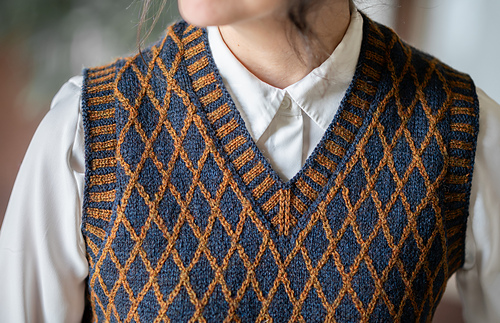
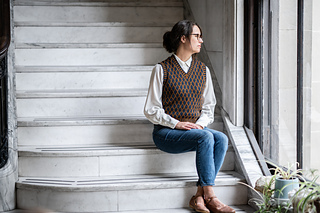
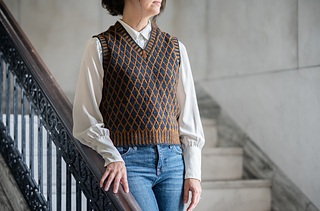
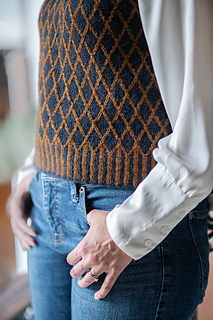
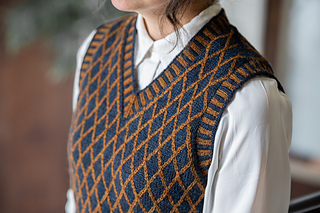
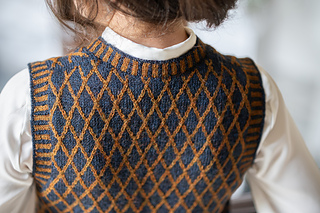
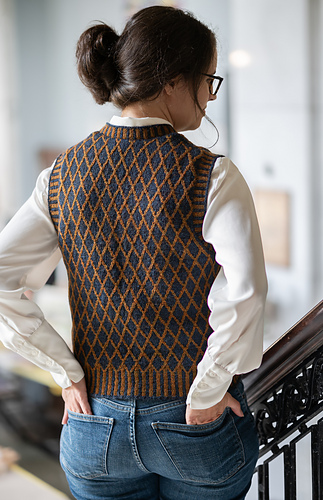
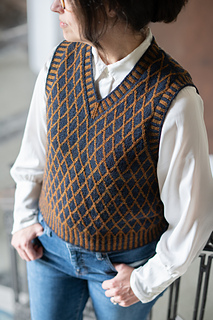
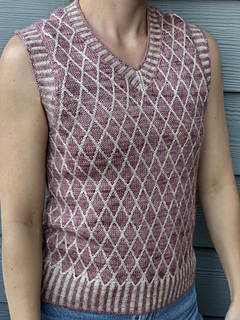
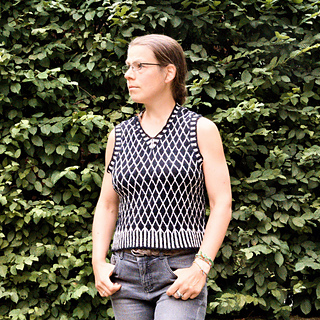
De La Fere Vest

Kits from John Arbon may be found here. Use code DeLaFereVestLove on John Arbon’s site for 10% off the yarn or kits through 10/16
Use code DLFVest for 10% off the pattern through 10/10.
Purchase includes a Low Vision file with enlarged charts, no columns or italics, and 22pt sans serif font.
About the De La Fere Vest:
This vest is worked in the round from the bottom up, beginning with 2x2 corrugated ribbing. The body is worked first, then, at the underarm, steek panels are cast on at each armhole, and front and back panels are shaped, working in the round. Instructions are also included to knit the front and back panels flat. At the neck depth, an additional steek panel is cast on and v-neck shaping begins. On the next to last row, short rows are worked across the front and back to shape the neck. Shoulders are grafted together, then the garment is blocked and steeked. Armhole and neck edges are picked up and knit in corrugated ribbing to match the hem. An Alteration Guide may be found at the end of the pattern.
Level: Advanced/Ambitious Intermediate
Sizing:
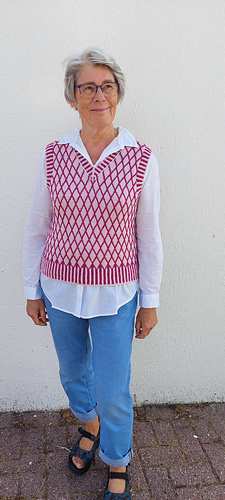
Sizes: 1 (2, 3, 4) {5, 6, 7} [8, 9, 10] (11, 12, 13) {14, 15, 16} to fit 30” to 60” full busts with 2” (5 cm) - 3.75” (9.5 cm) positive ease. (Graded to women’s sizing standards.) Model is wearing Size 3 with 2.25” (6 cm) of positive ease in the full bust.
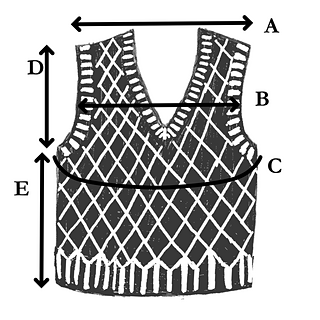
Finished Garment Measurements (See schematic photo at left):
Cross Back (A): 13.25 (13.5, 14.25, 14.5) {14.75, 15.25, 15.25} [15.5, 15.5, 15.75] (16.25, 16.75, 17) {17.5, 17.75, 18.5} inches, or 33.5 (34, 36, 37) {37.5, 39, 39} [39.5, 39.5, 40] (41.5, 42, 43) {44.5, 45, 47} centimeters.
Cross Front (B): 12.75 (12.75, 13.25, 14.25) {14.25, 14.5, 14.75} [15.5, 16.25, 16.75] (16.75, 17.5, 17.75) {18, 18.5, 18.75} inches, or 32 (32, 33.5, 36) {36, 37, 37.5} [39.5, 41.5, 42] (42, 44.5, 45) {45.5, 47, 47.5} centimeters.
Full Bust Circumference (C): 32 (34.25, 36.25, 38.5) {40.5, 42.75, 44.75} [47, 48, 50.25] (53.25, 55.5, 57.5) {59.75, 60.75, 63} inches, or 81.5 (86.5, 92, 97.5) {103, 108.5, 114} [119, 122, 127.5] (135.5, 141, 146.5) {151.5, 154.5, 160} centimeters.
Armhole Depth (D): 7 (7.25, 7.5, 7.5) {7.75, 8, 8.25} [8.5, 8.5, 8.75] (8.75, 9, 9.25) {9.25, 9.5, 9.75} inches, or 18 (18.5, 19, 19) {20, 20.5, 21} [21.5, 21.5, 22.5] (22.5, 23, 23.5) {23.5, 24.5, 25} centimeters. Includes armhole edging.
Body Length (E): 13.25 (13, 12.75, 12.75) {12.5, 12.5, 12.25} [12.25, 12.25, 12] (12, 11.75, 11.75) {11.75, 11.5, 11.25} inches, or 33.5 (33, 32.5, 32.5) {31.5, 31.5, 31} [31, 31, 30.5] (30.5, 30, 30) {30, 29, 28.5} centimeters.
Includes armhole edging.
Gauge:
Diamond Motif: 30 sts and 31 rows in 4” (10.2cm)
Materials:
Yarn:
Main Color: 525 (550, 580, 610) {635, 665, 690} [725, 740, 765] (800, 830, 860) {885, 900, 925} yards or 480 (505, 530, 555) {580, 610, 630} [665, 675, 700] (735, 760, 790) {815, 825, 850} meters.
Contrast Color: 330 (350, 370, 385) {405, 425, 440} [465, 470, 490] (515, 530, 550) {570, 575, 595} yards or 305 (320, 340, 355) {370, 390, 400} [425, 430, 445] (470, 485, 505) {520, 530, 545} meters.
Recommended Yarn: John Arbon Textiles Harvest Hues 4-ply, 33% Bluefaced Leicester, 33% Falklands Merino, and 33% Zwartbles with 435 yards (400 meters) in 100g.
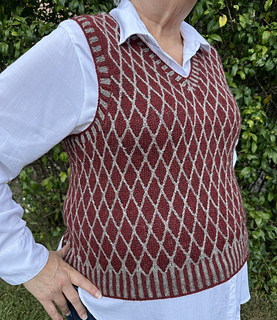
4-ply sample utilizes Blackthorn (MC) and Russet (CC).
Suggested Needles:
Motif: US 4 (3.5mm) circular knitting needles, or size needed for correct gauge.
Ribbing: US 2 (2.75mm), or two sizes smaller than size used for diamond motif in the round.
Circular needle lengths should correspond to the chest, upper body, armhole, and neck of your garment. Double pointed needles or Magic Loop may also be used.
Notions:
¨ Cable needle
¨ Tapestry needle
¨ 6 Stitch markers, at least 5 should be removeable.
¨ Steeking supplies. Ribbon, thread, scissors, etc; these will vary based on your preferred steeking method.
¨ Blocking wires and combs (optional)


 Ravelry download


 Cancel
762 projects
stashed 921 times
 stashed