

 Cata Rubke's Ravelry Store
 Pattern


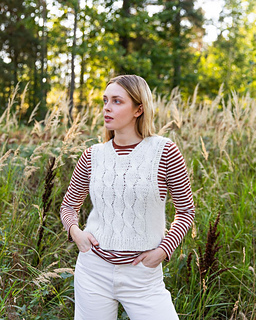


Diana

Named after the Roman goddess of hunting, the moon and nature, this vest embodies timeless elegance with a classic round neckline and a relaxed, comfortable fit that drapes beautifully over any outfit. The cables add a touch of vintage charm.
SIZES
1 (2, 3, 4, 5) (6, 7, 8, 9)
Recommended ease: 4–7.25” / 10–18 cm of positive ease.
FINISHED MEASUREMENTS
Chest Circumference: 34.5 (38.5, 42.5, 46.5, 50.5) (54.5, 58.5, 62.5, 66.5)“ / 87.5 (97.5, 107.5, 117.5, 127.5) (137.5, 147.5, 157.5, 167.5) cm.
Shoulder to Shoulder (with Rib): 15.25 (15.25, 15.25, 16.5, 16.5) (17.25, 17.25, 18.5, 18.5)“ / 38 (38, 38, 41, 41) (43, 43, 46, 46) cm.
Armhole Depth (with Rib): 10.5 (11, 11.5, 11.5, 12) (12.5, 13, 13, 13.5)“ / 26.5 (27.5, 29, 29, 30) (31.5, 32.5, 32.5, 34) cm.
Length from Underarm (with Armhole Rib for Back Hem): 10 (10, 10, 10, 10) (10, 10, 10, 10)“ / 25 (25, 25, 25, 25) (25, 25, 25, 25) cm.
Total Length: 20.5 (21, 21.5, 21.5, 22) (22.5, 23, 23, 23.5)“ / 51.5 (52.5, 54, 54, 55) (56.5, 57.5, 57.5, 59) cm.
MATERIALS
Yarn: Yarn A: 3 (3, 3, 4, 4) (4, 5, 5, 5) balls of Organic Soft Merino by Kaos Yarn (100% merino, 246 yds / 225 m – 50 g), colourway 1001 Natural.
Or approx. 595 (665, 740, 805, 875) (945, 1010, 1085, 1150) yds / 545 (610, 675, 735, 800) (865, 925, 990, 1050) m of fingering-weight yarn.
Alternative yarn suggestions are for example Knitting for Olive Merino, Sandnes Garn Sunday and Isager Tvinni.
Yarn B: 2 (2, 2, 2, 2) (2, 3, 3, 3) balls of Organic Brushed Alpaca by Kaos Yarn (100% brushed alpaca, 246 yds / 225 m – 25 g), colourway 2001 Natural.
Or approx. 300 (335, 365, 405, 435) (470, 510, 540, 575) yds / 275 (305, 335, 370, 400) (430, 465, 495, 525) m of lace-weight alpaca yarn. Alternative yarn suggestions are for example Knitting for Olive Soft Silk Mohair, Sandnes Garn Tynn Silk Mohair and Isager Soft Fine.
Needles: US 11 / 8 mm 32–40” / 80–100 cm circular needles (for body), US 10.5 / 6.5 mm 32–40” / 80–100 cm and 8” / 20 cm circular needles (for rib).
Notions: Stitch markers, stitch holders or waste yarn.
GAUGE
12 sts x 16 rows to 4” / 10 cm on US 11 / 8 mm needles (with 2 strands of A and 1 strand of B held tog) in St St, after blocking.
12 sts x 16 rows to 4” / 10 cm on US 11 / 8 mm needles (with 2 strands of A and 1 strand of B held tog) in Cable patt, after blocking.
14 sts x 22 rows to 4” / 10 cm on US 10.5 / 6.5 mm needles (with 2 strands of A and 2 strands of B held tog) in 1 x 1 rib, after blocking.
CONSTRUCTION
This vest is knitted from top down. The upper back is worked first, followed by both fronts. The front is designed to be slightly longer than the back before the join, so that the cast-on edge falls slightly towards the back. The front and back are joined together at the underarms and the vest is worked in the round until the split hem. Stitches are then picked up around the neckline and armholes and ribs are worked to finish off the vest.
ESPAÑOL
Inspirado en la diosa romana de la caza, la luna y la naturaleza —símbolo de fuerza y protección—, este chaleco combina elegancia atemporal con un diseño clásico de escote redondo y un calce relajado que cae con suavidad sobre cualquier look. Pensado para llevarse con holgura positiva, ofrece una silueta favorecedora en distintos tipos de cuerpo. Las trenzas aportan un sutil aire vintage, convirtiéndolo en una prenda versátil y esencial en cualquier clóset.
TALLAS
1 (2, 3, 4, 5) (6, 7, 8, 9)
Holgura Sugerida: 10–18 cm / 4–7.25 “ de holgura positiva.
MEDIDAS FINALES
Circunferencia de Pecho: 87.5 (97.5, 107.5, 117.5, 127.5) (137.5, 147.5, 157.5, 167.5) cm / 34.5 (38.5, 42.5, 46.5, 50.5) (54.5, 58.5, 62.5, 66.5) “.
Hombro a Hombro (con elástico): 38 (38, 38, 41, 41) (43, 43, 46, 46) cm / 15.25 (15.25, 15.25, 16.5, 16.5) (17.25, 17.25, 18.5, 18.5) “.
Profundidad de Sisa (con elástico): 26.5 (27.5, 29, 29, 30) (31.5, 32.5, 32.5, 34) cm / 10.5 (11, 11.5, 11.5, 12) (12.5, 13, 13, 13.5) “.
Largo desde la sisa (Incluyendo elásticos): 25 (25, 25, 25, 25) (25, 25, 25, 25) cm / 10 (10, 10, 10, 10) (10, 10, 10, 10) “.
Largo Total: 51.5 (52.5, 54, 54, 55) (56.5, 57.5, 57.5, 59) cm / 20.5 (21, 21.5, 21.5, 22) (22.5, 23, 23, 23.5) “.
MATERIALES
Hilado: Hilado A: 3 (3, 3, 4, 4) (4, 5, 5, 5) ovillos de Kaos Yarn Organic Soft Merino (100% lana merino, 246 yds / 225 m – 50 g), color 1001 Natural.
O aprox 545 (610, 675, 735, 800) (865, 925, 990, 1050) m / 595 (665, 740, 805, 875) (945, 1010, 1085, 1150) yds de hilado grosor fingering.
Sugerencias alternativas de hilado incluyen, por ejemplo, Knitting for Olive Merino, Sandnes Garn Sunday, Isager Tvinni o Rosários 4 Merino Land.
Hilado B: 2 (2, 2, 2, 2) (2, 3, 3, 3) ovillos de Kaos Yarn Organic Brushed Alpaca (100% brushed alpaca, 246 yds / 225 m – 25 g), color 2001 Natural.
O aprox 275 (305, 335, 370, 400) (430, 465, 495, 525) m / 300 (335, 365, 405, 435) (470, 510, 540, 575) yds de hilado grosor lace. Sugerencias alternativas de hilado incluyen, por ejemplo, Knitting for Olive Soft Silk Mohair, Sandnes Garn Tynn Silk Mohair, Isager Soft Fine o Rosários 4 Aurora.
Agujas Sugeridas: agujas circulares de 8 mm (US 11) 80–100 cm (32–40 “) de largo (para el cuerpo), agujas circulares de 6.5 mm (US 10.5) 80–100 cm (32–40 “) y 20 cm (8”) de largo (para el elástico).
Otros Materiales: aguja auxiliar, cable sujeta puntos o hilado de desecho, marcadores de punto.
MUESTRA DE TENSIÓN
12 pts x 16 filas = 10 cm / 4” en punto jersey, con palillos de 8 mm (US 11), con 2 hebras del hilado A y 1 hebra del hilado B tejidas juntas, después de bloquear.
12 pts x 16 filas = 10 cm / 4” en patrón de trenzas, con palillos de 8 mm (US 11), utilizando 2 hebras del hilado A y 1 hebra del hilado B tejidas juntas, después de bloquear.
14 pts x 22 filas = 10 cm / 4” en elástico 1 x 1, con palillos de 6,5 mm (US 10.5), utilizando 2 hebras del hilado A y 2 hebras del hilado B tejidas juntas, después de bloquear.
CONSTRUCCIÓN
Este slipover se teje de arriba hacia abajo. Primero se trabaja la parte superior de la espalda y luego ambos delanteros. El delantero está diseñado para ser ligeramente más largo que la espalda antes de unir las piezas, de modo que el borde de montaje (CO) se incline sutilmente hacia la espalda. El delantero y la espalda se unen a la altura de las sisas y el slipover se continúa tejiendo en circular hasta la abertura lateral del borde inferior. Luego se levantan puntos alrededor del escote y de las sisas, y se tejen los elásticos para finalizar la prel finala. En el delantero se trabaja un patrón de trenzas, mientras que la espalda se teje en punto jersey.


 Ravelry download


 Cancel
1464 projects
stashed 1047 times
 stashed
1505 projects
stashed 1350 times