

 Mirjam Molenbeek's Ravelry Store
 Pattern


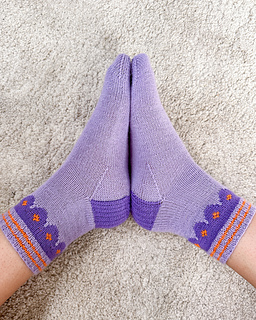
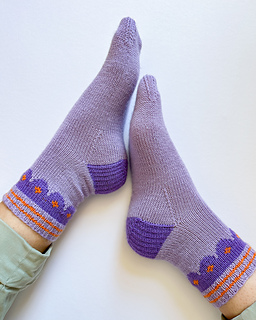
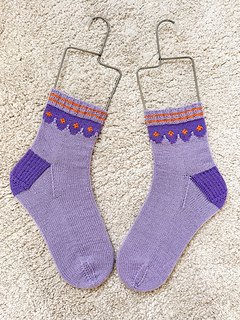
Dune Flower Socks

For years, I have been wandering through the Westduinpark (the dune area between Scheveningen and Kijkduin; the Beach part of The Hague) every Sunday morning for a few hours. Every season has its charm, and I find it magical to see the flora and fauna in this area change weekly.
The area is particularly special in June: a huge number of dune plants are blooming then, and it is an oasis of colour thanks to the flowers growing on the plants! From roses to viper’s bugloss: it is all equally beautiful.
This sock pattern is inspired by all these beautiful flowers.
Sign up to my newsletter Join my mailing list and be the first to know about new pattern releases, exclusive discounts and other news: https://www.mirjammolenbeek.nl/patterns/
Notes:
- This pattern is for a top-down (partially) colourwork sock, with a heel flap and gusset, knit using the magic loop method of knitting in the round.
- Pattern contains written instructions as well as a chart for the colourwork part.
- New to sock knitting and/or reading an English knitting pattern? Please check out my online knitting courses, where I teach you step-by-step how to navigate through an English pattern and how to knit top down socks (Dutch only): https://www.mirjammolenbeek.nl/cursussen/
Notes on knitting the colourwork part of the socks (and getting the tension right):
- Use a 23cm circular needle for the colourwork part if you find carrying the floats difficult at the turning point of the magic loop.
- For the colourwork part of the sock I advise to use a larger needle, since it will knit up tighter than the stockinette part. Go up 0.5 or 0.75 mm. Don’t go up more than 0.75 mm, because more will make the colourwork too loose.
- Be sure the stitches on your right needle are not scrunched up, to prevent tight floats while carrying the yarns at the back of your work.
- Catch your floats when the distance between one colour and the other is more than 4 or 5 stitches. This video tutorial shows you how to catch your floats, while remaining a stretchy fabric: https://youtu.be/cD6c8kyyXsc (Dutch) https://youtu.be/lxEfmy3N5IQ (English)
Yarn:
Sample used:
- Filcolana Arwetta, colours 267 (as colour A) + 365 (as colour B) + 268 (as colour C), 50 grams (210 metres), 80% superwash wool, 20% nylon.
Any fingering weight sock yarn will do. The largest size will use up more yarn than the smaller sizes. 100 grams total is enough yarn for knitting the socks in the largest size (size large, European shoe size 49): appr. 55 grams (A) + 10 grams (B) + 35 grams (C).
Make sure the contrast in colours is high enough to make the colourwork stand out. A little trick to check if your contrast is high enough: lay out your yarns and take a black and white picture. When you see different shades of grey: your contrast is high enough. If you are not seeing any difference between yarns, the contrast is too low.
Needles:
- 2.25 mm and 2.75 mm (or size needed to obtain gauge), 80 or 100 cm circular needle for knitting magic loop.
Or use your preferred method of knitting colourwork in the round. I prefer knitting the colourwork part on a 23 cm circular needle (largest size), since it’s easier to carry your floats.
Notions:
- 2 stitch markers (closed, matching your needle size)
- opening stitch markers / progress keepers when you want to keep track of your rounds
- tapestry needle for weaving in your ends
- wool wash for washing & blocking
- sock blockers for blocking (optional)
- sock ruler (optional)
Gauge:
32 sts x 48 rnds in stockinette stitch (knit in the round, washed & blocked) = 10 cm.
Sizes:
Pattern is written for: kids (small, medium, large).
European shoe size: 27-32 (33-37, 38-42, 43-49).
Foot circumference: 16-19 (20-22, 23-25, 26-28) cm.
The sizes are based on the foot circumference, not the actual size of the sock. Measure foot circumference of the ball of your foot.
YouTube vlog
I am showing these socks in my knitting vlog on YouTube: https://youtu.be/deYFvzCXu3k?si=OuZOqzkENJTCTzG1 (in Dutch, use subtitles or auto dubbing in the language of your choice, if needed.


 Ravelry download


 Cancel
62445 projects
stashed 33770 times
 stashed