

 Moreca knit's Ravelry Store
 Pattern

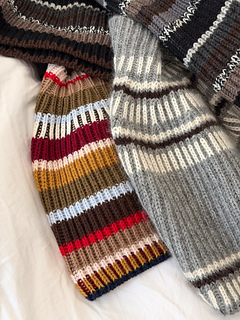
Flow Capelet


·Examples of knitted projects can be found on Instagram under the hashtag #flowcapelet_mck @morecaknit
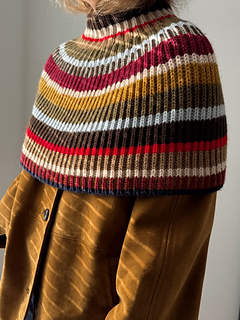
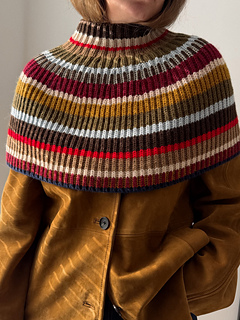
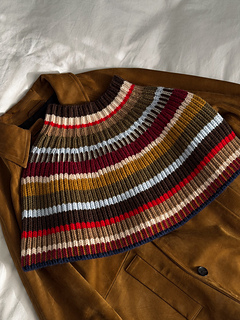
·Flow Capelet (bright multicolored striped version) is knitted with Peruvian by Filcolana in size 3.
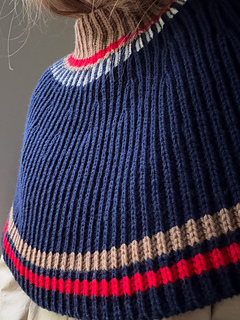
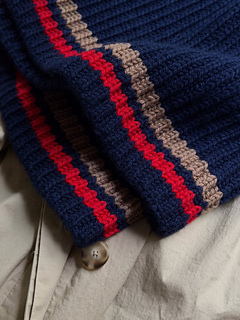
·Flow Capelet (blue version) is knitted with Peruvian by Filcolana in size 3.
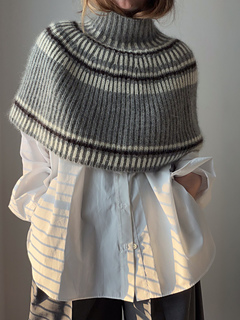
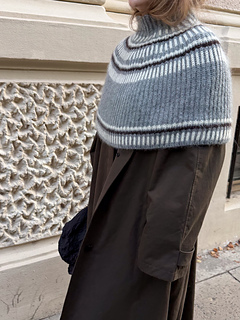
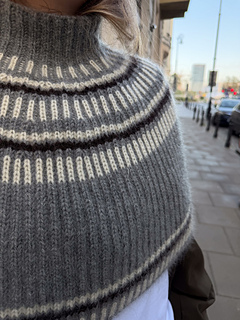
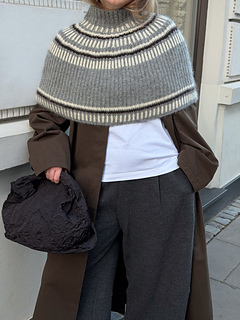
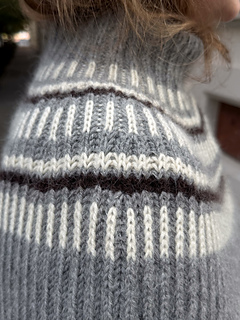
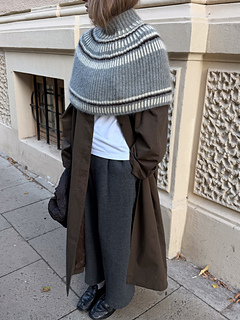
·Flow Capelet (grey version) is knitted with Pura Lana and Kid Seta by Gepard Garn in size 4.
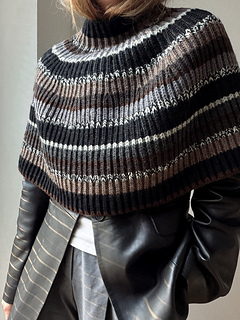
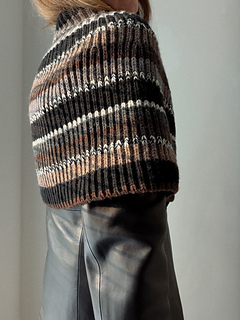
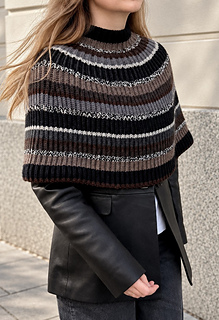
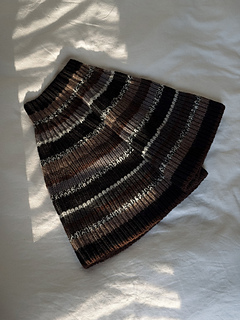
·Flow Capelet (dark multicolored striped version) is knitted with Peruvian by Filcolana in size 5.
DESIGN OVERVIEW
The Flow Capelet is worked seamlessly from the top down in brioche stitch. It begins with the neck, which is worked in the round. After the neck is complete, the yoke is shaped with increases. The increases are worked in several sections, with plain brioche rounds between each increase round to gradually shape the capelet. Once all increases are complete, the capelet is worked straight in brioche stitch without further shaping until the required length is reached. Finally, the stitches are bound off.
SIZE GUIDE
The sizes 1 (2) 3 (4) 5 (6) 7 (8) correspond approximately to standard sizes 3XS–2XS (XS) S–M (L) XL (2XL) 3XL–4XL (5XL) and are designed to fit a bust circumference of 70–80 (80–85) 85–95 (95–100) 100–110 (110–120) 120–140 (140–150) cm 27½–31½ (31½–33½) 33½–37½ (37½–39½) 39½–43¼ (43¼–47¼) 47¼–55 (55–59) in.
The Flow Capelet is designed with approximately 15 cm 6 in of positive ease. However, this does not mean that the capelet will fit loosely or stand away from the body. Brioche stitch behaves similarly to ribbing: it is highly elastic and naturally stretches and contracts to fit the body.
To choose your size, put on the outerwear or other clothing you plan to wear under the capelet. With your arms resting close to your body, measure around the widest part of your upper body, including your arms.
Add approximately 15 cm 6 in to this measurement. Compare the result with the finished measurements given for the capelet and choose the size with the circumference closest to your calculated measurement.
For example, if your body-and-arms circumference over your outerwear measures approx. 115–120 cm 45¼–47¼ in, add 15 cm 6 in for a target finished circumference of approx. 130–135 cm 51¼–53¼ in. The closest finished circumference is 136 cm 53½ in, so you should knit size 3.
MEASUREMENTS
Circumference: 120 (128) 136 (144) 152 (160) 168 (176) cm 47¼ (50½) 53½ (56¾) 59¾ (63) 66¼ (69¼) in
Total length (incl. neck): 33 (34) 35 (37) 39 (41) 43 (45) cm 13 (13½) 13¾ (14½) 15¼ (16¼) 17 (17¾) in
Note that the finished measurements can only be achieved if you maintain the correct gauge throughout the project.
GAUGE
15 sts × 52 rnds = 10 × 10 cm 4 × 4 in in brioche stitch on 3.5 mm US 4 needles.
Note: In brioche stitch, 2 worked rnds form 1 visible brioche rnd. Accordingly, 52 worked rnds correspond to 26 visible knit sts when counting on the fabric.
Swatches are measured after washing and blocking. Adjust needle size as needed to match gauge.
SUGGESTED NEEDLES
3.5 mm US 4 circular needles 40 cm 16 in and 80 or 100 cm 32 or 40 in.
SUGGESTED YARN
250 (250) 300 (300) 350 (400) 450 (500) g Peruvian by Filcolana (50 g = 100 m 109 yds).
Alternative yarn:
You can use almost any yarn or combination of yarns for this design, worked as a single strand or with 2 or 3 strands held together. The most important thing is that your yarn or yarn combination allows you to match the pattern gauge. As a general guide, look for a final yarn thickness close to Aran weight, typically giving approx. 18–20 sts per 10 cm 4 in in stockinette. The recommended yarn has approx. 100 m 109 yds per 50 g, which can also be used as a general reference. However, yarns with a similar meterage can behave very differently depending on fiber, construction, twist and density, so meterage alone should not be used to determine a suitable substitute. You may use one thicker yarn or combine 2 or 3 finer yarns held together. The individual strands do not need to have the same fiber content, meterage or yarn weight. What matters is that the final combination creates a fabric of a similar thickness and allows you to achieve the required gauge. Always make a gauge swatch and wash and block it before choosing your final needle size and yarn combination.
NOTIONS
Stitch markers, tapestry needle.
DIFFICULTY
EXPERIENCED BEGINNER ★★☆☆☆
You can read more about the difficulty levels here.
TECHNIQUES USED
ITALIAN CAST-ON (video available)
DOUBLE KNITTING
BRIOCHE STITCH ROUND (video available)
KNITTING IN THE ROUND
DOUBLE INCREASES IN BRIOCHE STITCH (video available)
ITALIAN BIND-OFF (video available)
COPYRIGHT & LICENSE
This pattern is for personal use by one user. Sharing the pattern file or readable excerpts (including charts, text, or photos) isn’t allowed. You may post photos or videos of your knitting process and finished garments online. It’s fine if the pattern is briefly visible on paper or on a screen, as long as the content isn’t readable. Finished garments: You may sell handmade finished garments in small quantities, if the maker owns their own copy of the pattern. When selling, credit Moreca Knit as the designer and include the pattern name. No mass production or third-party manufacturing.


 Ravelry download


 Cancel
12857 projects
stashed 6385 times
 stashed