

 Ronja Marlene's Ravelry Store
 Pattern

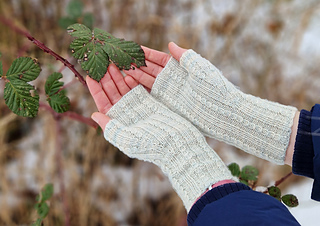
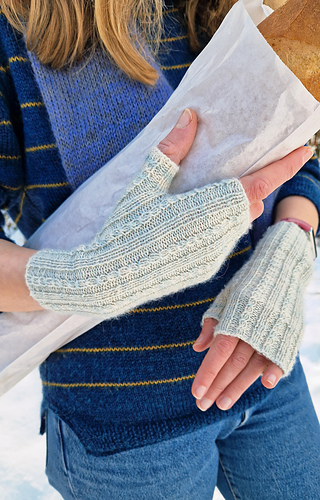
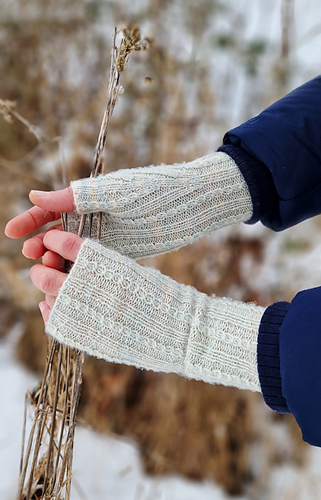

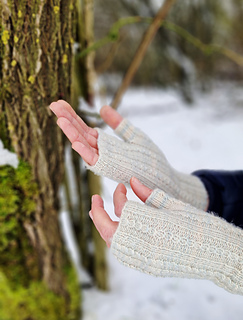
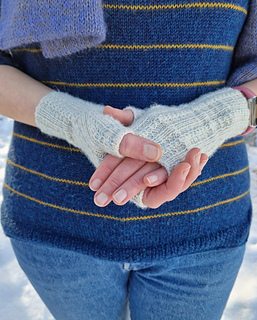
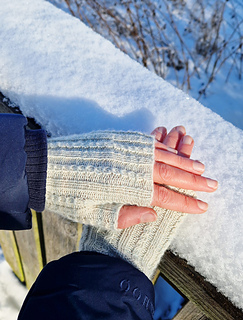
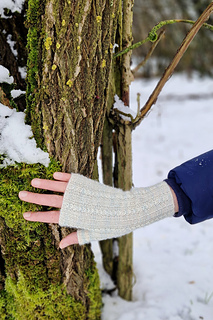
Frozen Falls
Reminiscent of frozen waterfalls, this design captures the sometimes powerful and straight, sometimes playful nature of falling water. No matter if you love your hiking trips or prefer cosying up with a page-turner - these mittens will keep your hands warm during all adventures.
________
This is a free pattern which has not been testknitted. I wrote the instructions very carefully and checked multiple times. However, if you find any errors or have problems understandig the instructions, please contact me.
Difficulty
This pattern is suitable for experienced beginners. Every round is explained.
Construction
The Frozen Falls fingerless mitts are worked from cuff to fingers. After working the cuff, you increase for the thumb gusset. You then put the thumb sts on hold. After completing the palm part, you work the thumb.
Sizes
The mitts are designed with negative ease to snugly fit a hand circumference of 15-18 (18-21) cm / 6-7 (7-8) in, measured over the widest point of the palm at the knuckles (without thumb).
Yarn
Approx. 32 (37) g / 130 (150) m / 142 (165) yds of a fingering weight yarn.
The yarn used in the sample is a hand-dyed Baby Alpaca yarn from Vildspire. Most fingering weight yarns that are mainly made of animal fibres should work for this pattern.
This pattern is also perfect for stash-busting your leftover sock yarns.
Gauge
Unstretched: 22 sts x 22 rds = 2 x 2 in / 5 x 5 cm in cable rib stitch after blocking
Stretched: 14 sts x 22 rds = 2 x 2 in / 5 x 5 cm in cable rib stitch after blocking
Needles and notions
2,25 - 2,5 mm (US 1 - 1½) circular needle for Magic Loop
The needle size should be seen as a suggestion for swatching.
The pattern is written for the Magic Loop technique. If you prefer, you can use dpns instead.
Tapestry needle
Note on cabling: You might want to use a cable needle if you are not comfortable cabling without one. However, as you only have to work 1x1 cables, this might be an opportunity to learn cabling without a cable needle. There are different ways to do so with tutorials available online for each. The method I used is described in the pattern.
Techniques
Knitting and purling
Increases
Backwards loop cast on
Picking up sts
Knitting sts together
1x1 cables


 Ravelry download

 Buy it now
 Add to cart
 Cancel
 stashed