

 52 Weeks of Sweaters | 52 x Villapaidat
 Pattern

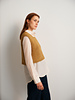
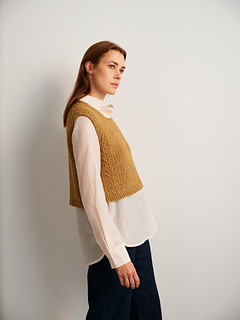
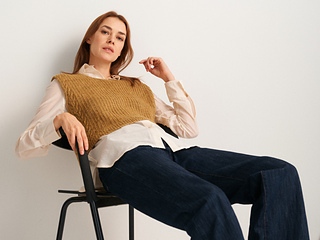

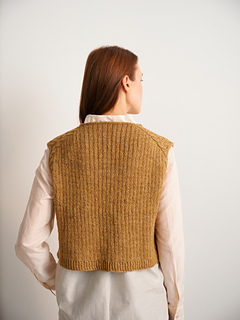
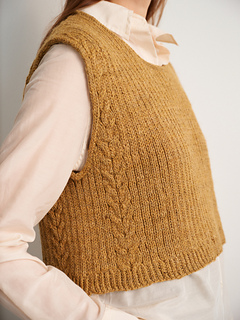
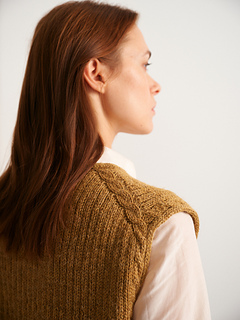

Harvest
Harvest is inspired by grain fields and the pathways between them. It features 2 x 1 rib and cable pillars that look like grain spikes. The shade is reminiscent of evening sun on the fields.
SIZES
1 (2, 3, 4, 5) (6, 7, 8, 9)
Recommended ease: 4–4.75” / 10–12 cm of positive ease.
FINISHED MEASUREMENTS
Chest Circumference: 39.25 (41.25, 44.25, 46.25, 50.25) (57.25, 60.25, 63.25, 66.25)“ / 98.5 (104, 111, 116, 126) (144, 151, 159, 166) cm.
Armhole Depth: 8.5 (9.75, 10.75, 11.5, 12.5) (12.75, 13.75, 15, 16)“ / 22 (24.5, 27, 29, 32) (32.5, 35, 37.5, 40.5) cm.
Neck Depth: 4.5 (4.5, 4.5, 4.75, 4.75) (4.75, 4.75, 4.75, 5)“ / 11 (11, 11, 11.5, 11.5) (11.5, 11.5, 11.5, 12.5) cm.
Length from Underarm to Hem: 7.75” / 20 cm.
MATERIALS
Yarn: 3 (3, 3, 4, 4) (4, 4, 4, 5) skeins of Linnen DK by Woollentwine Fibers (75% Bluefaced Leicester wool, 25% linen, 252 yds / 230 m – 100 g), in the colourway Harvest.
Or approx. 667 (694, 744, 793, 831) (869, 897, 973, 1017) yds / 610 (635, 680, 725, 760) (795, 820, 890, 930) m of DK-weight yarn.
Alternative yarn suggestions are for example Undine DK by Ritual Dyes or Duo by Sandnes Garn.
Needles: US 2.5 / 3 mm 16” / 40 cm circular needles (for neckline and armhole i-cord edges) and 32”–40” / 80–100 cm (for hem ribbing), US 4 / 3.5 mm 32”–40” / 80–100 cm circular needles (for body).
Notions: US 4 / 3.5 mm cable needle (if needed), 8 removable stitch markers, stitch holders or waste yarn.
GAUGE
24 sts x 30 rnds to 4” / 10 cm on US 4 / 3.5 mm needles in Textured Patt in the rnd, after blocking.
11 sts x 30 rnds to 1.5” / 4 cm x 4” / 10 cm on US 4 / 3.5 mm needles in Cable Patt in the rnd, after blocking.
CONSTRUCTION
This slipover is worked top-down, beginning flat from the back neck in 2 x 1 Rib and cables while shaping the shoulders using European shoulder shaping. Increases are worked toward the underarm to form the armholes, after which the back stitches are placed on hold and the front panels are worked, including neckline shaping. The fronts are then joined and worked flat to the underarm before being joined with the back to work the body in the round, continuing the textured pattern and cables. The slipover is finished with a twisted-rib hem and i-cord edges at the neckline and armholes.


26 projects
stashed 31 times
 stashed