

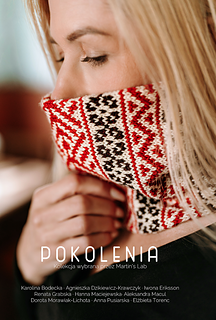
 Pokolenia
 Pattern



Kurpie
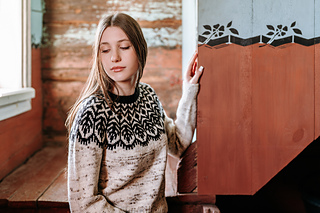
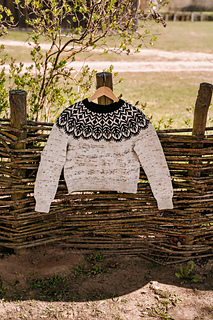
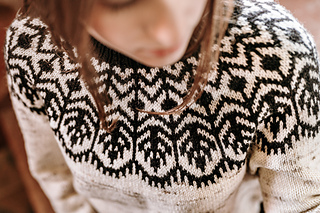
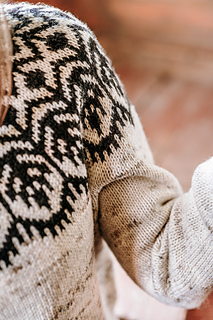
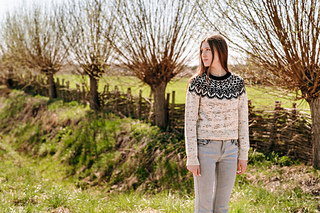
Kurpie is a beautiful and original pullover with a circular colorwork yoke. The unique pattern on the yoke was inspired by Kurpie stars, a traditional form of Polish folk art. These stars are lace, circular cutouts created from multiple layers of paper. They are a symbol of the region and still adorn the interiors of homes in Kurpie today.
Sizes:
The pattern has been designed for 8 sizes to fit the chest circumference of
81–137.5 cm/32.5–55”. Choose your size according to the positive ease of 2.5–10 cm/ 1–4”.
1, 2, 3 (4, 5, 6) 7, 8 with the following finish project chest circumference:
91, 96, 101 (108, 115, 122) 129, 136 cm/36.5, 38.5, 40.5 (43.25, 46, 48.75) 51.5, 54.5”
with the possibility of increasing the chest circumference in the modified version:
95, 100, 105 (112, 119, 126) 133, 140 cm/38, 40, 42 (44.75, 47.5, 50.5) 53.25, 56”.
The sample sweater is made in a standard size 2. The sweater is worn with a 5 cm/2” positive ease. The model is 172 cm/5.7 ft tall.
Basic or modified?
The pattern includes instructions for making the sweater in the basic version – for women with smaller busts – and in the modified version – for women with fuller busts. The modified version accommodates the special needs of women with larger busts by increasing the width of the sweater at the front, at bust level, and adding horizontal bust darts.
Yarn:
4, 4, 4 (4, 5, 5) 5, 6 skeins of Highland DK by Martin’s Lab.
(100% Peruvian wool, 225 m/246 yds in 100 g)
Color: Apple Flower (MC)
1, 1, 1 (1, 1, 1) 1, 2 skein of Highland DK by Martin’s Lab.
( 100% Peruvian wool, 225 m/246 yds in 100 g)
Color: Pitch Black (CC)
Note: yarn consumption was estimated based on a sample piece – the given skein number includes 10% reserve.
Needles:
US 6/4 mm or size needed to obtain gauge, circular or double-pointed needles
US 7/4.5 mm or 0.5 mm bigger than for the swatch, circular needles
US 5/3.75 mm or 0.25 mm smaller than for the swatch, circular needles
US 4/3.5 mm or 0.5 mm smaller than for the swatch, circular or double-pointed needles
Note: Adjust the length of the cable to the sweater’s circumference and your own preferences.
Notions:
stitch markers (regular and removable), row counter (optionally), spare yarn or crochet hook for a provisional cast-on, stitch holders, a tapestry needle, scissors, measuring tape.
Gauge:
20 sts and 28 rnds = 10 cm/4” in stockinette stitch in the round on US 6/4 mm needles after blocking
20 sts and 23 rnds = 10 cm/4” in colorwork pattern in the round on US 7/4.5 mm needles after blocking
To save your time, check your gauge.
Change the needle size to obtain the right measurements.
How to work the colorwork pattern:
The colorwork pattern is worked with at least two colors at a time. For the best result, CC should be the dominant one and held below the background color (to the left of the MC). When looking at the work from the WS, the CC should run below the MC. The pattern was designed to minimize the need to catch floats. The only moment when the floats were caught was if the pattern consisted of 9 sts (rows 37 and 40 of Chart B). While working these long passes, I swapped the dominant color with the background one for one stitch. For example, the pattern color, worked as the dominant color in row 37, became the background color for one stitch. Remember to maintain the same yarn tension throughout the yoke.
Increasing in the colorwork pattern:
The stitches in the colorwork section are increased in two steps. In one round, a standard yarn over or a reverse yarn over is made, and in the next round, the yarn overs are worked as twisted stitches to avoid a hole in their place. The standard yarn over is worked through the back loop, as a twisted purl stitch (similarly to m1L). The reverse yarn over is worked through the front loop, as a twisted knit stitch (similarly to m1R).
Construction:
The pullover is worked seamlessly in the round from the top down. It begins with the neckline pleat, after which the yoke is worked in the round, first in a colorwork pattern, then in stockinette stitch. Finally, the yoke is shaped using Japanese short rows. The work is divided into the body and sleeves, which are worked in stockinette stitch in the round and finished with a 1x1 rib stitch.


0 projects
stashed 2 times
 stashed