
 Nordic Chic: Knitting a Modern Wardrobe
 Pattern


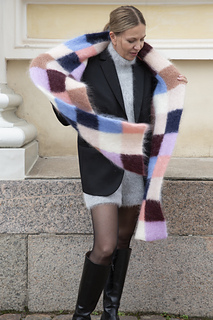
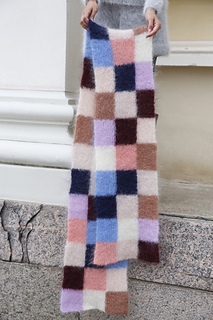
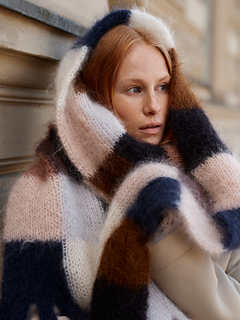
Matilda Shawl
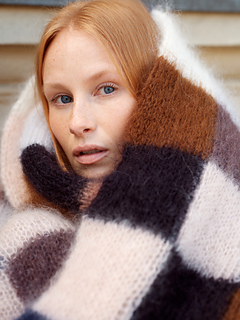
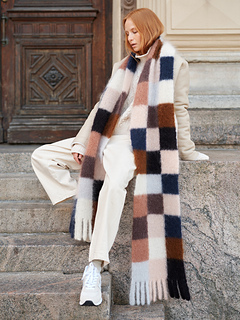
Sizes: One size ● Level: 3/5 ● A plaid scarf is a familiar sight in Stockholm. In understated tones, it blends seamlessly into an outfit; in vibrant shades, it becomes the ultimate centrepiece.
The Matilda scarf is highly addictive to knit, as it is based on a randomized colour rotation. Each nine-colour grid is constructed to be entirely unique, with a total of seven different grids repeating throughout the scarf. While working on it, you’ll constantly find yourself wanting to knit “just one more row of squares” to see how the next section will turn out.
If you’re worried about having a million yarn ends to weave in, don’t be. They are woven in as you knit, meaning a completely finished scarf will fly straight off your needles.
*
FINISHED MEASUREMENTS
Length: 210 cm / 84”.
Width: 30 cm / 12”.
MATERIALS
Yarn
Sandnes Garn Chunky Ballerina Mohair (77% mohair, 18% wool, 5% polyamide, 135 m / 148 yds – 50 g).
450 g (9 balls) in 9 colours.
Or 1215 m / 1330 yds of chunky mohair yarn in 9 colours (135 m / 150 yds per colour).
Colours in the shawl with fringes: Arctic Ice (5811), Ballet Tutu (3409), Black (1099), Mocha Mousse (3342), Natur (2012), Monks Robe (2573), Mork Sjokolade (3880), Marsipan (2321), Dyp Marine (5581).
Colours in the shawl without fringes: Blossom (4213), Ballet Tutu (3509), Dyp Burgunder (4372), Provence Blue (5824), Natur (1012), Lilac (5023), Dyp Marine (558), Marsipan (2321), Mocha Mousse (3342).
Other yarn options include Fonty Ombelle, Sunday Knitting Club Halo and Novita Hehku.
Needles
4.5 mm (US 7)
Circular needle for the shawl.
3.5 mm (US 4)
DPNs for the fringes.
Notions
Tapestry needle, waste yarn (for Provisional Cast-On).
GAUGE
12 sts x 16 rows = 10 cm / 4” in Stockinette St worked in double knitting with 4.5 mm (US 7) needle.
CONSTRUCTION
The shawl is worked in double knitting and intarsia from end to end. Each row incorporates three colours at a time.“. Intarsia is easier than stranded colourwork, as there are no floats — each yarn waits in its own place for its turn. Double knitting is also much more straightforward than you might think: it simply means that every other stitch is knitted and every other stitch is slipped. If desired, you can add fringes to the shawl, which are also worked in double knitting.


1000 projects
stashed 486 times
 stashed