

 Fumiko Segawa's Ravelry Store
 Pattern


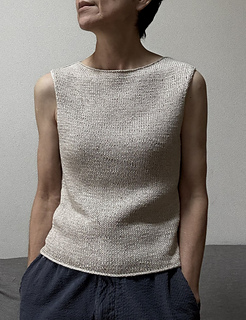
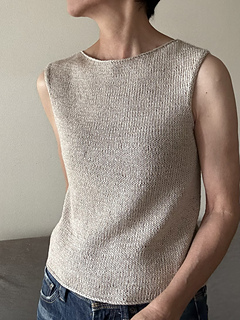
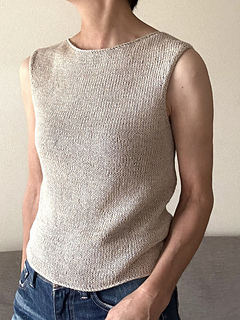
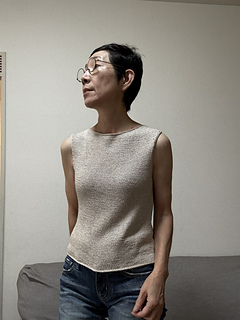
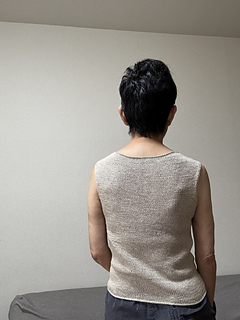
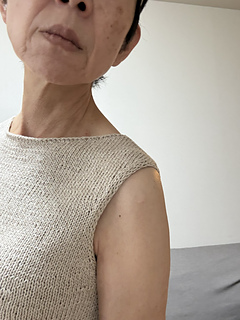
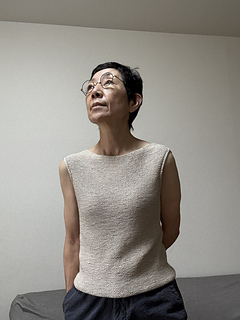
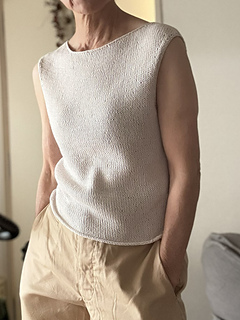
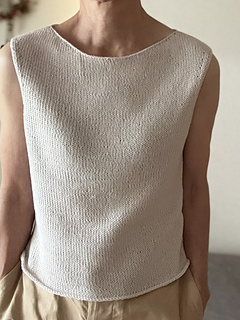
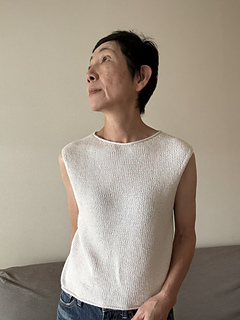
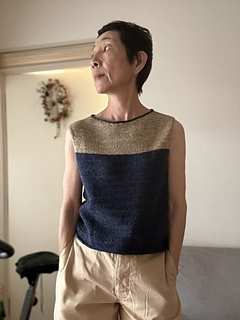
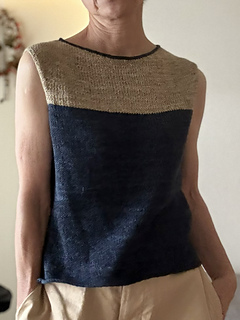
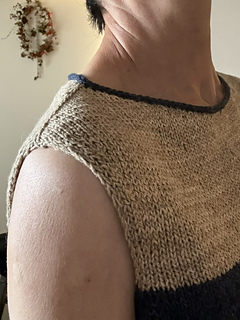
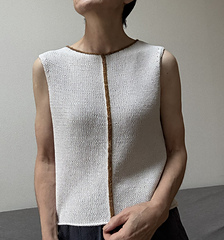
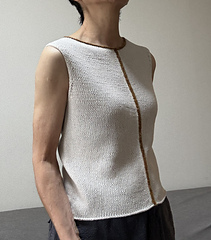
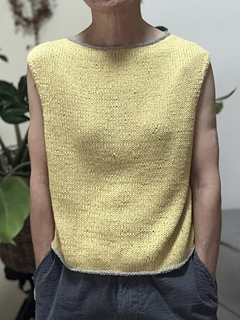
Nejibana top

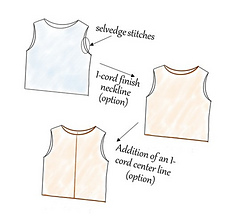
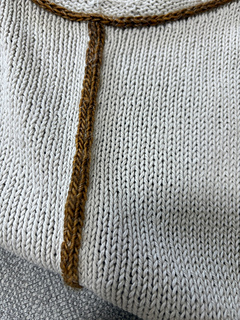
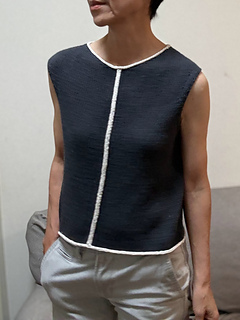
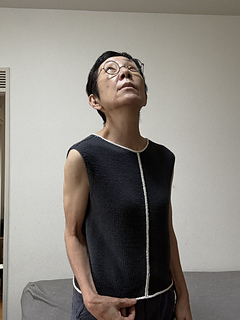
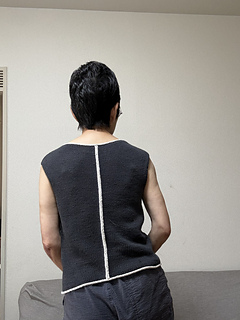
The Nejibana Top is a basic summer top designed for everyday wear. Its defining features are a slightly wider neckline and shoulders and armholes that gently curve to follow the body’s contours. After shaping the neckline with short-row knitting, you’ll knit a few rows in the round. Next, the front and back are separated and worked separately back and forth; the curve of the armholes differs between the front and back panels. Afterward, the front and back are joined, and the body is worked in the round. The hem is bound off with a narrow I-cord, and, if desired, decorative I-cord stitching can be added to the neckline and the center of the body. Since this is a top-down knit, please try it on and adjust it to your preferred length. The top can be worn snug with approx. 0~2.5 cm (0~1”) positive ease. If you’d like a looser fit, please knit a piece that’s 1 to 2 sizes up.
CONSTRUCTION
NEJIBANA TOP is worked from the top-down. Starting with the neck shaping using German short-rows knitting to create a wide curved neckline. Then, divide the garment into a front and a back piece, and knit each piece separately back and forth, while shaping the armholes by decreasing and increasing stitches to create a curve that follows the body’s contours. Once the front and back yokes are finished, join them and knit the body in the round until the hem. Finish the hem with a 2-stitch I-cord bind-off. If desired, add decorative I-cord stitching along the neckline and down the center of the body. Three selvedge stitches along the armhole produces a beautiful finish.
SIZES
1(XXS), 2(XS), 3(S), 4(M), 5(L), 6(XL), 7(2XL), 8(XL)
The garment is intended to be worn with 2.5cm (1”) positive ease. If you prefer a looser fit, please choose the one or two size up.
Body circumference; 81, 85, 91, 99, 107, 117, 129,137 cm (32, 33.25, 36, 39.25, 42.5, 46.5,52, 54.5 inches)
Length; 44.5, 45.5, 47.5, 49.5, 49.5, 51.5, 52.5, 53.5 cm (17.5, 18, 18.5, 19.5, 19.5, 20.5, 21, 21.5 inches)
GAUGE
20 sts x 28 rows = 10 x 10 cm / 4 x 4” Stockinette stiches on main needle after blocking.
SUGGESTED NEEDLES
4 mm (US6) (depending on your knitting tension) (40 cm 16”, 60 cm 24” or longer one) for main and 3.5 mm (US4) (40 cm 16” circular needle or DPN for knitting the I-cord lines (OPTION) on the center of body (OPTION).
SUGGESTED YARN
SANDNES GARN TYNN LINE: 53% cotton/ 33% viscose/ 14% linen, 241 yds (220 m)/50 g
Note that two strands of yarn are held together throughout. If you’re knitting an I-cord along the neckline and down the center of the body, use yarn that is the same as—or slightly thinner than—the main yarn.
YARN REQUIRMENT
Body:
approx. 831(918, 984)(1050, 1126)(1257, 1389, 1498) yds/ 760(840, 900)(960, 1030)(1150, 1270 ,1370) m
(Total amount needed when knitting the entire piece using two strands of Tynn line)
I-cord knitting for neckline: approx. 6.5 yds/ (6 m)
I-cord knitting on the center of body: approx. 12 times the final length of the I-cord
MATERIALS
Stitch markers, waste yarn or stitch holder, tapestry needle.
SPECIAL TECHNIQUES
M1L, M1R, M1LP, M1RP, ssk, K2tog, K2togtbl, I-cord bind off, I-cord addition to the center of body, German short row knitting.
It includes illustrations that explain in detail how to perform these special techniques.
Nothing would make me happier than for you to love this as your go-to top every day this summer.


 Ravelry download


 Cancel
15754 projects
stashed 10078 times
 stashed