
 Aggie in Stitches
 Pattern


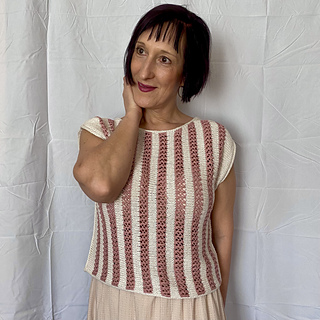
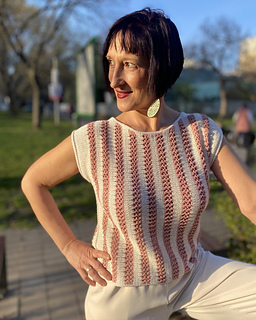
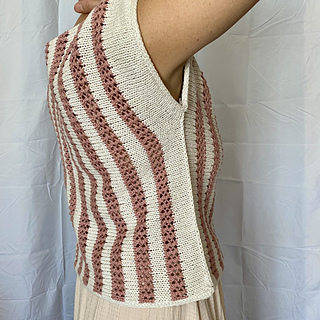
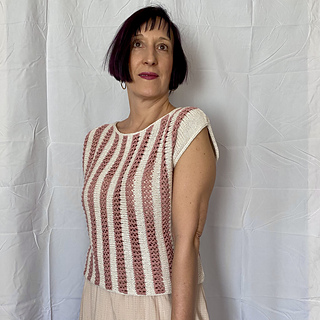
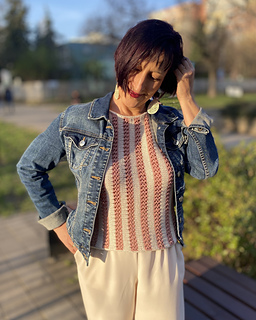
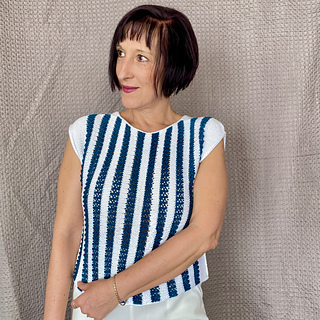
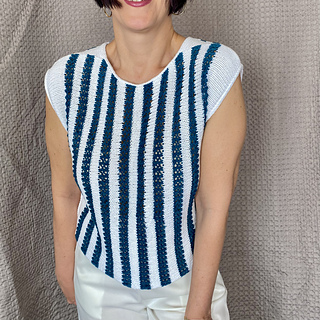
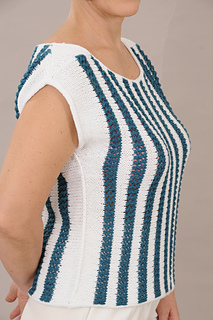
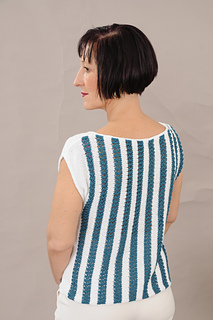
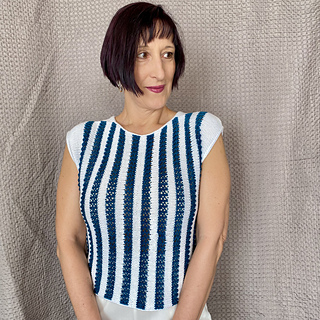
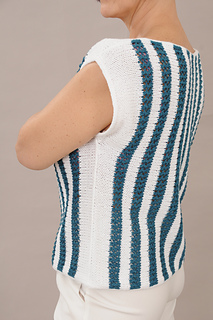
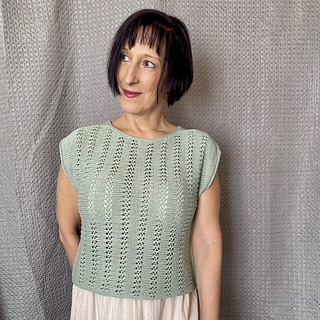
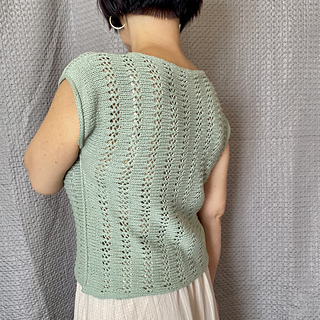
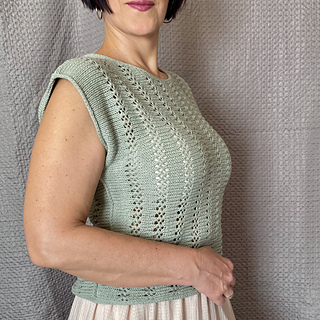
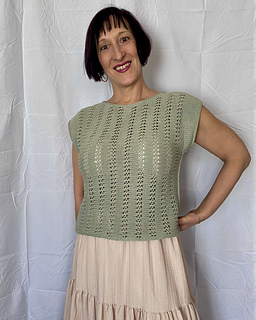
Pannika Top

The Pannika Top takes its name from my mother, Anna – “Anyu” to her children, and Pannika to those who know her. The name carries warmth, love, and the beauty of everyday moments, all woven into the heart of this design.
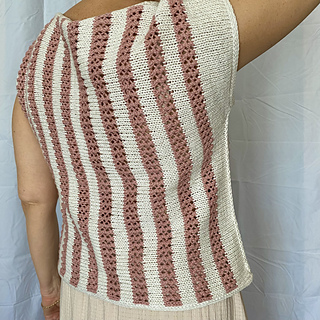
This lightweight, modern top features clean lines and a thoughtful construction, making it both engaging to knit and versatile to wear. Worked sideways, it creates elegant vertical stripes when using two colours – but it can just as beautifully be made in a single colour for a more minimal look.
CONSTRUCTION
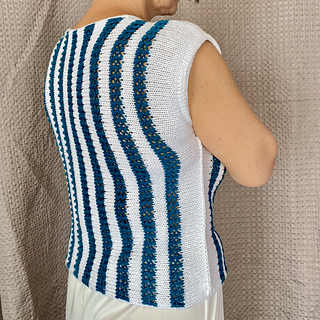
The Pannika Top is worked sideways using two colours to create vertical stripes throughout the garment.
The front and back panels are worked separately back and forth, with no seaming required. The shoulders are joined using purl grafting, while the sides are joined using the three-needle bind-off method.
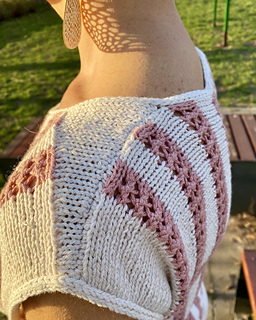
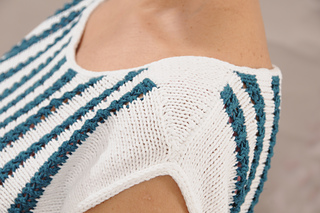
The piece begins with a provisional cast-on at the centre front. The left front panel is worked sideways, with neckline shaping created by increases. Once the desired length is reached – which determines the final width of the garment – the side stitches are placed on hold, while the armhole stitches are worked a few rows longer to form a subtle cap sleeve.
Stitches are then picked up from the provisional cast-on to work the right front panel, which mirrors the left. The back panels are worked in the same manner, without neckline shaping.
Shoulder shaping is created by picking up stitches along the front shoulders and working German short rows to form a triangular shoulder panel. The shaped front shoulders are then joined to the back shoulders using purl grafting.
The sides of the garment are joined using the three-needle bind-off method, creating a neat faux side seam detail on the right side.
Finally, stitches are picked up around the neckline, armholes, and hem, and all edges are finished with clean applied I-cord edging.
The pattern was tech-edited by Marie-Eve Wedge and test- knitted by a wonderful group of knitters.
Sizes 7 and 8 have not been test knitted. If you would like to knit one of these sizes, please contact me for a complimentary pattern copy in exchange for feedback on fit and overall sizing experience.
SIZING AND MEASUREMENTS
Sizes 1 (2; 3; 4) (5; 6; 7; 8) detailed below are designed to be worn with 0-10 cm / 0-4” positive ease.
The samples are shown in size 2, with 1 cm / 0.5” positive ease.
To fit bust: 71.5-81.5 (82-92; 92.5-102.5; 103.5-113.5) (114-124; 124.5-134.5; 135.5-145.5; 146-156) cm / 28.5-32.5 (32.75-36.75; 37-41; 41.5-45.5) (45.5-49.5; 49.75-53.75; 54.25-58.25; 58.5-62.5) inches.
Finished bust circumference: 81.5 (92; 102.5; 113.5) (124; 134.5; 145.5; 156) cm / 32.5 (36.75; 41; 45.5) (49.5; 53.75; 58.25; 62.5) inches.
Armhole depth: 21 (22; 23.5; 24.5) (25.5; 25.5; 26.5; 26.5) cm / 8.5 (8.75; 9.5; 9.75) (10.25; 10.25; 10.5; 10.5) inches.
Length of garment - easily adjustable: 50 (50; 51; 53) (53; 55.5; 56.5; 56.5) cm / 20 (20; 20.5; 21.25) (21.25; 22.25; 22.5; 22.5) inches.
Neck opening circumference: 54 (57; 60; 60) (62; 62; 65; 68) cm / 21.5 (22.75; 24; 24) (24.75; 24.75; 26; 27.25) inches.
YARN
The Pannika Top is designed to be worked at a DK-weight gauge.
For my white / petrol blue sample I used Drops Belle (50 g = 120 m / 131 yards; 53% cotton, 33% viscose, 14% linen), in shades 01 – white as main colour, and 17 – petrol as contrast colour.
For my off - white / dusty rose sample I used Sandnes Garn Line (50 g = 110 m / 120 yards; 53% cotton, 33% viscose, 14% linen), in shades 1015 as main colour, and 4033 as contrast colour.
For my single colour, light green sample, I used Knitting for Olive Pure Silk (50 g = 250m / 273 yards; 100% bourette silk), held double, in shade Dusty Artichoke.
You will need approximately:
Main colour: 300 (340; 385; 435) (480; 535; 585; 635) metres / 330 (370; 420; 475) (525; 585; 640; 695) yards;
Contrast colour: 185 (210; 235; 270) (295; 330; 360; 395) metres / 200 (230; 255; 295) (325; 360; 395; 430) yards;
of DK weight yarn, if using a single strand. If working with fingering weight yarn held double, double the meterage and yardage listed above..
GAUGE
18 stitches and 30 rows = 10 cm x 10 cm / 4” x 4” on 4 mm / US 6 needles in stitch pattern worked flat, after blocking.
Because this garment is worked sideways, row gauge is just as important as stitch gauge. Stitch gauge determines the length of the garment, while row gauge determines the width.
NEEDLES AND NOTIONS
- 4 mm / US 6 circular needles for the main fabric or needle size needed to reach gauge. You will need two pairs of the main needles and one double pointed needle in the same size, for the three-needle bind off.
- 3 mm / US 2.5 circular needles of 40 and 80 cm / 16” and 32” for the I-cord edges or needles 1 mm smaller than the main needles.
- 4 mm / US G-6 crochet hook for the provisional cast-on. The size of the crochet hook is not overly important, but it should be similar to the main needles.
- 4 removable stitch markers.
- 4 pieces of try-it-on tubing cords or waste yarn to place the side stitches on hold.
- Smooth sport or DK weight waste yarn for the provisional cast-on.
- Tapestry needle.
- Measuring tape.
TECHNIQUES
- Provisional cast-on
- Knitting flat
- Working lace - the pattern includes both charted and written instructions
- Right- and left leaning increases
- German short rows
- Picking up stitches
- Three-needle bind-off
- Purl grafting
- Applied I-cord edges


 Ravelry download


 Cancel
22070 projects
stashed 11608 times
 stashed
30836 projects
stashed 19904 times