

 Aggie in Stitches
 Pattern


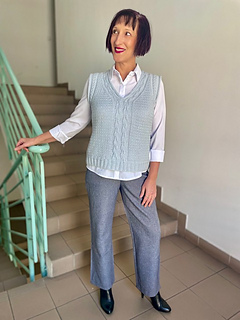

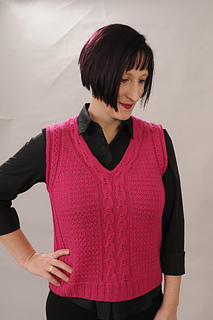
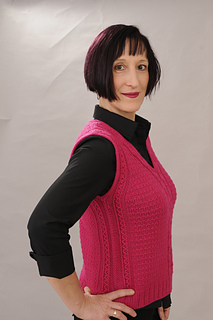
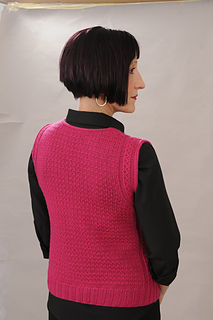

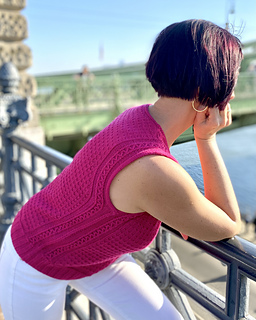
Eloria Slipover

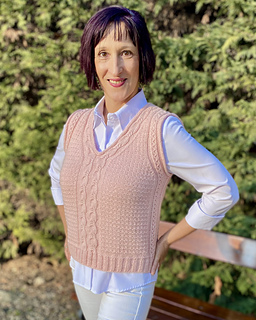
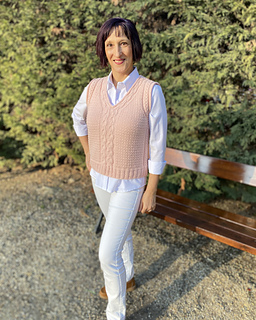
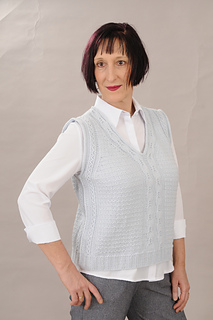
The Eloria Slipover is a refined, cable-focused layering piece with clean lines and thoughtful details.
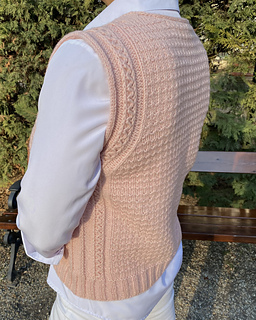
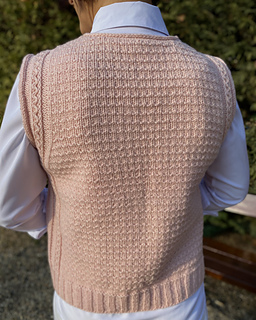
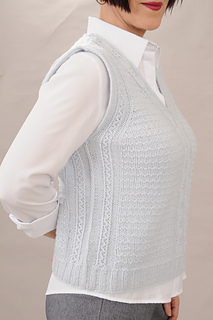
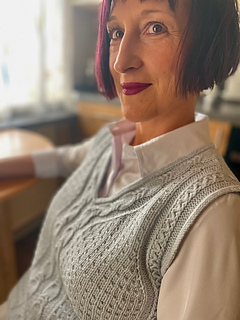
At the centre front, a striking quail cable panel follows the V-neckline and continues down the body once the neckline shaping is complete. Smaller zigzag-style cables run vertically along both sides of the garment, on the front and back, creating a balanced and elegant structure. The cables can be worked without a cable needle and the pattern is very easy to memorise.
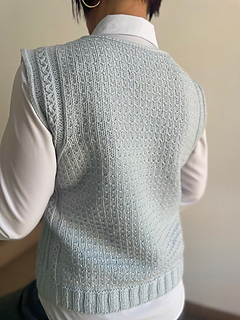
The spaces between the cables are worked in a subtle purl ridge textured pattern, adding depth without overwhelming the design. Below the armholes, a faux side seam marks the transition between the front and back, giving the slipover a tailored finish. The body is completed with a classic 2x2 rib hem, while the V-neckline and armholes are finished with a neat, applied I-cord.
The pattern was tech-edited by Marie-Eve Wedge and test- knitted by a wonderful group of knitters.
CONSTRUCTION
The slipover is worked seamlessly from the top down. The majority of the pattern is worked using charts, with a small number of sections explained through written instructions only.
The piece begins with the upper back, worked flat. German short rows are used to shape the back shoulders, followed by increases to form the underarm. These stitches are then placed on hold.
Stitches are then picked up along the cast-on edge to work the left front flat. German short rows shape the front shoulder, while increases form the V-neckline and later the underarm. The right front is worked in the same way.
The two fronts are then joined, continuing the underarm shaping.
Once the upper body is complete, the front and back are joined to work the lower body in the round. The body is finished with 2x2 ribbed hem. Finally, stitches are picked up around the V-neckline and armholes to work an I-cord edge for a clean, polished look.
SIZING AND MEASUREMENTS
Sizes 1 (2; 3; 4) (5; 6; 7; 8) detailed below are designed to be worn with 5-15 cm / 2-6” positive ease.
The sample is shown in size 2 with 7 cm / 2.75” positive ease.
To fit bust: 72-82 (83-93; 92-102; 102-112) (111-121; 121-131; 132-142; 142-152) cm / 28.75-32.75 (33.25-37.25; 36.75-40.75; 40.75-44.75) (44.5-48.5; 48.5-52.5; 52.75-56.75; 56.75-60.75) inches.
Finished bust circumference: 87 (98; 107; 117) (126; 136; 147; 157) cm / 34.75 (39.25; 42.75; 46.75) (50.5; 54.5; 58.75; 62.75) inches.
Back shoulder width: 36 (38.5; 40.5; 41.5) (41.5; 43; 45; 46) cm / 14.5 (15.5; 16.25; 16.5) (16.5; 17.25; 18; 18.5) inches.
V-neck depth: 18 (18.5; 19.5; 19.5) (20; 20; 20.5; 20.5) cm / 7.25 (7.5; 7.75; 7.75) (8; 8; 8.25; 8.25) inches.
Armhole depth: 19 (19.5; 21; 22.5) (23; 23.5; 24.5; 25) cm / 7.5 (7.75; 8.5; 9) (9.25; 9.5; 9.75; 10) inches.
Body length from underarm to hem: 31 (31.5; 30.5; 30) (29.5; 29.5; 30; 30) cm / 12.5 (12.5; 12.25; 12) (11.75; 11.75; 12; 12) inches.
Shoulder drop: 2.5 cm / 1 inch.
YARN
The Eloria Slipover is designed to be worked in worsted-weight yarn.
For my light blue sample, I used Knitting for Olive Heavy Merino (50 g = 125 m / 137 yards; 100% merino wool), in the Ice Blue shade.
For my light pink sample, I used Sandnes Garn Atlas (50 g = 108 m / 118 yards; 70% Norwegian wool, 30% merino wool), in the 4202 – Lotus shade.
For my fuchsia sample, I used Cascade 220® (100 g = 200 m / 220 yards; 100% Peruvian Highland Wool), in the 7802-Cerise shade.
You will need approximately: 515 (590; 635; 690) (735; 785; 875; 935) metres / 565 (645; 695; 755) (805; 860; 9555; 1025) yards of worsted-weight yarn.
GAUGE
18 stitches and 30 rows = 10 cm x 10 cm / 4” x 4” on 4.5 mm / US 7 needles in purl ridge textured pattern worked flat and in the round, after blocking.
NEEDLES AND NOTIONS
- 4.5 mm / US 7 circular needles of 80 or 100 cm / 32” or 40” for the main fabric.
- 3.5 mm / US 4 circular needles of 80 or 100 cm / 32” or 40” for the ribbing and 60 cm / 24” for the I-cord edges.
- Cable needle (optional)
- Stitch markers
- Try-it-on tubing or waste yarn to place stitches on hold
- Tapestry needle
- Measuring tape
TECHNIQUES
- Long tail cast-on
- Knitting flat, and in the round
- German short rows
- Picking up stitches
- Right- and left leaning increases
- Cables - can be worked without a cable needle
- Backwards loop cast-on
- Applied I-cord edges
- Reading charts


 Ravelry download


 Cancel
184922 projects
stashed 116671 times
 stashed
17734 projects
stashed 9689 times
1590 projects
stashed 821 times