I do not recommend this pattern for anyone who doesn’t want to make a lot of modifications.
PATTERN NOTES: The gauge on this pattern should be 5 sts =1” to work as written width wise for the std sizes listed, but will not likely reach the full width after blocking that is stated here.
Knit until the armhole is as deep as needed for the size, do not go by row counts. For instance, 120 rows after the armhole shaping, at 8 rows to the inch, results in an armhole depth of over 17”! And considering the row gauge is going to be looser than that at a stitch gauge of 5 sts an inch, then the armhole depth can be expected to be even longer.
That pretty much goes for all the row counts in this sweater… knit to the length needed.
Other notes: The decreases on the sleeve are way too quick and too many. Distribute decreases every 6th row, and don’t decrease the cuff nearly as much as written. Creates a really tight cuff, even in ribbing, if you follow what is written.
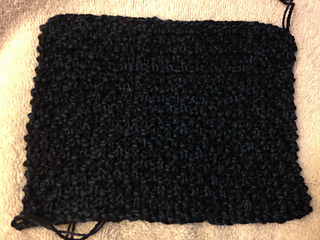
PROJECT NOTES: Client wanted these two yarns held double. After determining the yarn was inappropriate for our usual Isis pattern, we’ve decided to use this pattern instead. That is why there is a swatch photo of double moss stitch, which appears nowhere in this pattern.
FAILED Mods: st gauge 5.5 sts = 1 in., so removing 14 stitches overall: 8 in back and 3 in each front to maintain finished measurements. Removed a single purl stitch in the first and last repeats and the center purl segments in the center of in the back in other words, (M1, p4)x3 becomes (M1, p3)x3 and the two p3’s in the center of the back become p2’s.
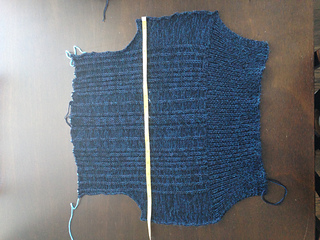
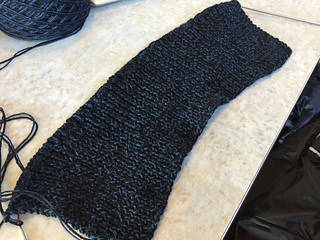
The picture of the back piece with the measuring tape stretched across is documentation of gauge-fail.
Update: FAILED AGAIN Mods. In this yarn, the slipped stitches ride on the surface of the purl side of the fabric and for the purposes of determining gauge, do not exist. In effect, that leaves this sweater with 23 fewer stitches in the smallest size. At 6 stitches to the inch, the back winds up measuring 15.5” across. That means at 5.5 stitches = 1 inch, I need 110 working stitches, + 23 decorative stitches to make the back 20 inches wide. Cast on 111 stitches for the ribbing, 22 stitches are increased for the back and 23 are used for decorative stitching.
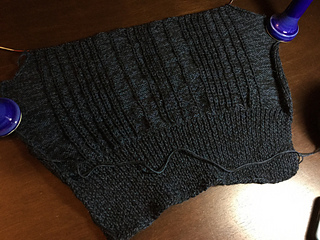
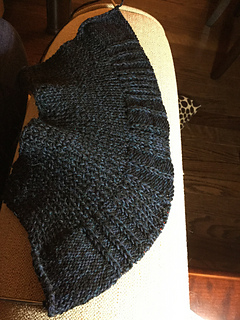
In the interest of documentation, I stopped ripping out the second back and took a photo of it laying on top of the first. I call this the Goldilocks photo: the first one was too small, and the second was too large. Here’s hoping the
third will be “just right.”
Update: Late March. I ended up taking a “mental health break” from this project until after we had finished moving and got mostly settled into a new house. Now that it’s Spring Break, and I’ve found the yarn for this in the boxes, it’s time to think about this again. Here’s what I’ve decided:
The pattern “works” at the gauge of 6 sts to the inch an counting all the stitches, including the slip stitches riding on the surface of the fabric. Except the slip stitches do not contribute to the width of the fabric. The next problem is getting a accurate measurement of gauge. Despite my modifications, the second back that I made ended up being 22” wide after blocking. Clearly my measurement of my gauge was very off. What happened?
I stopped knitting so damn tightly! Trying to get this yarn, held two strands together, to end up at 5.5 sts = 1” was reeking havoc on my hands. I relaxed into the pattern on my second attempt and ended up with a looser, drapier, much nicer fabric. But I didn’t stop and check my gauge as I knit. So… what do I have now? Another back that is a giant gauge swatch for me to reevaluate!
Recalculations: 110 working sts / 22” final width = 5 sts to the inch. Taking the measuring tape directly to the fabric and checking a dozen places confirms my gauge. Okay. Now I know, right?
I need 100 working stitches + 23 decorative slip stitches. 101 cast on stitches for the ribbing in the back + adding in 22 decorative slip stitches (the center stitch is “converted” to a decorative slip stitch after the ribbing) = 123 stitches in the final width.
Wish me luck!


 Beglitchery notebook


 projects
 handspun
 stash
stash queue
queue favorites
 friends
 groups & events
 needles & hooks
 library
 blog posts
 Project



 stashed