

 Aggie in Stitches
 Pattern


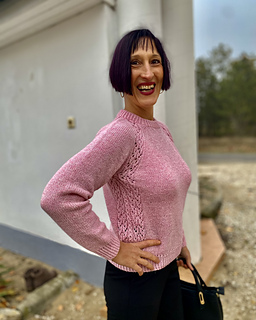
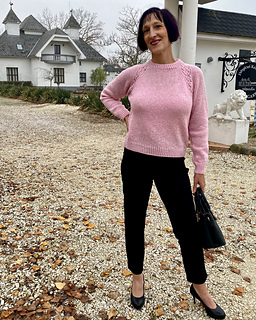
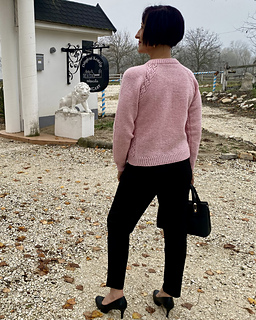
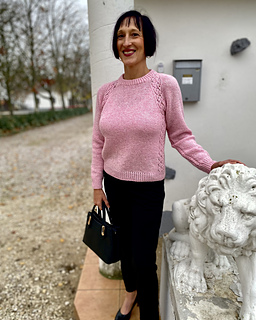
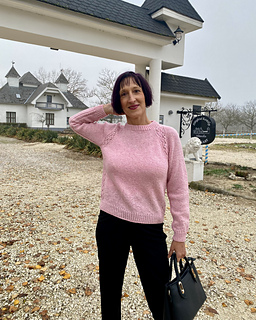
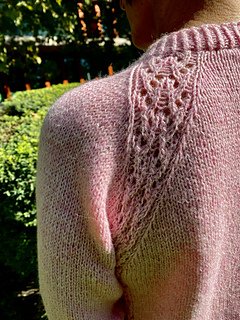

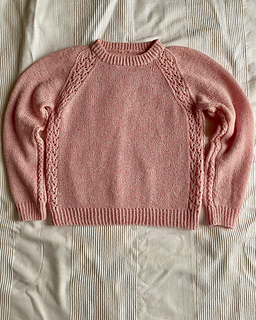
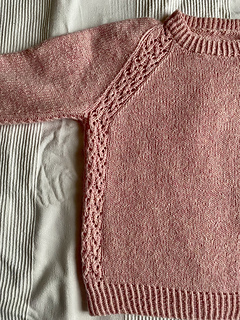
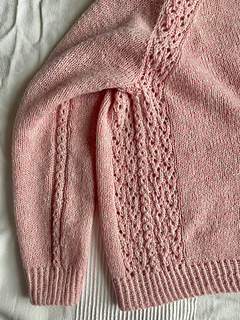
Blush Trails Sweater

Blush Trails is a modified raglan sweater worked seamlessly from the top down. The body is worked in stockinette stitch while delicate, decorative lace panels flow along the raglan lines, meet at the sides of the body and continue downward alongside a mock cable. The mock cable extends from the underarm along the inner side of each sleeve. Although the lace pattern looks intricate, the repeats are straightforward and easy to memorise.
CONSTRUCTION
You begin by casting on at the neckline and working back and forth with some increases to shape it. The work is then joined in the round to work the yoke, with different increase rates for the body and sleeves. The pattern includes a tick sheet for each size to make it easy to follow the increase sequence. The tick sheet also indicates the corresponding row number in the lace chart to be worked for each round of the yoke. Once the yoke is complete, you will separate the body and sleeves. The body is worked in the round in stockinette stich and continuing the lace pattern on both sides according to the chart, to your preferred length. The hem is finished in half-twisted rib.
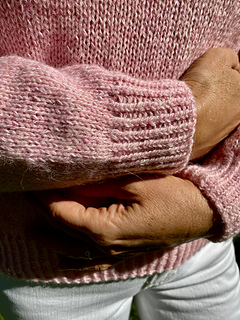
Stitches are then picked up around the neckline to work a folded collar, also in half-twisted rib. Finally, the sleeves are worked in the round with gradual decreases in stockinette stitch and following the mock cable chart along the inner side of the sleeves. The cuffs are finished in half-twisted rib.
SIZING AND MEASUREMENTS
Sizes 1 (2; 3; 4) (5; 6; 7; 8) detailed below are designed to be worn with 5-15 cm / 2-6” positive ease.
To fit bust: 70-80 (81-91; 90-100; 101-111) (111-121; 121-131; 130-140; 141-151) cm / 28-32 (32.5-36.5; 36-40; 40.5-44.5) (44.5-48.5; 48.5-52.5; 52-56; 56.5-60.5) inches.
Finished bust: 85 (96; 105; 116) (126; 136; 145; 156) cm / 34 (38.5; 42; 46.5) (50.5; 54.5; 58; 62.5) inches.
Yoke depth: 19 (20.5; 22; 22.5) (24; 24.5; 25.5; 27) cm/ 7.5 (8.25; 8.75; 9) (9.5; 9.75; 10.25; 10.75) inches.
Body length from underarm: 34 cm / 13.5 inches.
Upper sleeve circumference: 33.5 (35.5; 39.5; 41.5) (45; 48; 52; 56) cm / 13.5 (14.25; 15.75; 16.5) (18; 19.25; 20.75; 22.5) inches.
Sleeve length from underarm: 45 cm / 18 inches.
SAMPLE
The sample is shown in size 2 with 5 cm / 2” positive ease.
The sample was made using Holst Garn Supersoft (50 g = 287 m / 314 yards; 50% Merino wool, 50% Shetland wool), in shade 013 candy floss, held together with Holst Garn Titicaca (50 g = 400 m / 437 yards; 100% alpaca), in shade 23 nude.
YARN
A fingering weight and a lace weight yarn are held together throughout the whole project. Alternatively, a single strand of DK weight yarn can be used.
You will need approximately 4 (4; 5; 5) (5; 6; 6; 7) balls of Holst Garn Supersoft and 3 (3; 3; 4) (4; 4; 5; 5) balls of Holst Garn Titicaca.
If you want to use different yarn, you will need approximately 945 (1050; 1165; 1270) (1400; 1500; 1620; 1765) metres / 1035 (1150; 1275; 1390) (1530; 1640; 1770; 1930) yards of both a fingering and a lace weight yarn if working with 2 strands, or of a DK weight yarn if working with a single strand.
GAUGE
20 stitches and 28 rows = 10 cm x 10 cm / 4” x 4” in stockinette stitch worked in the round on 4 mm / US 6 needles after blocking or needle size needed to reach gauge.
NEEDLES
- 4 mm / US 6 circular needles of 40, 60, 80 and 100 cm / 16”, 24”, 32” and 40” for the main fabric.
- 3 mm / US 2.5 circular needles of 40 and 80 cm / 16” and 32” for the ribbing or needles 1 mm smaller than the main needles.
NOTIONS
- 8 stitch markers, including one distinct marker to indicate the beginning of round.
- 1 removable stitch marker to indicate the starting point of the collar.
- Try-it-on tubing or waste yarn to place stitches on hold.
- Tapestry needle.
- Measuring tape.
TECHNIQUES
- Long tail cast-on
- Working flat and in the round
- Right- and left-leaning lifted, twisted increases
- Working lace pattern from chart
- Backwards loop cast-on
- Half-twisted rib
- Picking up stitches
- Right- and left-leaning decreases
- Simultaneous join and bind-off
The pattern was tech-edited by Marie-Eve Wedge and test- knitted by a wonderful group of knitters.


 Ravelry download


 Cancel
39530 projects
stashed 45356 times
 stashed
7883 projects
stashed 6193 times