

 Mirjam Molenbeek's Ravelry Store
 Pattern


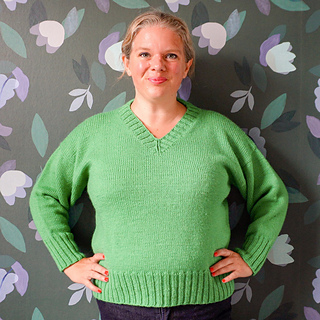
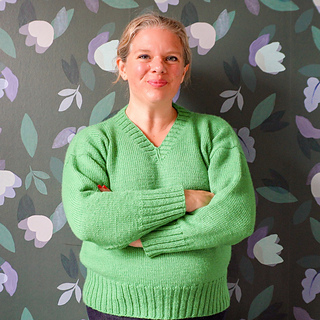
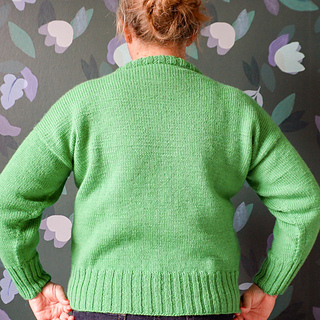
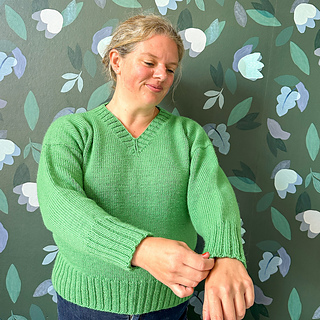
Cosy Reading Sweater

Notes:
- This pattern is for an oversized drop-shoulder sweater. The pattern starts with knitting flat. First the upper back is knit, then the stitches are put on hold. Stitches for the front shoulder along each side of the back neck are picked up, and then the shaping of the V-neck starts. After the front has been knit until the armhole depth, the back stitches will be put back on the needle and from this point the sweater is knit in the round until the required length is reached. After the body is finished, stitches are picked up around the armholes and the sleeves are knit until the desired length, decreasing to form tapered sleeves. A short sleeve option is also provided. At the end stitches are picked up to create the V-neckband.
- The pattern is written with the sleeves knitted in the round using the magic loop method. Of course, you can also knit these in the round using your preferred method; you will then need extra knitting needles, in addition to the prescribed needles.
- Video tutorials on how to knit a M1R, M1L M1rp and M1lp are provided in the pattern. Tutorials are in Dutch; use subtitles or auto dubbing in the language of your choice, if needed.
- New to knitting a top-down drop-shoulder sweater? Please check out my online course (Dutch only), where I teach you step-by-step how to knit this sweater: https://www.mirjammolenbeek.nl/cursussen/
Sign up to my newsletter Join my mailing list and be the first to know about new pattern releases, exclusive discounts and other news: https://www.mirjammolenbeek.nl/patterns/
Yarn:
Samples used:
Long sleeves:
10 (11, 12, 14, 14) (16, 17, 18, 19) skeins of Sandnes Peer Gynt, colour 2016, 50 grams (91 metres/100 yards), 100% Norwegian wool.
Or 890 (990, 1090, 1195, 1270) (1400, 1500, 1625, 1725) metres / 980 (1085, 1195, 1315, 1395) (1540, 1650, 1785, 1895) yards of DK weight yarn that gives you the right gauge.
Short sleeves:
8 (9, 10, 11, 12) (13, 14, 15, 16) skeins of Sandnes Peer Gynt, colour 4625, 50 grams (91 metres/100 yards), 100% Norwegian wool.
Or 700 (785, 880, 960, 1030) (1145, 1245, 1340, 1440) metres / 770 (865, 965, 1055, 1130) (1255, 1370, 1475, 1585) yards of DK weight yarn that gives you the right gauge.
The yarn amount includes enough yarn to knit up a 20 x 20 cm / 8 x 8 inch swatch.
Testers succesfully used the following yarns:
- Holst Garn Coast (held double)
- Rosários 4 Romaria
- West Wool Tandem
- Isager Yarn Jensen
- Mr. Cey Artist
- Bc Garn Bio Balance (held double)
- Svarta Faret Cecilia
- Istex Fjallalopi
- Garnstudio Drops Lima
Needles:
3.5 mm (US 4), 80 cm (32 inches) circular needles
4.0 mm (US 6), 80 cm (32 inches) circular needles or sizes needed to obtain gauge.
Keep in mind that your gauge might be different while knitting flat, compared to knitting in the round.
You may find it easier to use a longer needle when knitting sizes 4 to 9.
Notions:
- stitch markers (closed, matching your needle size)
- locking stitch markers
- knitting cord or waste yarn
- tapestry needle for weaving in your ends
- wool wash for washing & blocking
Gauge:
20 sts x 28 rows/rnds in stockinette stitch (on larger needle, washed & blocked) = 10 cm.
If you don’t meet the right rows/rnds gauge, make sure to follow the lengths given rather than the rows/rnds counts.
Sizes:
1 (2, 3, 4, 5) (6, 7, 8, 9).
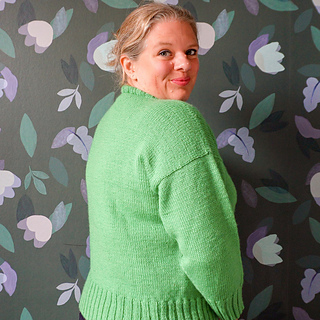
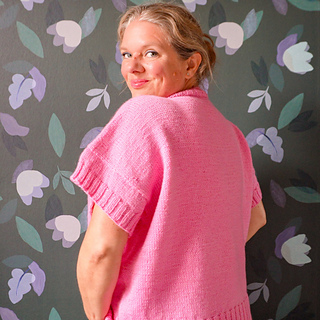
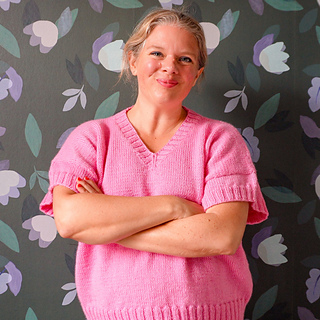
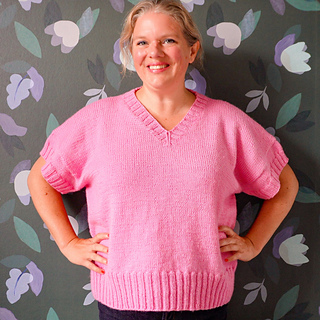
The model in the pictures is wearing size 4 (green version) with 7 cm of positive ease and size 5 (pink, short sleeve version) with 16 cm of positive ease.
Finished Measurements:
Chest circumference (A): 86 (96, 106, 116, 126) (138, 148, 158, 168) cm / 33¾ (37¾, 41¾, 45¾, 49½) (54¼, 58¼, 62¼, 66¼) inches.
Upper arm circumference (B): 43 (45, 48, 51, 53) (56, 58, 61, 63) cm / 17 (17¾, 19, 20, 20¾) (22, 22¾, 24, 24¾) inches.
Armhole depth (C): 21½ (23, 24½, 25½, 26½) (28, 29½, 30½, 31½) cm / 8½ (9, 9½, 10, 10½) (11, 11½, 12, 12¼) inches.
Body length from underarm to hem (D): 37 (37, 37, 36, 35) (35, 35, 35, 35) cm / 14¾ (14¾, 14¾, 14¼, 13¾) (13¾, 13¾, 13¾, 13¾) inches.
Sleeve length from underarm/ Long Sleeves (E): 41 (42, 42, 43½, 43½) (44½, 44½, 46, 46) cm / 16¼ (16¾, 16¾, 17¼, 17¼) (17¾, 17¾, 18¼, 18¼) inches.
Sleeve length from underarm/ Short Sleeves (F): 7½ cm / 3 inches for all sizes.
Total sweater length from back neck to hem (G): 58½ (60, 61½, 62, 61½) (63, 64½, 65½, 66½) cm / 23 (23¾, 24¼, 24½, 24¼) (24¾, 25¼, 26, 26¼) inches.
Designed to have 12 cm (4¾ inches) of positive ease for an oversized version. Use a bit more ease if you want the sweater to be really oversized, or a bit less if you want the sweater to be a bit more fitted.
So: measure your chest, add the amount of positive ease you would like and pick the size nearest to that ‘finished chest circumference’.
If your chest is way larger than your waist size, you might want to measure your upper chest instead of your full bust to prevent the sweater becoming too large overall. Or: start by knitting the size that measures your full bust (positive ease included) and when you start knitting the sweater in the round, knit 1 round while decreasing stitches to a size smaller.


 Ravelry download


 Cancel
29285 projects
stashed 17677 times
 stashed