

 Vanessa Casal's Ravelry Store
 Pattern


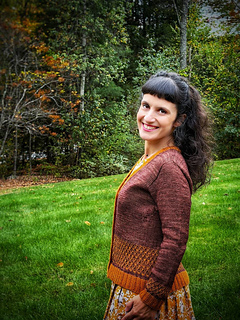
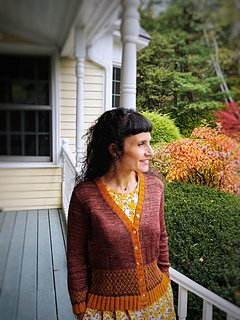
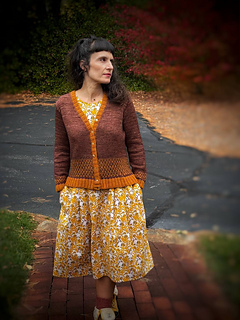
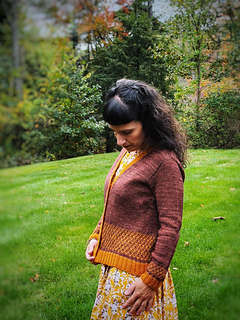

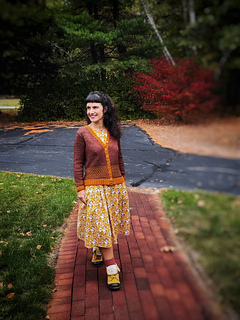

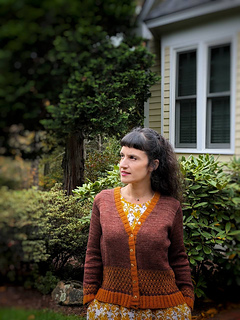
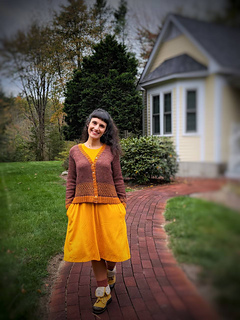
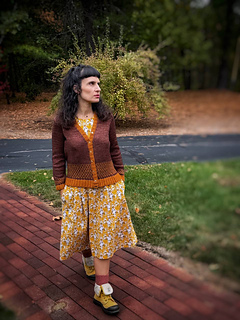
Dendera

English below
La chaqueta Dendera estará disponible el 14 de noviembre.
El templo de Dendera, en Egipto, es uno de sus complejos mejor conservados, gracias a que permaneció sepultado en la arena hasta que fue descubierto a mediados del s. XIX por August Mariette. Está dedicado a Hathor, diosa del amor y la fertilidad, y se caracteriza por las enormes cabezas de mujer que adornan los capiteles de su templo principal.
La chaqueta Dendera se inicia por la espalda, tejiendo después los dos delanteros para unir las tres piezas y tejer el cuerpo de la chaqueta, que termina con un trabajo de color inspirado en la Gran Sala Hipóstila del templo. Terminado el cuerpo, se levantan puntos para tejer las mangas, con el mismo detalle de color cerca del puño. Los elásticos de cuerpo, mangas y la banda de botones están tejidos en el color de contraste que, unido a una hebra de lace, le añade un toque de suavidad que hará de ésta tu prenda favorita.
Técnicas utilizadas
Para poder tejer la chaqueta Dendera tendrás que saber tejer del derecho, del revés, montar puntos y cerrarlos, levantar puntos, deslizar puntos, echar hebra, hacer aumentos y disminuciones, dejar puntos en espera y saber recuperarlos.
Agujas recomendadas
Agujas circulares de 3’5 mm (US 4) y de 3 mm (US 2 ½) con un cable de al menos 80 cm para trabajar el cuerpo, y cable de 20 cm para trabajar las mangas, o mini agujas de 23 cm o agujas de doble punta para tejer las mangas si esa es tu elección. Para trabajar el cuerpo puedes usar agujas rectas, al tratarse de un tejido de ida y vuelta. Puedes utilizar el número de aguja que necesites para ajustar tu tensión.
Lana
Lana grosor fingering (400 m/ 100 gr) en dos colores diferentes, y lana grosor lace, preferiblemente del mismo tono que el color de contraste.
Yo he utilizado lana grosor fingering, con una composición de 75% merino extrafino superwash y 25% seda mulberry (400m en 100gr) tanto para el color principal como para el color de contraste. En cuanto a la lana lace, su composición es 70% cashmere, 25% seda y 5% lana (300m en 25 gr). La cantidad de lana que utilizarás variará en función de la talla elegida y del largo del cuerpo y de las mangas, por lo que las siguientes cantidades son aproximadas:
CP (marrón): 2 (2, 3, 3, 4) (4, 4, 4, 5) madejas.
CC (mostaza): 1, (1, 1, 1, 1) (2, 2, 2, 2) madejas.
Lace (mostaza): 1 (1, 1, 1, 1) (1, 1, 1, 1) mini madeja de 20 gr.
Muestra de tensión
25pt x 34 vtas en un cuadrado de 10cm x 10cm, tejido en punto derecho, en plano y con agujas de 3’5 mm (US 4), después del bloqueo.
Tallas
1 (2, 3, 4, 5) (6, 7, 8, 9). La chaqueta Dendera está diseñada para tener una holgura positiva de entre 5 cm y 15 cm, lo que significa que medirá entre 5 cm y 15 cm más, en redondo, que lo que mide tu contorno de pecho.
Medidas finales
- Contorno de pecho: 79 (88, 97, 106, 116) (125, 135, 145, 156) cm.
- Contorno de brazo: 30 (33, 34’5, 37, 39) (41, 42’5, 46, 49) cm.
- Contorno de puño: 18 (19, 20, 20, 22) (22’5, 24, 25’5, 25’5) cm.
- Largo cuerpo (medido desde la sisa): 28 (31, 33, 36, 38) (41, 43, 45, 46) cm.
- Largo mangas (medidas desde la sisa): 43 (43, 43, 44’5, 44’5) (45’5, 45’5, 47, 47) cm.
English
The Dendera cardigan will be available on November, 14th.
The Dendera temple in Egypt is one of the best- preserved temple complexed, as it remained buried under the sand until it was discovered in the mid- 19th century by Auguste Mariette. Dedicated to Hathor, Goodness of love and fertility, it is notable for the large female heads that decorate the columns of its main hall.
The Dendera cardigan is knitted flat, beginning in the back; each front is then worked separately and later joined with the back to continue knitting the body back and forth. The body is finished with a section of mosaic knitting inspired by the Great Hypostyle Hall of the temple. Once the body is complete, you will pick up stitches along the armholes to knit the sleeves in the round, with the same detail that the body just before the cuffs. The ribbings and the button band are knitted in a contrast color, held together with a strand of lace weight yarn. This detail gives the cardigan a light, delicate finish that makes it a true wardobe favorite.
Skills required
Pattern requires the following skills: knit, purl, increasing and decreasing, cast on and bind off stitches, slip stitches, leave stitches on hold using scrap yarn or a stitch holder, and pick up stitches.
Recommended needle size
US 4 (3’5 mm) and US 2 ½ (3 mm) circular needles, either 80 cm long to knit the body, and either 20 cm long to knit the sleeves, or mini circular needles (23 cm) or DPN’s, if that is your choice. You can also use straight needles to knit the body, because it is knitted back and forth. You can use another needle size to obtain gauge.
Yarn
Fingering weight yarn (400m in 100 gr) in two different colors, and lace weight yarn in the same color as the CC.
I have used, for both main color and contrast color, fingering weight yarn, 75% extrafine merino superwash and 25% mulberry silk (400m in 100gr); as for the lace weight yarn, I have used a mix of 70% cashmere, 25% silk, and 5% wool (300m in 25 gr). The amount of yarn you will use will depends on the size chosen and the length of the body and the sleeves. Please note that the following amounts of yarn are approximate:
MC (brown): 2 (2, 3, 3, 4) (4, 4, 4, 5) skeins.
CC (yellow): 1, (1, 1, 1, 1) (2, 2, 2, 2) skeins.
Lace (yellow): 1 (1, 1, 1, 1) (1, 1, 1, 1) 20gr mini skein.
Gauge
25 sts and 34 rows in over 4 inches (10 x 10 cm), knit flat, with US 4 (3’5 mm) needles and stockinette stitch, after blocking.
Sizes
1 (2, 3, 4, 5) (6, 7, 8, 9). The Dendera cardigan is designed to fit with approximately 2- 6 inches (5- 15 cm) of positive ease at the bust, meaning it is designed to be 2- 6 inches (5- 15 cm) larger in circumference than your bust measurement.
Final measurements
- Chest circumference: 31 (34 ½, 38, 41 ¾, 45 ¾) (49 ¼, 53, 57, 61 1/5) inches or (79 (88, 97, 106, 116) (125, 135, 145, 156) cm.
- Sleeve circumference (upper arm): 12 (13, 13 ½, 14 ½, 15 ½) (16 ¼, 16 ¾, 18, 19 ¼) inches or 30 (33, 34’5, 37, 39) (41, 42’5, 46, 49) cm.
- Cuff circumference: 7 (7 ½, 8, 8, 8 ¾) (9, 9 ½, 10, 10) inches or 18 (19, 20, 20, 22) (22’5, 24, 25’5, 25’5) cm
- Body length (from underarm): 11 (12 ¼, 13, 14 ¼, 15 ) (16, 17, 17 ¾, 18) inches or 28 (31, 33, 36, 38) (41, 43, 45, 46) cm.
- Sleeve length (from underarm): 17 (17, 17, 17 ½, 17 ½) (18, 18, 18 ½, 18 ½) inches or 43 (43, 43, 44’5, 44’5) (45’5, 45’5, 47, 47) cm.


 Ravelry download


 Cancel