

 Belén Fernández's Ravelry Store
 Pattern

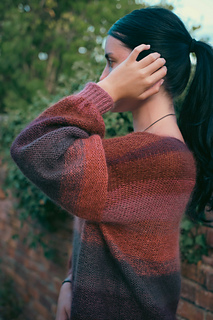
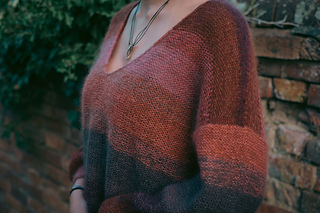
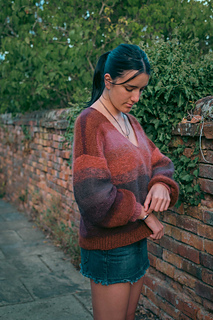
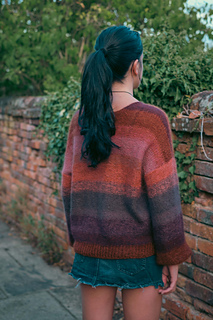
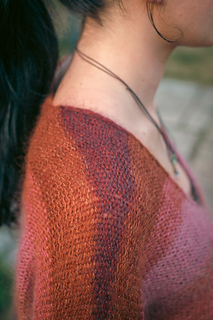
Llume


Español más abajo
ENGLISH
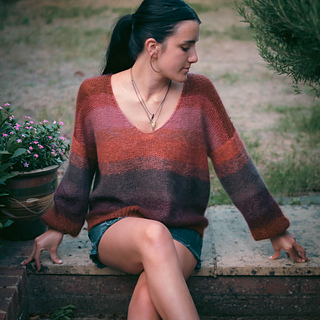
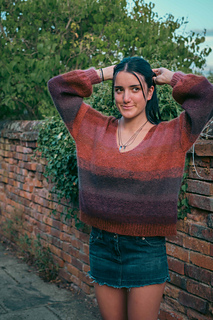
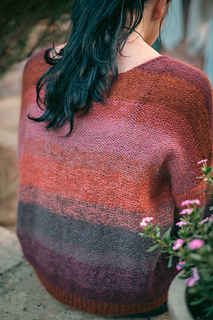
Llume is a very light and airy V-neck sweater. It is worked holding two strands together, with the colours changing gradually to create a soft, blurred stripe effect. The sweater is worked from the top down, beginning with the fronts and back worked flat. Once the required armhole depth has been reached, the pieces are joined and the body is worked in the round. The fabric is reverse stockinette stitch but the body and sleeves are worked on the inside of the garment to avoid purling.
MATERIALS
-
5 mm (US 8) circular needles for the body and sleeves. Adjust needle size if necessary to achieve the same gauge as the pattern – see below.
-
4.5 mm (US 7) (or a size smaller than the main needles) for the ribbing.
-
Markers, tapestry needle and scrap yarn, stitch holders or extra cables to put stitches on hold.
SIZES
1 (2, 3, 4) (5, 6, 7) (8, 9)
How to choose your size: measure your bust circumference, add the ease recommended below (i.e. 20-30 cm / 8-12 inches) and find the finished circumference at bust measurement below that is closest to that figure. Make sure your gauge matches the one given below to ensure your finished garment will be the same dimensions.
GAUGE
16 stitches and 22 rows in 10 cm / 4” in stocking stitch with the main needles, worked flat, after blocking.
MEASUREMENTS
Finished circumference at bust:
99 (109, 119, 129) (139, 151.5, 161.5) (171.5, 181.5) cm
39 (43, 46.75, 50.75) (54.75, 59.75, 63.5) (67.5, 71.5) inches
Ease: + 20-30 cm / 8-12 inches
YARN
In the original I used 1 strand of fingering with 1 strand of mohair. With the gauge given for this pattern it’s possible to replace this yarn with any other weight from lace (or another mohair thread) to worsted. The only difference will be how dense or sheer the final fabric will be.
5 colours of fingering or light fingering weight yarn (C1 to C5). I used Isager Tvinni (100% wool, 255 m in 50 g).
-
C1: I used colour 33S (maroon).
210 (240, 280, 320) (340, 370, 400) (420, 450) m
230 (270, 310, 350) (380, 410, 440) (460, 500) yd -
C2: I used colour 19S (pink).
120 (130, 140, 160) (200, 240, 290) (340, 390) m
140 (150, 160, 180) (220, 270, 320) (380, 430) yd -
C3: I used colour 1S (orange).
180 (190, 190, 200) (200, 210, 200) (190, 210) m
200 (210, 210, 220) (220, 230, 220) (210, 230) yd -
C4: I used colour 60S (aubergine).
180 (190, 210, 220) (240, 250, 270) (280, 300) m
200 (210, 230, 250) (270, 280, 300) (310, 330) yd -
C5: I used colour 52S (purple).
180 (190, 210, 220) (240, 250, 270) (280, 300) m
200 (210, 230, 250) (270, 280, 300) (310, 330) yd
5 mohair colours in similar tones to the main yarn (M1 to M5). I used Isager Silk Mohair (75% mohair, 25% silk, 212 m in 25 g).
-
M1: I used colour 33 (dark orange).
160 (190, 210, 260) (310, 340, 370) (390, 420) m
180 (210, 230, 290) (340, 380, 410) (430, 460) yd -
M2: I used colour 69 (dusty pink).
130 (130, 130, 140) (140, 160, 210) (250, 310) m
150 (150, 150, 160) (160, 180, 230) (280, 340) yd -
M3: I used colour 28 (coral).
170 (180, 200, 210) (220, 230, 230) (220, 210) m
190 (200, 220, 230) (250, 260, 260) (250, 230) yd -
M4: I used colour 60 (plum).
170 (180, 200, 210) (220, 240, 250) (270, 290) m
190 (200, 220, 230) (250, 270, 280) (300, 320) yd -
M5: I used colour 36 (purple).
190 (210, 230, 240) (260, 270, 290) (310, 330) m
210 (230, 260, 270) (290, 300, 320) (340, 370) yd
ESPAÑOL
Llume es un jersey de cuello de pico muy ligero y vaporoso. Se teje con dos hebras juntas y los colores se alternan gradualmente para crear un efecto de rayas difuminadas. Se trabaja de arriba abajo, empezando por los delanteros y la espalda en plano. Una vez alcanzada la profundidad de sisa, las piezas se unen y el cuerpo continúa tejiéndose en circular. El tejido es punto jersey del revés, pero se trabaja del derecho en toda la sección en circular.
MATERIALES
-
Agujas circulares de 5 mm para el cuerpo y mangas. Ajustar el número de aguja si es necesario para conseguir la misma tensión que el patrón – ver más abajo.
-
Agujas circulares de 4,5 mm (o una medida menos que las agujas principales) para el elástico del cuerpo.
-
Marcadores, aguja lanera y lana de desecho, sujetapuntos o cables extra para poner puntos en espera.
TALLAS
1 (2, 3, 4) (5, 6, 7) (8, 9)
Cómo elegir tu talla: mide tu contorno de pecho, añade la holgura recomendada (+20-30 cm) y encuentra en la tabla de medidas el contorno de pecho de la prenda terminada que más se aproxime a esa cifra. Asegúrate de que tu tensión coincide para que tu jersey tenga las mismas medidas. Ver vídeo en Tutoriales.
MEDIDAS
Contorno de pecho de la prenda terminada:
99 (109, 119, 129) (139, 151,5, 161,5) (171,5, 181,5) cm
Holgura: + 20-30 cm
TENSIÓN
16 puntos y 22 vueltas en 10 cm con las agujas más grandes en punto jersey en plano, después de bloquear.
Lana
En mi versión, combiné una hebra de grosor fingering con 1 hebra de mohair. Con la tensión que se da en el patrón sería posible sustituir esta lana por cualquier grosor desde lace (u otra hebra de mohair) hasta worsted; la única diferencia será lo tupido que quede el tejido.
5 colores de lana de grosor fingering o light fingering (C1 a C5). Yo usé Tvinni de Isager (100% lana, 255 m en 50 g).
-
C1: Yo usé el color 33S (burdeos). 210 (240, 280, 320) (340, 370, 400) (420, 450) m
-
C2: Yo usé el color 19S (rosa). 120 (130, 140, 160) (200, 240, 290) (340, 390) m
-
C3: Yo usé el color 1S (naranja). 180 (190, 190, 200) (200, 210, 200) (190, 210) m
-
C4: Yo usé el color 60S (berenjena). 180 (190, 210, 220) (240, 250, 270) (280, 300) m
-
C5: Yo usé el color 52S (violeta). 180 (190, 210, 220) (240, 250, 270) (280, 300) m
5 colores de mohair de tonos similares a los de la lana fingering (M1 a M5). Yo usé Silk Mohair de Isager (75% mohair, 25% seda, 212 m en 25 g).
-
M1: Yo usé el color 33 (naranja oscuro). 160 (190, 210, 260) (310, 340, 370) (390, 420) m
-
M2: Yo usé el color 69 (rosa palo). 130 (130, 130, 140) (140, 160, 210) (250, 310) m
-
M3: Yo usé el color 28 (coral). 170 (180, 200, 210) (220, 230, 230) (220, 210) m
-
M4: Yo usé el color 60 (ciruela). 170 (180, 200, 210) (220, 240, 250) (270, 290) m
-
M5: Yo usé el color 36 (violeta). 190 (210, 230, 240) (260, 270, 290) (310, 330) m


 Ravelry download


 Cancel
5393 projects
stashed 4077 times
 stashed
25837 projects
stashed 12399 times