

 Inge's Knitting Lab Ravelry Store
 Pattern




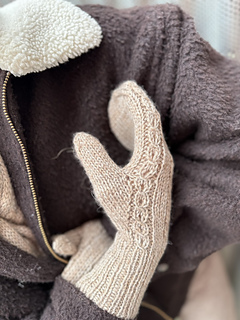
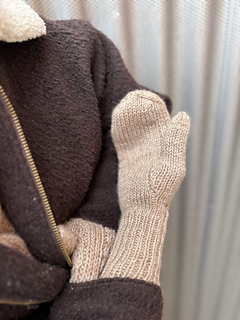

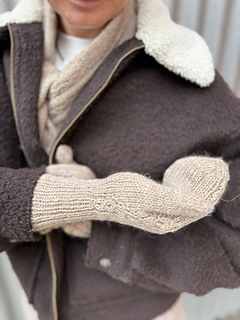
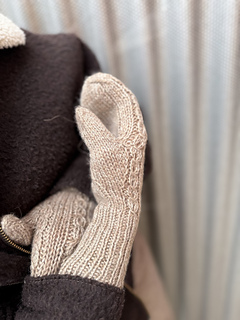
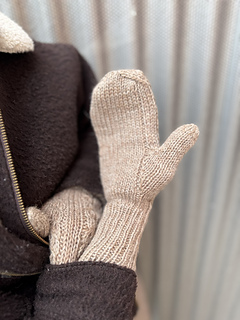


Lacy Cable Companion Mittens

The Lacy Cable Companion Mittens were designed as a companion to the Lacy Cable Comfort Scarf – combining Lacy Cables, Tree Trunk stripes and a shaped fit in a small, lightweight project.
The mittens feature Lacy Cables along the back of the hand, while a Tree Trunk stripe forms the thumb gusset and the palm is worked in stockinette.
Shaping begins at the cuff. Using fractional knitting, the cuff gradually tapers from forearm to wrist by changing needle sizes rather than stitch counts, keeping the rib structure uninterrupted. The cuff fits snugly under a coat sleeve, while the mitten itself has enough ease to trap insulating air around the hand.
You can follow the fixed instructions for sizes S, M and L, or personalise the fit using your own hand and wrist measurements. A series of natural fitting checkpoints helps you adjust the mittens as you knit.
Yarn choices & substitution
The reference mittens are worked holding one strand of fingering-weight yarn together with one strand of lace-weight yarn.
Because the mittens require only small amounts of yarn, they are also a lovely project for experimenting with yarn combinations from your stash.
You have plenty of room to substitute. For example, try:
- Fingering-weight wool + lace-weight mohair/silk for a light fabric with a soft halo
- fingering-weight wool + lace-weight alpaca for a soft and warm alternative to mohair
- fingering-weight wool + lace-weight wool for a smoother fabric with less halo
- A single strand of a slightly heavier yarn, such as sport weight or light DK, instead of combining two yarns
The pattern is not particularly sensitive to exact gauge, because you fit the mittens to your own hand as you knit.
There is no separate gauge swatch – the cuff becomes your first fitting checkpoint, followed by checkpoints based on your own hand landmarks.
When substituting yarn, pay attention to the fabric you are creating rather than trying to reproduce the reference yarn exactly. It should be flexible enough for the Lacy Cables and comfortable for the way you want to use your mittens.
The pattern is supported by step-by-step video tutorials covering the construction, techniques and fitting approach.
Here is the first episode: https://youtu.be/5KmE6fCrvJE
I hope you enjoy the comforting rhythm of knitting the lacy cables as much as I enjoyed designing this little project.


 Ravelry download


 Cancel

38409 projects
stashed 25430 times
 stashed
1274 projects
stashed 822 times


